








“There will always be drinking water for everyone, but agriculture will struggle,” warns outgoing Mekorot CEO
Amit Lang outlines Israel’s water challenges amid drought and climate variability, emphasizing the role of desalination, advanced monitoring technologies, and strategic planning to secure household supply while agriculture faces localized shortages.
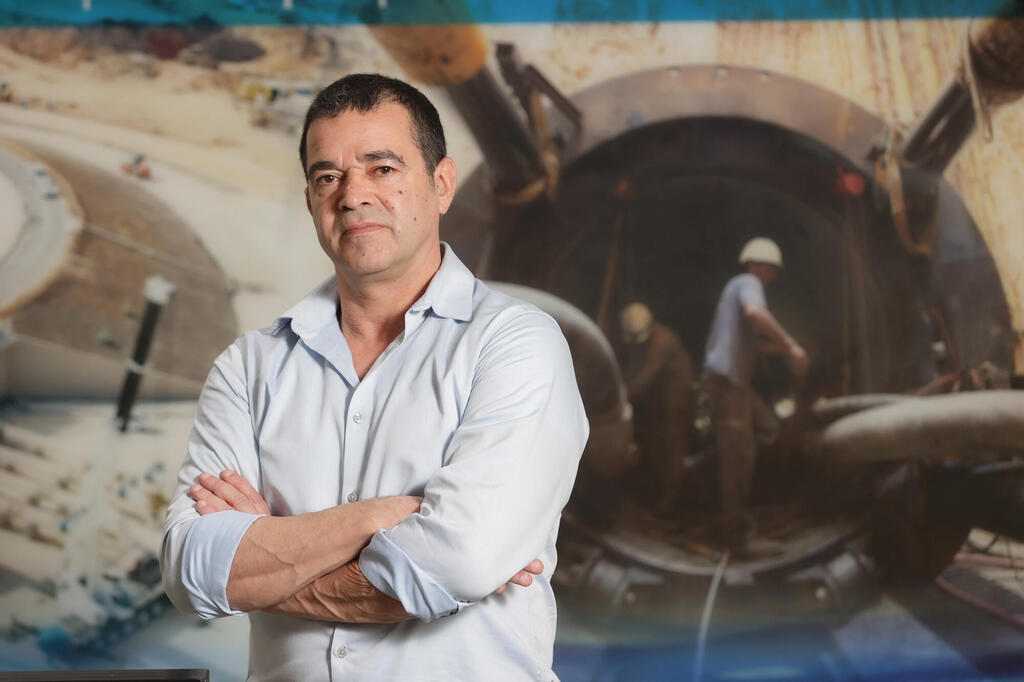
As Storm Byron drenched parts of Israel this week, the temporary relief has done little to mask the country’s deeper water challenges. After two years of drought and a forecast for another mild winter, Mekorot CEO Amit Lang warns that agriculture in key regions may still face serious shortages, even as drinking water remains secure.
"Unfortunately, the two rainy weeks prove the forecast we received from the Meteorological Service last year, according to which, in addition to being below the annual averages, the distribution of the rain will be as bad as possible. It is precisely in the places that need the most rain, that it does not fall. There is a problem in the Kinneret basin, which is the most important for the State of Israel in terms of natural water. There were two weeks with good amounts of rain for agriculture in certain areas, but that does not help us at the macro level of the water sector, because it does not fall in the areas where we need it most.
"In the short term, this year and next year, there could be various difficulties and hardships in areas where the local system relies on local water sources, those that are not connected to the national system. We are greatly depleting those areas, and when it doesn't rain, like in the northern Golan Heights, the reservoirs and drilling there have difficulty providing the required quantity."
At what level, including drinking water?
"There will always be drinking water for everyone. It will probably be difficult for agriculture in these areas, in the northern Golan Heights, in the Jordan Valley and in the Arava. In the longer term, the plans of Mekorot together with the private market, with the desalination plants that are supposed to be built in the coming years, will solve the problem in almost every extreme scenario you can think of. Why? Because it's not just a plan, it's execution, it's under construction, for example, a very large desalination plant in the Western Galilee, which will provide a lot of security in the water supply for the next two decades to the northern region and even further afield, including the Golan Heights."
And until then? Are we expected to have three difficult years, to the point of closing farms in the area?
"No. It's not as if there will be no water at all. We're talking about smaller amounts, and then they'll have to calculate their steps. We've been warning about this for years, so that they'll let us carry out the projects. This year, unfortunately, Birkat Ram, which is a very large reservoir in the northern Golan Heights that supplies all the water for agriculture, was filled to a third of what it usually is because of the drought, and farmers were forced to uproot orchards, because there wasn't enough water and I have no way to bring more water to the area."
Next week you are leaving after a 4-year term. Are you leaving the company with sufficient plans for the future?
"Absolutely yes. Subject to this, and I always say this, that the Water Authority provides the appropriate regulatory support. They need to approve the projects, not just in principle, but actually promote them. I hope that there will not be any so-called 'agenda changes' along the way that will hinder the plans and that it shouldn’t happen suddenly because it rains, plans will be stopped. This has happened before."
The economy today relies mainly on desalinated water. Isn't that problematic in itself?
"What choice do we have? First of all, it's not relying only on desalinated water. It will never be 100%, but yes, it is increasing and it can reach the 80% mark. And it also depends on the season - in winter, consumption drops by half of what it is in summer, so it changes the mix, but you really have no other choice. The more natural precipitation there is, the more your alternatives are desalination or recycling wastewater for agriculture. And we are working on that. The Shafdan plant, for example, and all our lines to the surrounding area and the Negev region, are going to be twice as large. This saves fresh water. The second thing is, as mentioned, a gradual increase in the desalination facilities and there is a long-term plan for this matter. They are already building in the Western Galilee. You have a plan in Emek Hefer that is progressing now. The facility in Ashkelon, one of the first to be built in the early 2000s, is coming to the end of its concession period and is now being put out to a new tender, which will include an expansion."
As part of the startup nation, how integrated are advanced technologies in the company?
"Mekorot is the number one company in the world in this regard. For example, our ability to monitor what is happening in the system in real time is the highest that I know of. Our operational system, which is currently in the process of being replaced, has already reached the level of a new world of water management. This allows us to consume optimal energy. Mekorot is a huge energy consumer and spends between 950 million shekels and a billion shekels a year on electricity. We are constantly dealing with the questions of when you turn on the pumps, in what quantities, at what pressures, when you fill the pools. After all, the entire system works on pools and peak and low hours. In a micro, it is very complicated to manage this manually.
"Apart from energy, you have the whole issue of water security. Not the reliability of supply, but the quality of the water. We know exactly what's happening in our system. Just an example, if you try to open the lid of our pool, within a second the valve that takes the water out of the pool closes, and we receive an alert in a control room, and until the water is tested, it won't return to that. The water we provide meets the highest possible standard, according to the instructions of the Ministry of Health. By the way, in Israel the Ministry of Health requires a very high standard."
Is there a local area where you see potential?
"Absolutely, and we have several innovation tracks in which we offer companies to work with us. We do a pilot with startups that fit our activity, and if it is successful we will also invest in them, depending on the stage they are at. When they need the money to continue developing and adapting, then we invest up to 20%, and we have 10 of them. Almost all of our developments are tested commercially, and where they can serve other water companies, we offer them both abroad and in Israel."
At the beginning of next year, the water rate will increase by 2.49%. Was there a way to prevent the price increase?
"No. In our world, two exogenous things are happening to all water supply systems. One, more and more desalinated water is coming in, water that costs money. The second is the cost of electricity. When it goes up, then it affects the price. Add to that the fact that there is more consumption. And yet, having said all this, if you do a global benchmark on water prices, in developed countries, we are in a good place in the middle. The cost of living is not in water. Mekorot's activities are efficient in these aspects. There are not many companies in the world that manage different sources of water in the same system and there are not many companies in the world that have depreciation below 4%, number one in the world in this aspect. Mekorot has also hardly increased its workforce thanks to technology for many, many years."
We went through two years of war. Was there concern about the water supply, similar to the energy sector after the attack on Bazan?
"There were damages to the facilities and there were also some difficult challenges. We conduct exercises and situation assessments every year to be prepared for emergencies. And the combination of the employees' readiness and commitment brought us to a situation where there was no damage to the water supply. We conducted an orderly process of drawing conclusions. In the coming years, we will strengthen and increase resilience, such as physical protection of critical components in the system and backups for the electrical system. We will also integrate more remote control technologies, such as those offered by the startup CQM, which has very advanced technology for producing chlorine directly on site, which saves on its transportation during routine times and emergencies."
And now we're talking about regional opportunities, maybe with Syria, maybe Lebanon, maybe Saudi Arabia?
"Saudi Arabia doesn't need our water, they have water just as good as ours. We're already working with Jordan through the Ministry of Energy. Jordan receives something like 100 million cubic meters from us. As for potential expansion, that's possible. We'll know, if necessary, to reach Syria or Lebanon in one situation or another. There were questions from political and security bodies about the capabilities we have. We answered them, but no one has talked to us about anything operational at the moment or about plans to prepare. We have activity with more distant countries, like Azerbaijan, and also in Argentina, where we're helping them understand how to balance the water system between areas with huge lakes and areas with no water at all. We have inquiries from many places, for example, from Kazakhstan."
How do you see the management of the water sector at the regulatory-governmental level?
"The concept of the water sector in Israel, the moves that have been made in the past to define the method of regulation and the concept of a closed system is a great concept. However, the Water Authority itself as a regulatory body has moved too slowly and too late in my opinion.
"I think that today Mekorot is truly at such a level of a company that one can rely more than before on its insights and its demands or its proposals for the water sector. There is always suspicion and distrust here. We are not like we were 20 years ago. There is no inflating of employees here, there are no longer all the incidents that we know from the past of all kinds of suspicions of moral violations, that does not exist."
You say that, but you're leaving a company that currently doesn't have a permanent chairman, in a country where they're trying to pass a law that would allow jobs for close associates of Knesset members?
"I can't comment on that. I can say that it's clear that it's never going to be sustainable, and I hope that the board of directors, the Ministry of Energy, and the Companies Authority will take care to preserve the company's current situation."
What would you recommend to your successor?
"First of all, he should continue to press to get all the necessary permits for the isolated areas, because that is what will define the coming years with the drought. He will have a very big headache if he does not take care to obtain the final permits for all those projects.
"I have never been able to understand the reasons why these plans are not being promoted quickly. We have also shown that in terms of the cost of this, we are not talking about astronomical costs. It is only now that it is starting to loosen up in light of the forecasts about the drought and the understanding of Hezi (Lipshitz, head of the Water Authority), who started promoting it. But we could have been after this already today."
And what was the impact on the rate?
"Every additional 100 million shekels in Mekorot's development affects less than an agora on the rate per cubic meter. Did you hear me? Yes, that's 0.4 agorot per cubic meter. 4 agorot per month per household."
You were recently appointed CEO of Ackerstein. Have you exhausted the public sector?
"Absolutely. I've had enough. I've been here for 7 years in two CEO roles, first of the subsidiary Shaham and then Mekorot. These are companies with heavy regulation and I have a great longing and a very strong desire to express myself more in my management, which the private market allows you much more. Managing Mekorot is the role I've enjoyed the most in the world to date, a magnificent company, with a legacy and a sense of mission and Zionism, but that too has an end."



