










"Those who lack these capabilities simply won’t survive," warns Reindeer AI CEO
Yoav Naveh says companies must prepare for AI agents to take on substantive work across business functions, from supplier relationships to payments, rather than limiting adoption to customer service and legal tasks.
“The most critical aspect of the current AI wave is that companies cannot afford to wait. This technology is so powerful that anyone who isn’t obsessed with it, or asking what their company will look like in two years, is not only missing an opportunity but also putting their business at risk,” said Yoav Naveh, founder and CEO of Reindeer AI, at the Tech1 conference.
Naveh spoke during a session on integrating AI into the corporate environment, moderated by Shelley Oppenheimer-Levi, a partner at EY Israel.
1 View gallery
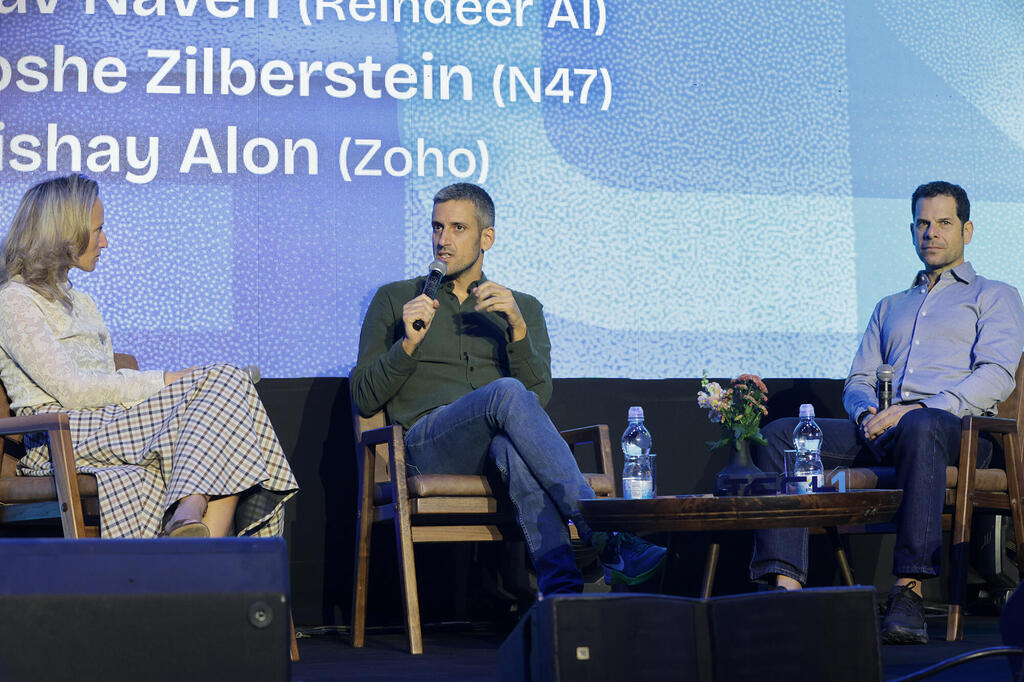
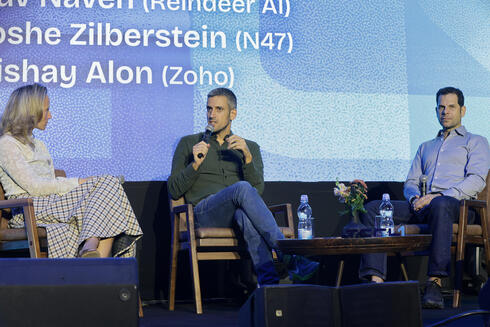
Tech1 conference panel. From right: Moshe Zilberstein (N47), Yoav Naveh (Reindeer AI), and Shelley Oppenheimer-Levi (EY).
(Photo: Nimrod Glickman)
“This technology is accelerating,” he added. “Something new emerges every month, and you have to build a strategy around it. Until now, companies have mostly just dabbled in it, with some success, primarily in peripheral areas such as customer service or legal tasks. Now, it’s time to start envisioning what an organization will look like when it employs hundreds of AI agents performing significant, substantive work.”
Customer service was a natural starting point for many companies, Naveh said, because it is costly to operate and produces measurable outcomes, such as customer satisfaction. The next challenge is to extend AI into a much wider range of business functions.
“There are many reasons why customer service served as a good starting point. It is an operation that entails significant costs, and it is an area where outcomes, such as customer satisfaction, are easily measured. Now, the goal is to extend this to other areas, to hundreds of thousands of additional scenarios, such as working with suppliers, processing payments or managing relationships with other companies.
“Defining these use cases requires vision, as does realizing a return on investment (ROI). Once a company successfully addresses 20 such scenarios, its business operations will accelerate and its ROI will increase. This will require dedicated roles and departments responsible for developing and implementing these business scenarios. Without this, you end up with individuals pushing isolated initiatives that never amount to anything substantial.”
Naveh offered an example of the potential impact. “We are working with a major supplier, and we have reduced the time it takes them to generate a price quote from hours to minutes. This has boosted their business activity by 20%. In the future, everyone will be doing this; those who lack these capabilities simply won’t survive.
“The real issue is ownership. Every company must own the agents it deploys. If a function is part of your core business, how could you possibly outsource it to someone else? If I am a bank or an insurance company, I must build what is unique to me. Organizations need to be given the tools to crawl, walk and eventually run on their own.”
Moshe Zilberstein, managing partner at N47, argued that the biggest challenge in implementing AI is not necessarily the technology itself, but knowing what a company wants to achieve.
“AI can do a great deal, almost anything,” he said. “Therefore, the first question every company must focus on is: what do we want to achieve in terms of goals, return on investment and impact? At the individual employee level, the question is how to boost productivity and knowledge, and how to leverage tools to improve daily tasks. But there is a more significant shift: how a company transforms its processes to harness these ‘agents’, entities that never sleep, have access to all information and are hyper-intelligent. It’s about how to use them to reshape the core of business operations.”
Zilberstein described AI adoption as an unusually fast-moving effort, with new tools and capabilities emerging continually.
“This is the fastest-paced pursuit of objectives we have ever seen. The technology evolves daily, bringing new tools and capabilities. It is an emerging landscape that is becoming incredibly powerful and absolutely critical. Organizations must move past the notion that everything can, or should, be built in-house, while also addressing the fear of what life might look like if we delegate all this work to AI.
“Companies must confront their own future, navigating the transition toward an AI-driven model: a leaner, faster and more efficient enterprise that maximizes shareholder value. All of this requires a clear understanding of what each new technology actually does in relation to one’s specific role.”



