










"Getting $10-20 million in Seed money from reputable funds is easy. That’s why we also see rapid failures."
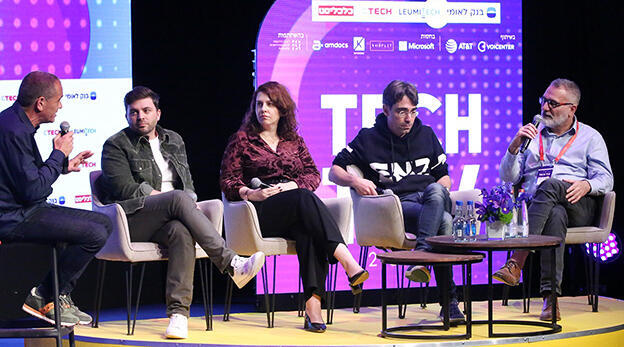
Ofer Ben-Yehuda, managing partner and leader of Shibolet’s high-tech department, was speaking at Calcalist's Tech TLV conference. The other panelists included: Pavel Gurvich, CEO of Tenzai, Iren Reznikov, partner, Vintage Investment Partners, and Liran Grinberg, managing partner of Team8.
“Everyone understands that the AI revolution is enormous, and whoever succeeds in building the truly significant companies will do so within the next year or two at most. Everyone is playing for time,” said Pavel Gurvich, co-founder and CEO of Tenzai, during a panel moderated by Meir Orbach at Calcalist’s Tech TLV conference, held in collaboration with Leumi.
“We see that the market is ready to fund such ventures, ready to back teams that not only have the technological ability to execute but also the capacity to go to market quickly. Raising a $75 million Seed round is a major and significant step, but the journey ahead is much bigger. In the very early stages, the main risks are the team, whether the market truly exists, and whether you know how to build a product,” he said.
1 View gallery
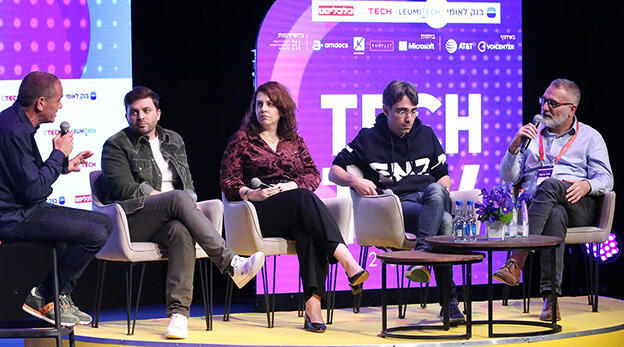
Tech TLV Panel (from left): Meir Orbach, Liran Grinberg, Iren Reznikov, Pavel Gurvich, Ofer Ben-Yehuda
(Ryan Purvis)
Are we in the midst of the biggest technological revolution we’ve ever seen?
Ofer Ben-Yehuda, managing partner and head of the high-tech department at Shibolet, said: “The changes, the pace, the uncertainty, they are constantly reflected in the failures of startups we see, as well as in the successes.”
Gurvich added: “This is a crazy revolution, unlike anything we’ve seen before.”
Meir Orbach: Iren, Vintage is a unique fund that touches all levels of the industry from every direction. What is your perspective on what is happening today?
Iren Reznikov, Partner at Vintage Investment Partners:
“Vintage currently manages $4.5 billion. We invest directly in funds, hundreds of them around the world, and directly in companies. We are very active in the United States, Europe, and of course in Israel. We see two main trends.
“First, there is a discussion about whether we are in a bubble. We see it in company valuations and in the daily reality of venture capital funds, entrepreneurs are raising large amounts at valuations not seen since before 2021. In my opinion, the answer is no. A bubble has five characteristics, such as the monetary environment or a lack of profitability. Today only one characteristic is present, investor expectations. Yes, expectations are extremely high, but we are also seeing companies reach $100 million in revenue within 12 months. We have never seen anything like that.
“The second change is in how investors perceive risk. Technology risk used to be the central question for early-stage funds. Today, the bigger challenge is go-to-market risk.”
Orbach: Ofer, how do entrepreneurs approach you at the beginning of the journey? Do you feel anything different today?
Ben-Yehuda:
“I think there is a bit of a bubble. You see two types of companies, and the entire venture industry is in a period of rethinking. On the one hand, there is a lot of money, but it is concentrated in far fewer funds. I see returning entrepreneurs, people who have already built companies, raised capital, and understand the game. On the other hand, there are many first-timers who, because the technological barrier has almost disappeared, have little understanding of how to enter the market. Their approach isn’t deep enough.”
Orbach: Isn’t this precisely the time for young, AI-native entrepreneurs who are not confused by legacy concepts like cloud or mobile?
Ben-Yehuda:
“This is their time, but today you can get a term sheet without even a presentation, just based on a team and an idea, without the go-to-market being tested. Getting $10-20 million in Seed money from reputable funds is easy. That’s why we also see rapid failures. There are amazing entrepreneurs and there will be amazing companies, but quite a bit of money, in my view, is going too quickly and too early to companies that won’t survive the initial stages.”
Orbach: Pavel, you previously raised a little and sold for a lot, ran a major R&D center, and now raised $75 million in Seed. Why so much?
Gurvich:
“First, regarding the bubble, specifically in cyber, which I know well, we ended last year with $200 billion in global cybersecurity purchases. By 2029 it will reach $300 billion, about 15% annual growth, roughly double the rate of investment in the field. That indicates a healthy market that is adopting new technology rapidly, so investing in innovation makes sense.
“Young entrepreneurs can build products faster with AI, but distribution, especially to large enterprises in cyber, is an acquired skill. Entrepreneurs who have done it before, worked inside American corporations, and now bring that know-how to Israeli startups are the real winners today.”
According to Gurvich, $75 million is not excessive for a Seed round. “To bring Guardicore to the point where I sold it, I raised $110 million. These are capital-intensive businesses, in development and go-to-market. An American sales team costs about $1 million a year and generates around $1.5 million in revenue. The ability to deploy capital smartly and quickly is the name of the game.”
Orbach: Liran, Team8 pioneered Venture Creation. Is it time to rethink the model?
Liran Grinberg, founder and co-managing partner of Team8:
“The venture capital model must change completely. When Team8 started 11-12 years ago, we built a different model based on deep research and thesis development. Today, especially in this era, the industry must reinvent itself again.
“Over the past year we developed AI agents that help create investment theses, analyzing Zoom conversations, scanning Reddit, Twitter, articles, and blogs, and synthesizing insights from CISOs and experts. The traditional analyst model is becoming technological.
“AI is also driving the most radical change in software development. It blurs the line between B2B and B2C. Enterprise software used to require long development cycles and complex integrations; now companies can be built much more like B2C startups, fast experimentation, rapid validation. That is a profound revolution in how companies are created.”



