








Smartphone review
Samsung’s new Fold finds the sweet spot between a phone and a tablet
The compact foldable offers a surprisingly useful larger screen without the bulk of Samsung’s biggest model, but its high price and limited camera system keep it firmly in luxury territory.
Top Line
It is not a perfect device, but it is definitely fun. The new Samsung Fold is light and compact enough to carry like a regular smartphone, while its larger internal display gives you a tablet-sized screen whenever you need one. That makes it particularly useful for maps, emails and documents, photos, movies and books.
The Fold is smaller and lighter than the Fold Ultra, while offering a large screen that is not far behind its bigger and more expensive sibling. At the same time, it is not dramatically larger or heavier than the Flip, but offers a much more useful external display and the ability to open into a small tablet.
In other words, Samsung may have found an appealing middle ground in its foldable lineup.
The biggest obstacle is still the price. The Fold starts at NIS 6,000 ($2,000) and rises to NIS 7,500 ($2,500), putting it in the territory of two Galaxy S26 phones and, at the higher end, even two S26 Ultras. That is a lot to pay for a device whose main advantage is its unusual form factor.
For those who can afford it, however, the Fold is an intriguing alternative to both conventional smartphones and Samsung's larger foldables.
Design: small enough to carry anywhere
It is not every day that a smartphone arrives looking fundamentally different from most of the devices on the market. Samsung has spent years developing two main types of foldables: the Flip, which folds like a clamshell, and the Fold, which opens into a small tablet.
This year, Samsung has expanded the lineup. The larger model has become the Fold Ultra, while the company has introduced a new, smaller Fold. The naming is confusing, but the device itself is relatively straightforward.
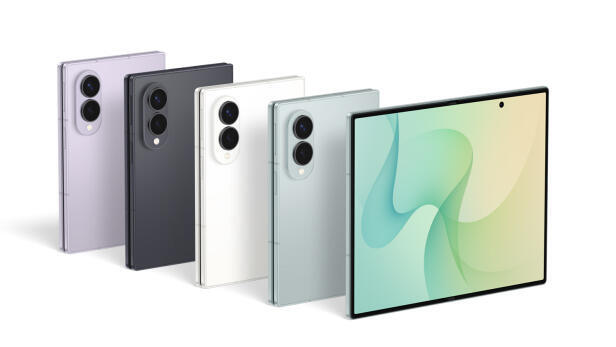
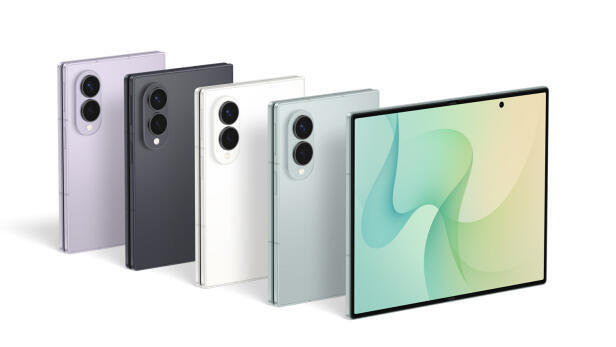
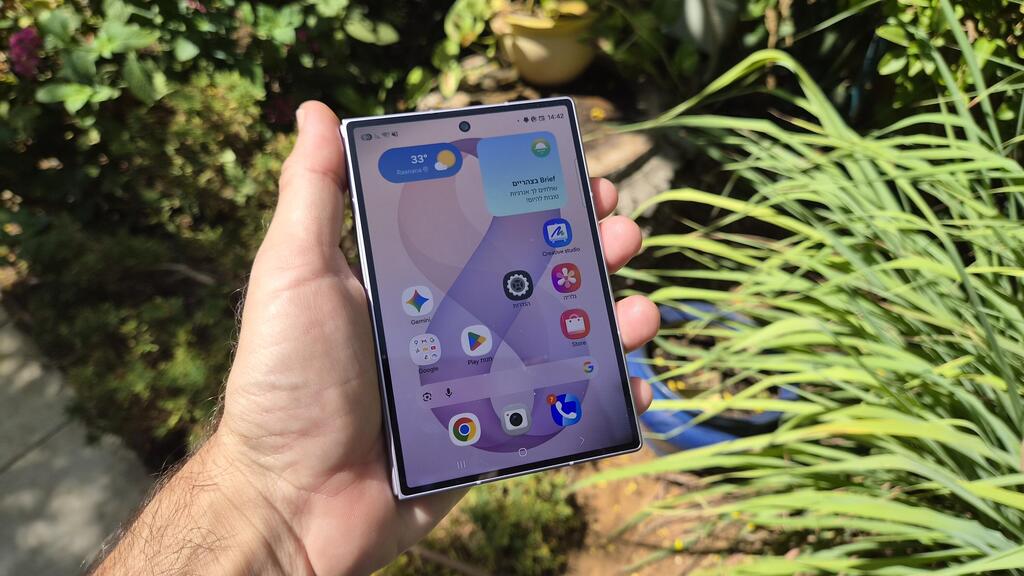
When folded, it has a 5.5-inch external display, making it shorter and wider than the typical smartphone. Open it and it becomes a 7.6-inch rectangular display that is closer to a small tablet than a conventional phone.
Foldables with this general shape have existed before, but the category remains niche. Samsung is the market leader in foldable phones, so its decision to embrace a wider, more compact format is likely to give the design much greater exposure.
The Fold is roughly the size of a passport when closed. It fits comfortably in the palm of the hand and weighs 200 grams, making it surprisingly easy to carry in a pocket.
When unfolded, it is only 4.5 millimeters thick. The Fold Ultra is even thinner at 4.1 millimeters, which makes the difference between the two noticeable when comparing them side by side.
Samsung has also upgraded the protection. The display uses Gorilla Glass Victus Ceramic 3, while the phone carries an IP48 rating. That does not provide complete protection against dust, and the phone itself warns about this. It is, however, designed to withstand immersion in water up to 1.5 meters for up to 30 minutes.
Hardware: plenty of power in a small package
Despite its compact dimensions, the Fold gives up relatively little to the Fold Ultra in terms of hardware.
It uses Qualcomm's fifth-generation Snapdragon 8 Elite processor and comes with 12GB of RAM in most configurations. The Ultra goes up to 16GB. Storage starts at 256GB and reaches 1TB.
In everyday use, the Fold is fast and capable. It handles routine tasks easily and has enough power to run demanding games.
There are some rough edges, however. When playing games on the external display, I encountered several instances in which pressing buttons or menus simply produced no response. The touch input was not recognized. The problem did not occur when playing on the larger internal display, suggesting that it could potentially be addressed through a software update.
The larger screen itself is excellent. Colors are vivid, brightness is high enough for use outdoors and the display remains easy to see in direct sunlight. The speakers are also surprisingly powerful for such a thin device, although good headphones or an external speaker will still provide a better experience.
One feature I expected to work more naturally was the ability to leave the phone partially folded at a 90-degree angle, as with the Flip. During the first few days, the hinge seemed reluctant to stay in that position. It became somewhat easier later, but the interface is not really designed around using the phone that way, with no dedicated split-screen layout for the folded position.
Samsung has also managed to fit a 4,800mAh silicon-based battery into the compact body. In normal use, it lasted roughly a day to a day and a half, depending on the workload.
Charging supports up to 45 watts, although Samsung does not include a compatible charger. With a fast charger, the battery went from 15% to 50% in about 15 minutes. A full charge took roughly an hour.
Software: the larger screen has a purpose
The Fold runs Android 17 with Samsung's One UI 9 interface.
Samsung has brought over the Super Steady video mode introduced earlier this year on the S26, which is designed to reduce movement during filming. The foldable also gets a new AI-assisted video editing feature that allows users to select a particular person in a recording and keep that person centered in the resulting video.
The feature could be useful for everything from filming a graduation ceremony to recording a concert or children playing in a park.
There are plenty of other AI tools, including writing and proofreading assistance, transcription, and tools for creating stickers, illustrations and photos. Hebrew support remains partial.
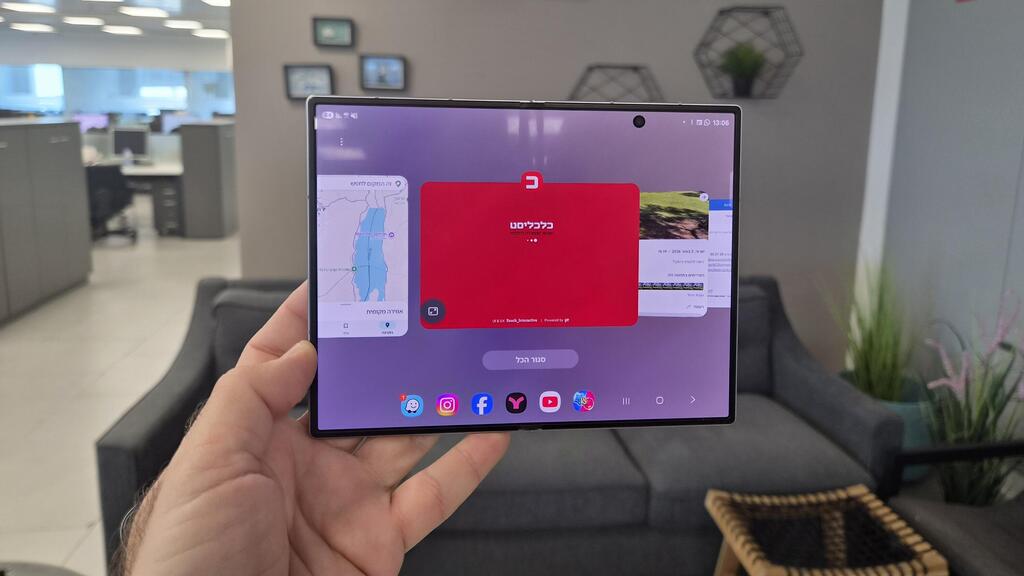
More important than the individual AI features, however, is the way Samsung uses the additional screen space.
The external display is relatively small, but apps and websites generally adjust their layouts well. In tablet mode, some apps automatically change orientation or layout to avoid simply stretching across the larger display. Facebook, for example, immediately switched to portrait mode, as did games designed for portrait orientation.
Users can manually override the setting for individual apps, although doing so is not particularly convenient.
WhatsApp provides a better example of what a foldable can do. When the device is held horizontally in tablet mode, the app displays the conversation list on one side and the selected conversation on the other, much like WhatsApp on a computer. Rotate the device vertically and the conversation fills the entire display.
That kind of adaptation is what makes the larger screen more than a novelty. Samsung is not simply giving users a bigger version of the same interface; in some cases, the software actually makes better use of the additional space.
The same is true in Samsung's photo editor. When comparing an original image with an edited version, both can be displayed side by side. Video also benefits from the wider screen, with less of the display being wasted on black bars.
Cameras: the compromise is hard to ignore
The most obvious weakness is the camera system.
The Fold has two rear cameras, both with 50-megapixel sensors: one wide-angle and one ultrawide. There is no telephoto camera, meaning there is no optical zoom.
That is a meaningful omission for a premium device, particularly one positioned alongside Samsung's flagship foldables.
There are two 10-megapixel selfie cameras, and users can also use the main camera for selfies while viewing the framing on the external display. In practice, however, finding a comfortable way to hold the phone while doing this can be difficult.
The cameras perform reasonably well in both good and low light, but the resulting images are not as impressive as those produced by some competing phones or by other Samsung models.
For a device that otherwise makes relatively few compromises, the camera system stands out.



