










Smartphone review
The iPhone Duo is a great foldable phone. The problem is what Apple charges for it
Apple's first foldable device is comfortable to use and beautifully built, but its starting price makes its compromises particularly difficult to overlook.
Top Line
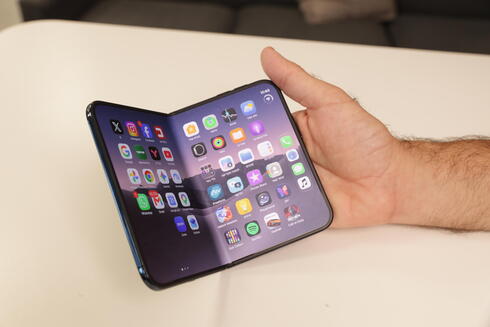
The iPhone Duo brings something new to the table, and for some users, that alone is exciting: it is Apple's first foldable device. It is also an excellent piece of hardware, offering a comfortable user experience, superb build quality, an outstanding display and powerful performance. It is heavy, however, and comes with several issues and compromises. None is a deal-breaker on its own, but together they leave the impression that some of the familiar hallmarks of Apple products are missing from what is ostensibly a flagship device.
Then there is the price. Throughout my testing, I found myself looking at the Duo in two very different ways: the device itself is great, but its price is excessive, even absurd. It starts at NIS 9,000 ($2,824) for the 256GB model and climbs from there, depending on the storage capacity. The price tag hangs over the entire experience. It is difficult to justify spending that much on almost any device, foldable or otherwise.
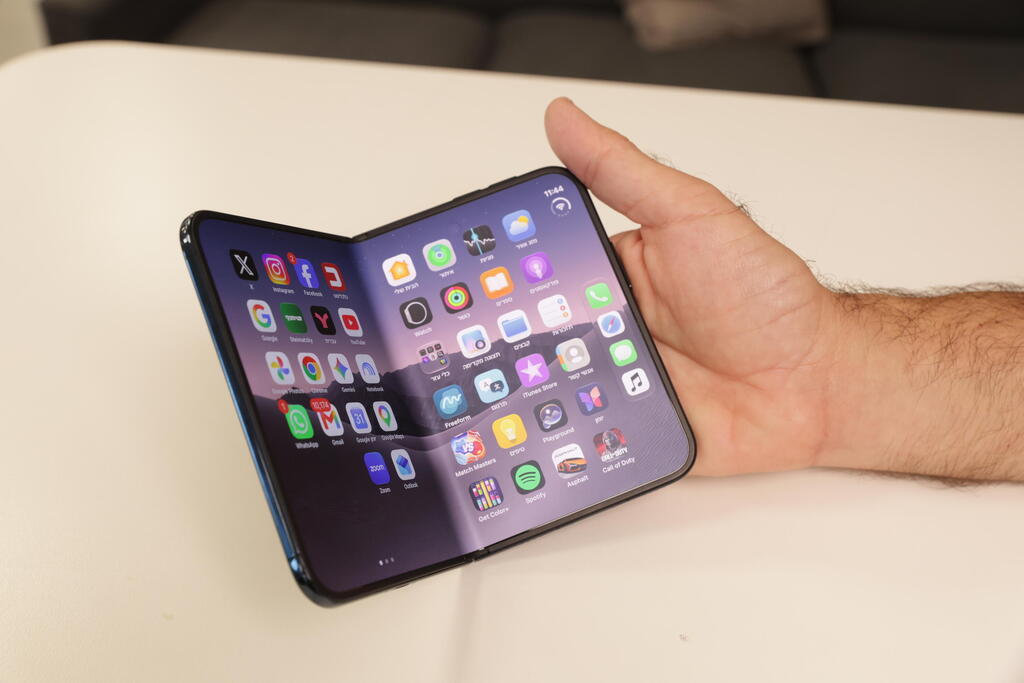
At this price, however, compromises should be hard to accept, whether they involve the way apps are displayed, the absence of facial recognition or a weight considerably higher than that of competing devices. For the price of the base model, you could also buy an iPhone and an iPad, or even a MacBook. Granted, that would not give you a foldable device, but you would have two separate, more powerful products instead.
And if that were not enough, its direct competitor, the Galaxy Fold 8, launched at around NIS 6,000 ($1,883) and has since become cheaper through various promotions. Die-hard iPhone fans are unlikely to consider switching to another brand, even for a foldable device. But at its current price, the Duo is a difficult sell. It may be worth waiting for the next generation, in the hope that it will be both lighter and more affordable.
Build and design: Compact yet heavy
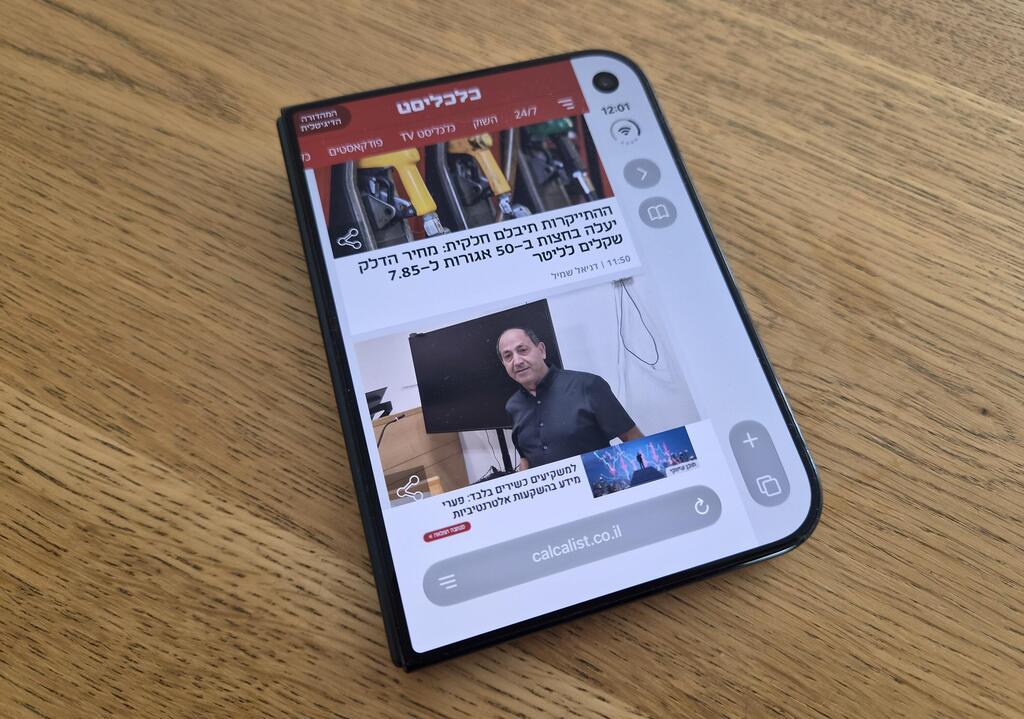
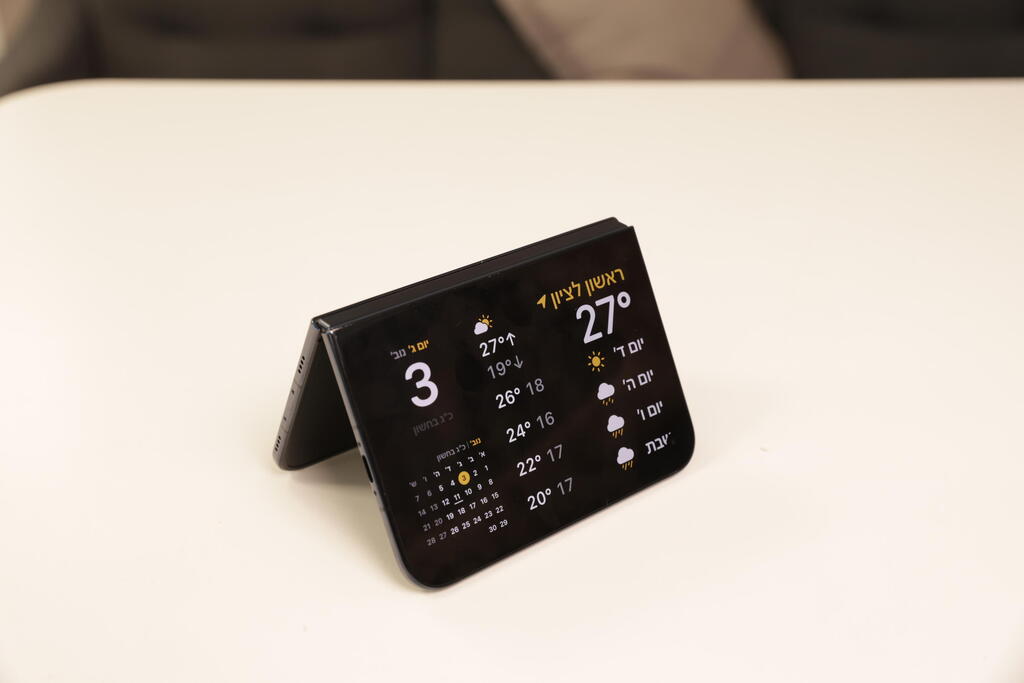
When closed, the iPhone Duo is roughly the size of a passport, much like Samsung's Galaxy Fold 8, although the Apple device has rounded corners while the Samsung model is more rectangular. In its folded form, the Duo has a relatively small, wide 5.4-inch display. Unfold it into tablet mode, and it reveals a 7.6-inch screen.
Despite its compact dimensions, the device is heavy. At 254 grams, it weighs slightly more than the iPhone 18 Pro Max, which is already a hefty device, and that is before adding a protective case. The weight is noticeable whether the Duo is sitting in a pants pocket or being used. By comparison, Samsung's Fold 8 weighs around 200 grams and feels considerably lighter.
The placement of the buttons is also somewhat problematic. This is an inherent challenge with foldable devices: a button positioned on one side of the phone can effectively shift to a different position when the device is unfolded.
For example, the volume buttons sit above the screen when the Duo is folded, as well as when it is held open in landscape orientation. Only when the device is unfolded like a small tablet and held in portrait orientation do the buttons appear on the left side, where users would typically expect them to be.
There is another, more peculiar issue. When menus are displayed in Hebrew, the default behavior is for pressing the "up" button to lower the volume and pressing "down" to raise it, the exact opposite of what most users would expect. This can be changed in the settings, but such an oversight might be understandable from a smaller manufacturer. From Apple, and on a device this expensive, it is harder to excuse.
Apple has also left out its Face ID facial-recognition system, relying instead on a fingerprint scanner integrated into the power button. It is possible to appreciate the technical challenges involved, particularly given the differences between Apple's system and those of its competitors. Still, the bottom line is that other foldable devices offer facial recognition, while the Duo does not.
The fingerprint scanner itself works well, but its shifting position can make it awkward to reach. Another familiar iPhone feature is also missing: the physical switch used to toggle silent mode or activate custom shortcuts. Perhaps Apple struggled to find a position for a switch that would remain accessible in every configuration. On the other hand, the device does include a dedicated shortcut button for launching the camera.
The Duo is protected by Ceramic Shield 2 glass, similar to that used on the iPhone Pro models, and has a titanium frame. It also carries an IP68 rating, meaning it is designed to withstand immersion in water and is resistant to dust. That is a notable advantage over Samsung's foldable models, which lack dust protection, a limitation explicitly mentioned in a warning during their initial setup. However, a durability test of the iPhone Duo showed that it could not withstand sand, so caution is still advisable.
Hardware: On par with Apple's flagship models
The new model is powered by Apple's A20 Pro processor, the same chip found in the iPhone 18 Pro and Pro Max, and comes with 12GB of RAM. Performance is excellent. The Duo is fast and handles virtually every task with ease, including demanding games.
There were a few isolated instances in which the device became warm, primarily while charging and at the beginning of gaming sessions. It cooled down shortly afterward, even while gameplay continued.
The external display is vibrant and colorful, with high brightness that makes it easy to use even in daylight. For the larger internal screen, Apple opted for a matte finish. While this slightly reduces the vibrancy of colors, it creates the impression that the image is printed directly onto the surface, somewhat like an e-reader display. In tablet mode, the matte coating actually makes the screen easier to read.
The crease between the two sections of the display is almost invisible and barely perceptible, although not entirely. Most of the time, users will hardly notice it, but it becomes visible at certain angles and can occasionally be felt. That is impressive, but not necessarily a breakthrough. After completing reviews of foldable devices from Samsung and OPPO, I realized that I had forgotten to mention the crease simply because I had barely noticed it. It is therefore difficult to argue that Apple has surpassed its competitors in this respect.
The battery has a capacity of approximately 4,880 mAh and lasts through a full working day, or slightly longer, although my testing period was relatively short. Charging with a 65W charger is fairly quick. The battery went from 15% to 50% in about 20 minutes, reached 80% after 40 minutes and took approximately an hour and 15 minutes to reach a full charge.
Software: Plenty of room for improvement
Building a foldable smartphone involves more than the physical challenge of creating a device that bends. The operating system and applications also need to be adapted to the different ways in which the device can be used. Apple has made a good start with iOS 27, but the job is far from complete.
Apple's own applications have been adapted particularly well. In tablet mode, for example, the Mail and Calendar apps divide the screen into two sections. One side displays the email list or the full calendar, while the other shows the selected message or the schedule for a particular day. The same approach is used in iMessage, while third-party apps such as WhatsApp and Outlook offer similar layouts.
The experience also changes when the Duo is opened at a 90-degree angle, effectively turning it into a miniature laptop. The interface adjusts automatically, with a large keyboard appearing in the lower section and a window for composing an email or message in the upper section.
Not all applications have been adapted to take advantage of the larger display, at least for now. Gmail and Google Calendar, for example, do not make proper use of the available screen space. Emails are simply stretched across the tablet display, while Calendar opens in its mobile format, leaving a small window in the middle and large, empty black areas on either side.
Gaming is similarly inconsistent. Some titles open in full-screen mode, while others appear in a smaller mobile layout, with a button allowing users to enlarge the display. Even after selecting that option, however, some games do not fill the entire screen, leaving a black border around the image.
The external display has its own compatibility issue. Apple has moved the Dock, the menu that provides shortcuts to applications and usually sits at the bottom of the screen, to the right side. The external display is shorter and wider than a standard iPhone screen, and this arrangement reduces the usable display area, bringing its proportions closer to those of a conventional iPhone.
The downside is that Apple effectively sacrifices part of the screen before users even open an application. In Apple's own apps, such as Safari, the browser controls appear in a relatively confined area. But in Google's Chrome and in various games, an empty black bar occupies a significant portion of the right side of the display.
These look like early software issues that could eventually be resolved through app updates. But Apple should have anticipated them before launch. If WhatsApp and Outlook can be adapted for foldable devices, and competing products have been available for years, Apple should have ensured that the most widely used applications worked smoothly from day one. That expectation is particularly reasonable when the device comes with such a high price tag.
Cameras: Good, but basic
The Duo makes do with two rear cameras, much like a standard iPhone or competing foldable devices. Both have 48-megapixel sensors: one is the main camera, while the other is an ultra-wide lens. There is no dedicated telephoto lens for high-quality optical zoom, leaving users with 2x zoom instead.
There are also two selfie cameras: a relatively modest 4-megapixel sensor for use when the device is unfolded and a 12-megapixel camera for when it is folded.
These are not necessarily the cameras one would expect from a flagship device, although there are technical limitations to consider when designing a foldable phone. Nevertheless, they perform well, producing good results and sometimes even exceeding expectations. Night Mode is particularly effective at capturing and incorporating ambient light.
The main drawback is the lack of optical zoom. There is no dedicated telephoto lens, not even the 5x zoom that has become relatively common in high-end smartphones. Users will simply have to get used to doing without it.
As expected from a foldable device, the external screen can be activated to give the person being photographed a preview of the shot. Apple has also added Snoopy animations to the external display to help attract children's attention.
Another feature is designed for group photos and selfies. Users can position the iPhone at a 90-degree angle and activate "Smart Take." Once the camera detects that everyone is in position and has had time to strike a pose, it automatically takes several photos from which users can choose.



