











Haifa port chief says India-Europe trade corridor could move 3 million containers a year
Captain Sumit Chauhan says the IMEC corridor could initially handle 1.5 million containers annually, with transit times potentially 40% shorter than the Suez route. But the project remains far from operational in Israel, as diplomatic obstacles, infrastructure gaps and competing regional routes threaten to sideline the country.
The IMEC trade corridor, designed to connect India with Europe through the Middle East and dubbed the “Railway of Peace” in Israel, could eventually handle approximately 3 million TEUs (20-foot equivalent units, the standard measure of container shipping) annually. Captain Sumit Chauhan, president of the Port of Haifa, made the estimate on Wednesday at the Mare Med conference in Tel Aviv.
Chauhan said initial volumes could reach around 1.5 million TEUs a year, with room for further growth depending on expanded capacity and better coordination between rail networks and ports.
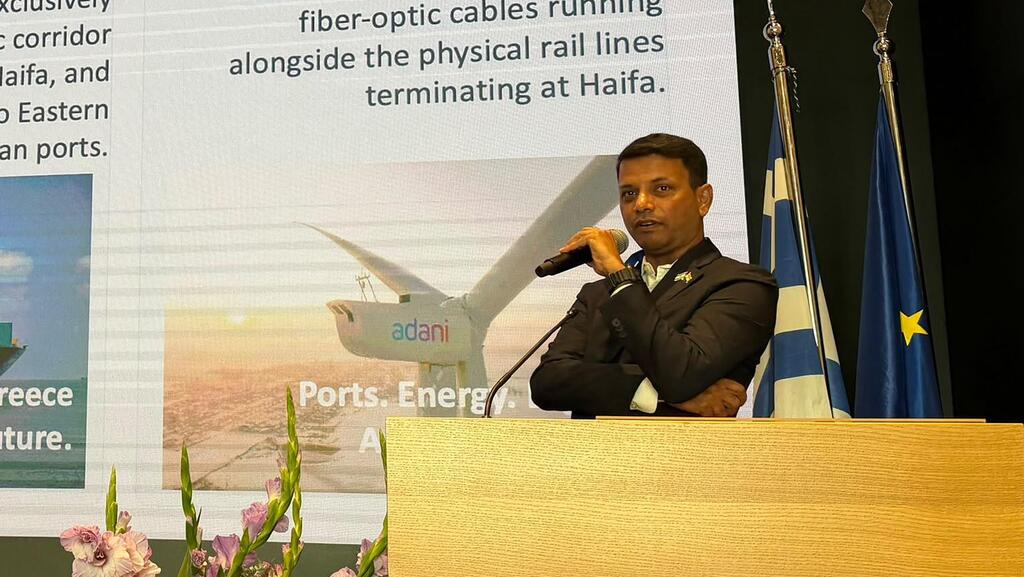
According to scenarios presented by Chauhan, the corridor could cut transit times by approximately 40% and reduce logistics costs by up to 30% compared with the route through the Suez Canal. These figures are projections, however, rather than measures of existing commercial activity, and would depend on infrastructure development and operational agreements along the route.
The IMEC initiative aims to connect India and Europe through a combination of maritime and rail links, passing through the United Arab Emirates, Saudi Arabia, Jordan and Israel. The Port of Haifa could serve as a gateway for cargo shipped from India to the Mediterranean, with goods then distributed to Europe and other markets.
Haifa has a clear commercial interest in advancing the plan. Chauhan pointed to the Adani Group’s port network in India and its investment in the Port of Haifa as a potential foundation for creating a continuous logistics chain between the two ends of the corridor.
He said coordination between ports, digital cargo tracking and synchronized arrival times could improve efficiency. He also outlined opportunities to expand operations through feeder services to other Eastern Mediterranean ports, connect with markets in the Balkans and Central Europe, and facilitate cargo shipments to the U.S. East Coast.
The remarks came at the Mare Med conference, held in collaboration with the foreign ministries of Israel, Greece and Cyprus, which focuses on economic, security and technological cooperation among the participating countries, including through the IMEC initiative.
The corridor's prospects are complicated by competing regional plans. Turkey and Syria are promoting an alternative route intended to connect the Gulf states with Europe through Jordan, Syria and Turkey, bypassing Israel and the Port of Haifa. The initiative reflects Turkey's ambition to become a major trade hub between Asia and Europe, as well as Syria's efforts to rebuild its economy and position itself as a transit route for energy and goods.
Saudi Arabia is also exploring the possibility of advancing a route through Syria rather than Israel, amid the stalemate in efforts to normalize relations with Israel.
Israeli Transport Minister Miri Regev has sought to advance Israel's participation in IMEC through meetings with senior officials from the United Arab Emirates and the United States. In January 2026, a delegation from the Transport Ministry and representatives of infrastructure companies traveled to the United States for meetings, following the resumption of talks with the UAE in November 2025.
Despite these efforts and official statements outlining the initiative's potential, the corridor has yet to reach the stage of operational implementation in Israel.
Key obstacles include the absence of normalization with Saudi Arabia, through which the proposed railway route is intended to pass, as well as the ongoing war and diplomatic impasse. Significant infrastructure investment and agreements governing cross-border transit would also be required.
Israel's rail network is not yet ready for the project. The existing line terminates at Beit She'an and is not connected to Jordan's rail network, leaving a major gap in the proposed land route.
The development of competing corridors that bypass Israel has raised concerns that the country could miss out on the initiative's potential economic benefits. The stakes are particularly high amid security threats to regional shipping lanes from the Houthis in the Red Sea and Iran, which could disrupt the movement of goods and the continuity of supply chains.



