










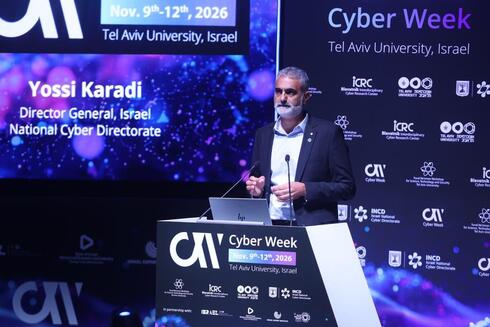
Israel warns Iran is seeking AI-powered cyberattack capabilities
Yossi Karadi, head of the National Cyber Directorate, says Tehran is pursuing artificial intelligence as a new offensive tool. He warned that AI could give attackers a decisive speed advantage over national defenses, while connected robots and other machines could eventually turn cyber intrusions into physical threats.
Iran is seeking to develop artificial intelligence-powered cyberattack capabilities that could pose a threat well beyond Israel, the head of the Israel National Cyber Directorate warned Tuesday, arguing that the growing speed of AI-driven attacks could expose a fundamental weakness in the way countries defend their digital infrastructure.
"While the world is working to prevent Iran from acquiring nuclear weapons, we know that Iran is also pursuing another offensive capability in cyberspace, leveraging artificial intelligence - a capability that could harm the world," Yossi Karadi said at Cyber Week at Tel Aviv University.
Karadi's warning reflects a broader concern among cybersecurity officials that artificial intelligence could change the balance between attackers and defenders. While AI can help organizations identify vulnerabilities and respond to threats, it can also allow adversaries to automate reconnaissance, identify weaknesses and conduct attacks at a speed that conventional security teams may struggle to match.
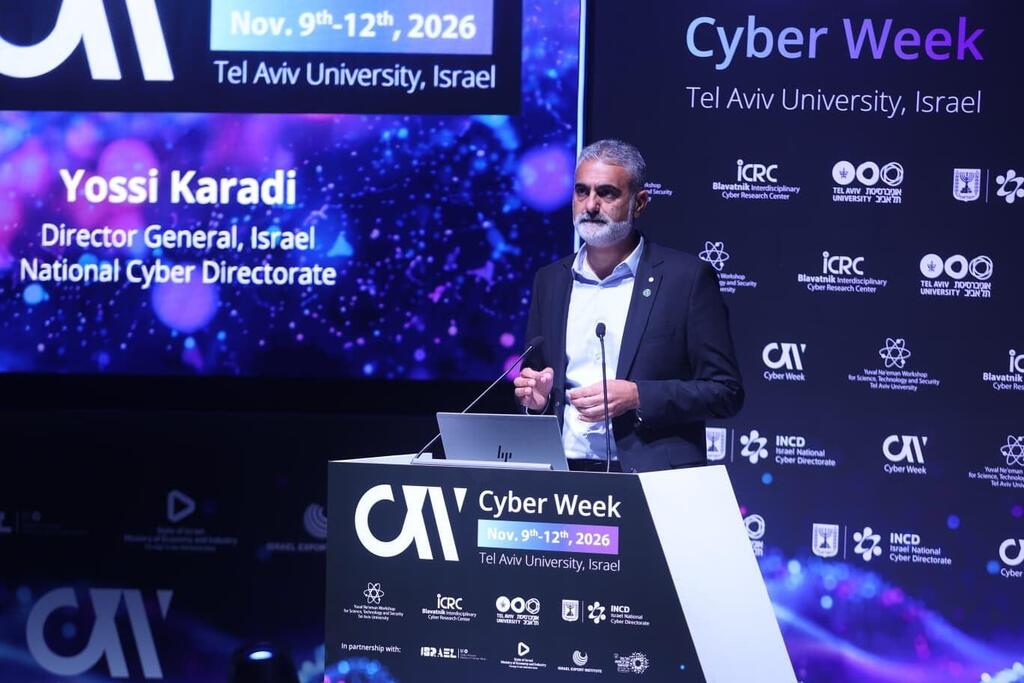
The critical advantage, Karadi argued, may lie less in the sophistication of individual attacks than in the ability to launch them repeatedly and faster than defenders can recover.
"An attacker needs only one AI model, one target, and the freedom to choose when to strike," he said. "At the national level, however, the defender's mission is far more complex: we must successfully protect numerous organizations simultaneously, around the clock, against attacks enabled by a wide range of AI models - all while operating within regulatory constraints."
The imbalance is particularly significant at the national level, where governments must protect an interconnected network of public institutions, businesses and critical infrastructure. A successful attack against one organization can have consequences beyond its immediate target, while defending against a sustained campaign requires coordination across multiple systems and agencies.
Karadi presented a framework for what he described as a new war of attrition in cyberspace, recently published in a U.S. professional journal. Its central argument is that the strategic danger of cyberwarfare should not be measured solely by the damage caused by a single attack. Repeated incidents, even relatively limited ones, can gradually undermine an organization's or country's ability to function if they occur faster than systems can be restored.
"In the new war of attrition in cyberspace, the adversary does not need to win through a single devastating attack. Instead, it can seek to prevail through sustained pressure and gradual erosion," he said.
"In the age of AI, the race is no longer just about who can attack or defend more effectively - it is about who can move faster. A nation that cannot recover as quickly as it is attacked risks being gradually worn down, even without a single decisive cyberattack."
The warning comes as Israel continues to face sustained cyber activity linked to Iran. In March, Karadi said the Shin Bet and the National Cyber Directorate had thwarted multiple Iranian attempts to gather intelligence on security personnel, defense companies and their relatives. The campaign included attempts to take control of surveillance cameras, which could be used to track individuals and collect information ahead of potential physical attacks.
The Directorate identified 50 incidents involving attempts to penetrate public camera systems since the beginning of the war, as well as another 50 cases in which attackers entered organizational systems and deleted critical data. In a separate report, the Directorate said it had issued 2,304 targeted cyber alerts to organizations during 2025, an increase of nearly 350% from the previous year.
The broader threat is not confined to Israel. Microsoft's annual cyber defense report, published in October, ranked Israel as the world's second-most targeted country for cyber activity between July 2025 and June 2026, behind only the United States. Iran was identified as the leading state-backed source of cyber operations targeting Israel, with Tehran-linked actors also expanding their activity against American interests.
The growing use of AI introduces another dimension to the threat. In May, Karadi urged Israeli company executives and board members to prepare for a new generation of AI models capable of identifying security vulnerabilities and potentially executing complex attack sequences. He warned that capabilities once associated with highly skilled specialists were becoming more accessible, and that traditional defenses alone would no longer be sufficient.
At Cyber Week, however, Karadi extended the warning beyond conventional computer networks. At the conclusion of his address, he was joined on stage by Roberta, a humanoid robot developed in the laboratory of Professor Yuval Elovici. The demonstration served as a starting point for a question that is becoming increasingly relevant as AI systems move from generating information to controlling physical devices: how much control will people retain over machines operating in the real world?
"Imagine one million robots from the same manufacturer, operating across dozens of countries. Then, one day, a software update or a cyberattack causes all one million robots to perform the same dangerous action at exactly the same time. People could be injured," Karadi warned.
The scenario was hypothetical, but it illustrates the potential consequences of vulnerabilities in connected devices and centralized software systems. A compromised robot or industrial machine can pose a very different kind of risk from a breached database. If the same software flaw or malicious update affects large numbers of devices, the consequences could extend simultaneously across workplaces, public spaces and critical infrastructure.
The concern is part of a wider shift in cybersecurity as AI becomes embedded in systems that interact with the physical world. Connected devices, industrial equipment and autonomous machines expand the number of potential entry points for attackers, while software updates and remote management can create common points of failure across large fleets of equipment.



