










“Highly dangerous for Israel”: Netanyahu’s crypto plan draws fierce backlash
The prime minister’s call to prepare an alternative economy has alarmed high-tech leaders, even as advisers close to him argue that contingency planning for possible sanctions is necessary.
Benjamin Netanyahu’s declaration on Friday, just days before the election, that Israel needs to “organize an alternative economic system” to prepare for potential banking sanctions was widely mocked online as a lapse in judgment. But people who have worked alongside the prime minister in senior economic roles say the idea should not be dismissed as an offhand remark.
“He is genuinely thinking about this,” Prof. Avi Simhon, head of the National Economic Council and Netanyahu’s economic adviser, told Calcalist. Simhon neither distanced himself from the statement nor played down its significance.
Another senior figure who has been close to Netanyahu since the early stages of his career offered a more nuanced interpretation. He suggested that the prime minister may have experienced a “slip of the tongue,” but that the underlying idea reflects a genuine concern. The substance of the proposal, he argued, is not cryptocurrency itself, but the need to prepare for the possibility that Israel could face economic restrictions.
1 View gallery
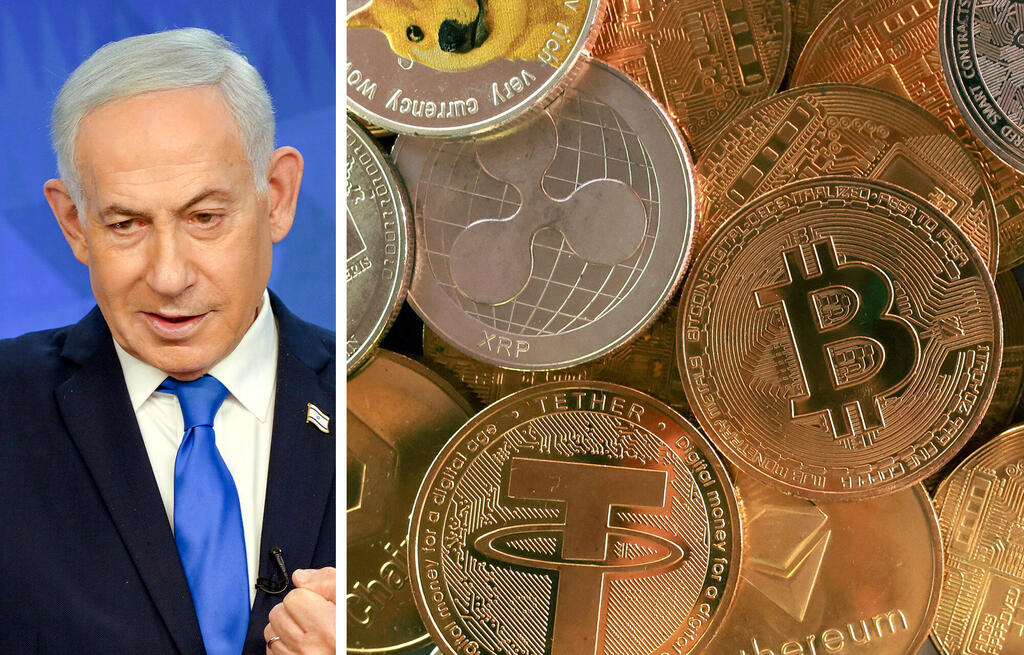
Benjamin Netanyahu alongside cryptocurrencies.
(Photo: Maayan Tuaf, Dado Ruvic/Reuters)
That concern, he said, is informed by Netanyahu’s reading of the political landscape in Europe, Israel’s primary trading partner for much of its history.
“If you analyze the reality in Europe, you see that Spain is shifting back toward the right, as is France. The UK remains on the left, at least for the next two years, and it is no longer part of the European Union,” he said. “The EU itself lacks the capacity to impose sanctions, but individual nations, such as the Netherlands, Norway or the UK, do. Therefore, we must be prepared for any scenario.”
The distinction between EU-wide and national sanctions is important. EU sanctions generally require unanimous agreement among member states, while individual countries can take certain measures independently. The official’s broader argument is that Israel should prepare for the possibility of restrictions, even if sanctions are not currently imminent.
Another senior official who has worked closely with Netanyahu for years believes the global political landscape could shift significantly in the coming months, changing the debate over sanctions. He also sees the political right gaining ground in South America and parts of Europe.
“In such a scenario, the subject of sanctions against Israel will simply drop out of the discourse,” he said.
This official also supports Netanyahu’s position on ending American military aid, suggesting that the assistance could end regardless of the election result. He views that prospect positively, arguing that US aid has distorted some of the Israel Defense Forces’ procurement decisions.
“For years, the aid has had a detrimental effect on the IDF’s procurement considerations,” he said. “Items were purchased because it was possible, not because they were necessary; it is important that future procurement decisions be sound.”
The official believes Israel could cope economically with a period of sanctions, although he does not rule out the possibility of a scenario in which blockchain-based systems play a role. He considers sanctions unlikely in the near term.
He points to Netanyahu’s “Sparta” speech, which also caused controversy when it was delivered, as an indication of the prime minister’s broader strategic thinking. The underlying principle, he said, is that countries should seek greater independence in critical areas, including defense production and supply chains.
“The strategy of most nations today is to ensure their own independence, including independence in armaments and supply chains,” he said.
He cited the Trump administration’s policy on critical minerals and China’s Belt and Road Initiative as examples of countries seeking to strengthen their strategic position and reduce their dependence on others.
“It is always wise to be prepared for a disruption by having alternative pathways in place,” he said. “Such a disruption is not currently on the agenda; furthermore, given global political trends, specifically the shift toward the right in Europe, combined with a Trump administration, it is unlikely to become an issue over the next two years.”
The Bank of Israel, however, has cautioned against treating cryptocurrencies as a way to circumvent sanctions.
“Cryptocurrencies cannot serve as a means to circumvent sanctions,” the central bank said in a response to the proposal. “The right course of action for the Israeli economy is to preserve economic relations with our primary trading partners and to focus on preventing sanctions and their negative impact on the economy. This matter falls within the purview of the political leadership, and appropriate steps should be taken to address it.”
Industry leaders warn of economic damage
Netanyahu’s remarks, made during a weekend interview with a business news channel, prompted a sharp response from Israel’s high-tech and financial sectors. He said he was concerned that Israel could face international banking restrictions and other sanctions, and had instructed officials to prepare a plan for an “alternative economy” based on currencies and systems that could bypass such restrictions.
“Of course I’m concerned,” Netanyahu said. “One must realize that banking sanctions could be imposed. We need to prepare an alternative economy, utilizing currencies that bypass such restrictions, and that is something I am working on. I have already requested that a plan be drawn up.”
He also linked the proposal to the prospect of an end to American military assistance.
“If you assume that we will continue to receive what I secured on two previous occasions, tens of billions of dollars in American aid for the defense budget, well, you had better prepare and adjust; that will not happen, because America has changed,” he said.
The proposal drew an immediate rebuke from the Israeli High-Tech Headquarters, which represents dozens of senior industry executives and other economic stakeholders. The organization argued that preparing to operate outside the Western financial system would undermine the very economic model Israel needs to protect.
“What the prime minister said is highly dangerous for the Israeli economy in particular, and for Israel in general,” the organization said. “The very notion of an isolated economy, and the use of crypto to facilitate it, is absurd. It is reminiscent of isolated nations like Iran or North Korea, countries you certainly wouldn't want to emulate, which exist outside the Western economic sphere.”
“We want the Israeli economy to continue trading with Asia, Europe, and, of course, the United States, rather than having to contend with economic boycotts, as is the case for ‘insane’ nations,” said Eyal Waldman, founder of Mellanox, now part of Nvidia.
Prof. Itai Ater, head of the Department of Economics at Tel Aviv University, warned that sanctions would strike at the foundations of Israel’s economy.
“Economic sanctions would dismantle the economic model that sustains Israel as a modern economy. The damage would be felt by every Israeli citizen: unemployment would immediately skyrocket, investments would vanish, and Israel’s standing on the global stage would collapse,” he said.
The High-Tech Headquarters also criticized what it viewed as an acceptance of the possibility of sanctions rather than an effort to prevent them.
“The prime minister speaks of sanctions and economic isolation for Israel, while suggesting a reliance on a ‘crypto-economy,’ thereby paving the way for the destruction of Israel’s high-tech sector,” the organization said. “Our sector lives and breathes the free market and international trade. Without these, companies will shut down, investments will cease, and operations will be relocated abroad, not because we want this, but because we will have no other choice.”
The organization went further, comparing the proposal to accepting a strategic threat rather than working to avert it.
“This passive, defeatist resignation to a bleak future of sanctions and isolation is tantamount to the prime minister accepting a nuclear-armed Iran and offering the public fallout shelters instead of preventing the danger. A leader who proposes surrender and adaptation to ruin, rather than fighting for solutions, has forfeited the right to lead.”



