










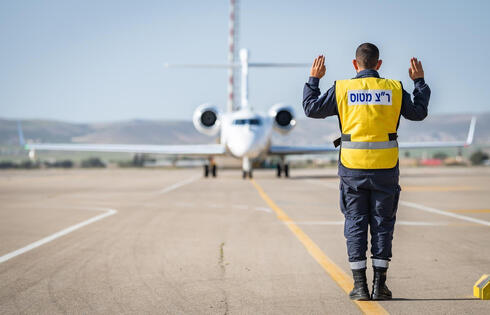
F-35 base exposed: security gaps emerge at Nevatim
Report identifies gaps in protection, with growing concerns over surveillance and emerging drone threats.
This surreal sight is hard to imagine: Nevatim Airbase, home to some of the world’s most advanced and secret F-35 Lightning II aircraft, serves as a launch point for sensitive missions across the Middle East, while its perimeter fences are used by nearby Bedouin residents to hang laundry and tie animals.
The fences surrounding the base are electronic, and any contact with them triggers alerts of potential intrusion, sending emergency teams rushing to respond, often to false alarms.
In other cases, the burning of tree branches in olive groves belonging to the nearby Ar'ara community, in some instances just a meter from the base’s perimeter, repeatedly damages the fencing. “In this narrow space, tree branches are frequently burned, damaging the base's perimeter fence,” the State Comptroller wrote in a report highlighting collapsing governance in the Negev.
Over the past two years, Nevatim has also become a target for Iranian attacks. In addition to housing stealth fighter squadrons, the base hosts transport aircraft and the official state plane, the Wing of Zion, used by the prime minister and president. During direct confrontations with Iran, the aircraft has been relocated from Nevatim to undisclosed locations due to its status as a strategic asset. Throughout the recent war with Iran, it was stationed at Berlin’s airport in Germany, returning to the southern base only after the ceasefire.
The auditor’s report states that “the base is surrounded on all sides by dense Bedouin settlement, including Ar’ara and the surrounding diaspora, creating a range of challenges related to security, environmental quality, infrastructure, and relations with residents.”
According to the comptroller, it is possible to observe the base continuously from a nearby ridge, documenting takeoffs and landings and identifying operational patterns during both routine and wartime, effectively exposing sensitive intelligence to anyone watching. Last July, an indictment was filed against a local resident for alleged ties to Iranian intelligence, including gathering information on base activity and photographing fighter jet operations.
Many of these deficiencies were already highlighted in a 2021 report, yet the response was marked by neglect and inefficiency. Since then, conditions have worsened. “There has been a real increase in shooting incidents in the vicinity of the base, including spillover into its territory, in one case, an aircraft wing was struck by gunfire,” the report noted. The current report also warns of a new and growing threat: the risk of drone infiltration into the base.
The Authority for Development and Settlement of the Bedouin in the Negev told the comptroller that Nevatim is not within its primary areas of focus and is considered a low priority. The Defense Ministry said it is working with the authority to address specific incidents, while police stated that cooperation between the Ar’ara station and the base has improved and reduced criminal activity.
Broader governance challenges extend beyond the base itself. Deficiencies identified in earlier audits regarding incursions into IDF firing zones have only been partially addressed. Activity by the Green Patrol, including efforts to dismantle illegal cannabis farms, increased in recent years but declined following the outbreak of war in late 2023, as manpower was diverted to reserve duty.
Meanwhile, critical infrastructure operators face similar vulnerabilities. Companies such as Mekorot and the Israel Electric Corporation report a sharp rise in theft and sabotage. Incidents involving damage to electrical infrastructure rose from 13 cases between 2018 and 2019 to 131 between 2020 and mid-2024. Mekorot alone recorded around 570 sabotage incidents across the Negev during the same period, including arson, cable theft, and the theft of vehicles such as Toyota Hilux trucks used by employees.



