










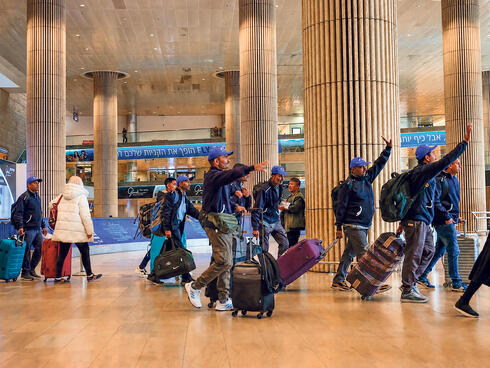
How Israel lost control of the foreign worker market
The number of foreign workers has surged by nearly 80% since the start of the war, but no one can clearly explain how quotas are set, or where the policy is heading.
Israel’s policy toward foreign workers has undergone a dramatic reversal over the past three years. Until the war, foreign labor was treated as a necessary evil, viewed as a potential threat to both the country’s Jewish character and its labor market. Migrant workers were largely confined to a handful of sectors and subject to strict quotas. Following the war and restrictions on the entry of Palestinian workers from the West Bank, however, the government decided to more than double the number of foreign workers, from 136,000 at the end of 2023 to a quota of 336,000. The expanded framework is expected to allow foreign workers into a long list of industries that had not previously experienced labor shortages.
This transformation is taking place without comprehensive planning, a thorough examination of its economic and social implications, or any meaningful public debate. Despite the fact that the current quota remains far from fully utilized, the government is already considering increasing it further, to 400,000 workers. Even if labor shortages justify such a move, other factors are receiving little attention, including the impact of an additional 200,000 foreign workers on housing demand and rental prices, as well as concerns that they could exert downward pressure on wages for lower-income Israelis.

Calcalist examined the ways in which foreign workers are reshaping Israeli society and the economy. A study published in January by the Knesset Research and Information Center (KRIC) attempted to identify the methodology used to determine foreign-worker quotas. After consulting every government body involved in the issue, the researchers were unable to find a clear answer.
“We do not know to what extent broader issues were examined and considered from a systemic, long-term perspective, including the impact on Israeli workers, tax revenues, the burden on social infrastructure, and the economy’s performance during emergencies,” the report stated.
The policy shift was formally introduced in a government resolution passed on May 15, 2024, under the title “Efficiency and Improvement of Supervision and Enforcement of the Employment of Foreign Workers.” The resolution gave little indication of the scale of the transformation to come. It established a maximum foreign-worker quota equivalent to 3.3% of Israel’s population, or approximately 335,900 workers by 2026. The stated justification was “a shortage of workers in various industries and the need to strengthen certainty and stability in the economy.”
The only sector for which substantial evidence of a labor shortage was presented was construction, a sector where few dispute the need for additional workers. However, the data referred to conditions at the end of 2023, during the height of the war. The most significant sentence in the explanatory notes may have been the assertion that:
“Dependence on Palestinian workers increases economic instability and creates significant uncertainty during times of crisis.”
In practice, the policy appears to have been driven less by a professional assessment of labor-market needs and more by a strategic decision to reduce reliance on Palestinian labor. The government determined that a committee of directors-general would set quotas for various sectors at up to 115% of pre-war levels and could exceed that threshold in exceptional cases.
A study published by the Finance Ministry’s Chief Economist in December 2025 concluded that:
“With a few isolated exceptions, we do not identify signs of a labor shortage in the Israeli economy at the macroeconomic level.”
The ministry likewise identified a significant shortage only in construction.
Nevertheless, in January 2026, the Prime Minister’s Office announced a tender for a comprehensive study to assess the labor market’s long-term need for foreign workers. The study is expected to take two years to complete. In the meantime, tens of thousands of foreign workers continue to arrive.
In the absence of comprehensive research, one of the primary tools used to determine quotas is the Central Bureau of Statistics’ job-vacancy survey. Vacancy levels have indeed been elevated in recent months, at times approaching 150,000 positions. However, this is largely attributable to the extensive reserve-duty mobilization. Whether this is an appropriate basis for setting long-term foreign-worker quotas is open to question.
Quotas have already been allocated to construction and infrastructure, agriculture, trade and services, manufacturing, hotels, healthcare institutions, nursing, and restaurants. The broadening of the policy is perhaps most evident in the allocation of 31,000 workers to the trade sector, where the arrival of roughly 10,000 workers is already noticeable in supermarkets across the country.
Employer groups frequently lobby for larger quotas through the Knesset Committee on Foreign Workers, chaired by a member of Likud. One recent discussion focused on employers’ requests to allow foreign workers initially approved for logistics and goods handling to work as cashiers.
Economic theory suggests that labor shortages should drive wages higher, as occurred in construction. However, that has not happened in industry and retail.
“We do not recognize a labor shortage in industry and trade,” Finance Ministry officials say. “Foreign workers are being brought into those sectors because of strong pressure from the Ministry of Economy.”
Officials warn that increased reliance on foreign workers could come at the expense of disadvantaged Israeli workers, particularly women.
Numerically, the importation of foreign labor has been highly successful. According to Population and Immigration Authority data, the number of legal foreign workers has increased by 79%, from 109,200 in 2023 to 195,700 today. In other words, approximately 85,000 foreign workers have entered Israel within two and a half years.
In addition, there are already 44,600 illegal foreign workers in the country. Together, legal and illegal foreign workers total approximately 240,400, about 71% of the current quota of 336,000. Given that the quota has not yet been exhausted, questions remain about the rationale for expanding it further.
The labor shortage was largely created by the exclusion of Palestinian workers. According to the Bank of Israel, approximately 156,000 Palestinians worked in Israel before October 2023, including 37,000 without permits. By the end of 2025, only 34,000 had returned to employment with Israeli employers, primarily in the West Bank. Most of the resulting labor gap has therefore been filled by foreign workers.
The Bank of Israel warned as early as 2024 about the risks associated with large-scale foreign-worker imports. In 2022, employment in Israel generated income equivalent to roughly 22% of Palestinian Authority revenues. The central bank cautioned that weakening the Palestinian economy could have adverse security consequences and contribute to rising crime.
Unlike Palestinian workers, foreign workers require housing.
“Expanding concentrations of foreign workers could increase social tensions between Israelis and foreigners,” the Bank of Israel warned.
For that reason, the central bank recommended maintaining a mix of foreign and Palestinian labor.
The Knesset Information Center identified additional risks, including the displacement of lower-income Israeli workers, downward pressure on wages, lower productivity due to reduced incentives to invest in technology, and excessive dependence on foreign labor. It also warned about lost tax revenues, as much of foreign workers’ income is remitted abroad, and about rising public expenditures on healthcare, welfare, education, and law enforcement.
The Ministry of Health estimates that unpaid medical debts accumulated by foreign workers and refugees who received treatment without adequate insurance have already reached approximately NIS 500 million.
The report concluded that fundamental questions remain unanswered, including which government body is responsible for labor-market planning, which sectors genuinely suffer from shortages, how severe those shortages are, and what steps have been taken to encourage Israelis to fill those positions.
Critics argue that the government has effectively created a new labor policy without establishing a clear long-term vision.
A 2025 report by workers’ rights organization Kav LaOved stated that the policy shift: “was implemented in a short period of time, without systematic examination or meaningful public debate, and without properly assessing its long-term implications for the labor market.”
The organization noted that no comprehensive discussion has taken place regarding where an additional 200,000 migrant workers would live.
The Histadrut has raised similar concerns. “The Directors General Committee does whatever it wants,” Adam Blumenberg, the Histadrut’s deputy director for economics and policy, told Calcalist. “There is no coherent policy. There is simply surrender to pressure from powerful interest groups.”
Ohad Amar, CEO of Kav LaOved, offered an example: “The Israel Antiquities Authority received a quota of 500 foreign workers because it shouted loudly enough.”
Blumenberg argues that Israel should focus on increasing labor-force participation among Israelis rather than relying on imported labor. “You can encourage people to work and pay higher wages. Instead, employers prefer foreign workers because raising wages for Israelis affects the entire enterprise.”



