










Israel’s Iron Beam laser was hailed as a breakthrough. It still isn’t operational
Rafael delivered the first system to the IDF at the end of 2025, but the system has yet to enter operational service. A senior defense industry official estimates full maturity could still be three to four years away.
More than eight months after Rafael delivered its Iron Beam interception system to the IDF’s air defense array, the system has yet to become operational. The development raises questions about whether declarations that Israel had entered the era of laser weapons were premature.
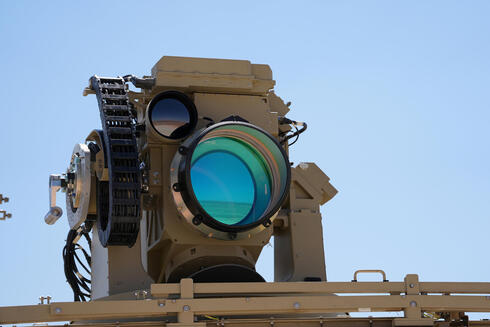
So far, Rafael has delivered only one Iron Beam system to the IDF. It was handed over in a high-profile ceremony at one of the company’s facilities in northern Israel at the end of 2025. The ceremony was attended by senior officials from across the defense establishment, including Defense Minister Israel Katz, Defense Ministry Director General Amir Baram, senior Air Force commanders and Rafael executives. One after another, they hailed the system as a major technological achievement that would provide Israel with capabilities unmatched even by some of the world’s leading military powers.
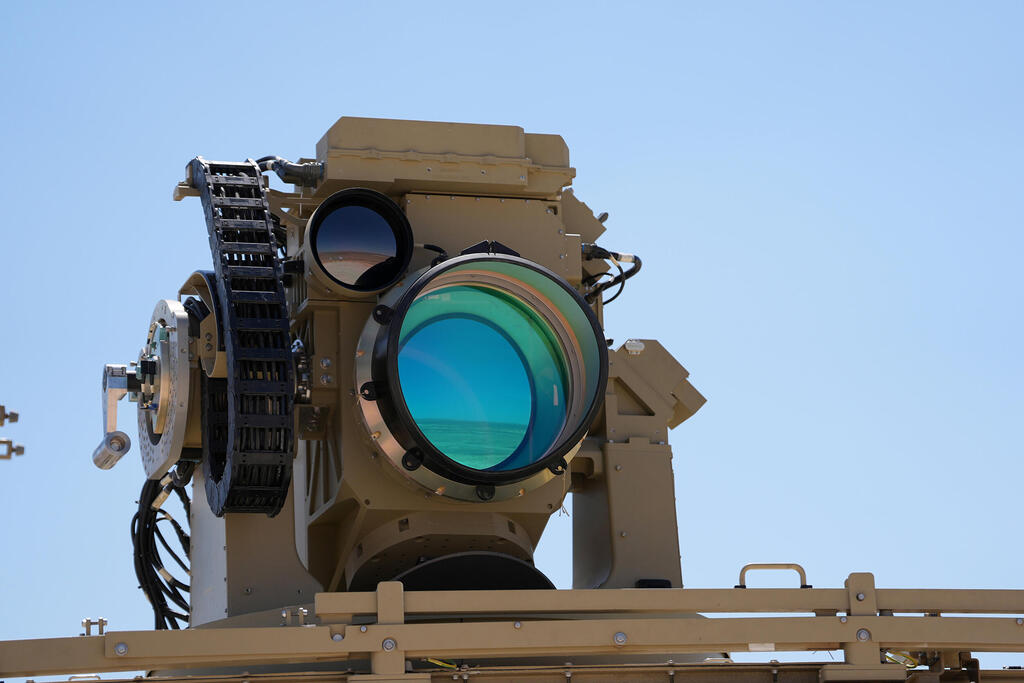
Yet during the recent war in Lebanon, when Hezbollah launched repeated barrages of rockets, UAVs and drones at northern communities and IDF forces, the new system was not activated.
Rafael said the air defense system had not yet completed the steps required to make it operational, while maintaining that the company had fulfilled its commitment to deliver the system to the IDF.
A senior defense industry official involved in the program estimated in a conversation with reporters that "Iron Beam would reach full operational maturity only in three or four years." The official added that “many more Iron Beam systems are being manufactured these days” and would be delivered to the IDF by the end of the year, but did not specify how many. Similar statements about additional deliveries were made about a year ago.
A senior Rafael official recently compared the process to the introduction of the F-35 fighter jet, noting that its integration into operational activity in the Air Force was also not immediate and required a lengthy preparation process.
Beyond its technological significance, Or Eitan is intended to address one of the most frustrating problems in asymmetric warfare: the enormous cost imbalance between inexpensive offensive weapons and the sophisticated systems used to intercept them.
Hamas and Hezbollah have repeatedly challenged Israel with relatively cheap rockets and drones that are widely available, forcing the IDF to respond with expensive defensive systems such as Iron Dome. A laser system is designed to change that equation by intercepting threats at a fraction of the cost. The cost of an individual interception is expected to be only a few shekels, essentially the cost of the electricity required to generate the beam, and potentially less than the price of the weapon being intercepted.
The system has a range of about 10 kilometers. According to Rafael and the Defense Ministry, it has successfully completed a series of tests under various combat scenarios in recent years.
But achieving the vision of intercepting aerial threats at almost no marginal cost requires a substantial investment upfront, and potentially on a very large scale.
Each laser system capable of generating the powerful beam is estimated to cost tens of millions of dollars. Its relatively short range, combined with the need to protect large areas of Israel against a variety of aerial threats, could ultimately require several hundred such systems.
“Alongside the operational gap, there is also the economic dimension, which is sometimes treated unrealistically, such as the promise that laser interception will cost ‘like a can of Coca-Cola,’” Brig. Gen. (res.) Ran Kochav, the former commander of the IDF’s Air Defense Command, told Calcalist.
“Such a statement may be good for a headline, but it ignores the enormous cost of research, development, engineering, testing, infrastructure and production of advanced laser systems,” Kochav said. “Over the past decade, and in the decade to come, the defense establishment has invested and will invest hundreds of millions of dollars in developing individual systems, establishing laboratories, building prototypes and implementing core technologies.”
“When you divide that investment in a simple mathematical calculation by the number of successful interceptions, it is very difficult to reach the promised figure of $5 per interception,” he added. “It is better to adjust expectations on the subject, talk less and intercept more. The future of the laser is coming, but it will not solve all our problems, and certainly not soon. It is still in its infancy, very expensive to implement, and it will take years before we see a significant reduction in costs.”
The debate over Iron Beam comes as the defense establishment faces another rapidly evolving aerial threat: explosive drones, including drones equipped with fiber-optic links.
On Thursday, the Defense Ministry held an urgent discussion on possible operational and technological responses to the emerging threat. Fiber-optic drones cannot be disrupted by conventional electronic warfare systems, forcing the IDF to rely on other methods, including nets deployed over manned positions and ground vehicles, as well as a growing range of technologies being developed and supplied by defense companies.
Some systems delivered to the IDF in recent months incorporate electro-optical detection capabilities. Potential interception methods range from drones designed to intercept other drones through direct collision to systems that fire nets at incoming drones and bring them down before they reach their targets.
But here too, the technological race is still underway. As Israel invests in new ways to defend against increasingly sophisticated and inexpensive aerial threats, the experience with Iron Beam highlights the gap that can emerge between a breakthrough technology demonstrated in testing and a system capable of reliably protecting the country in wartime.
First published: 09:35, 09.08.26



