










What Israel isn’t saying about missile strikes at home
Limited disclosures mask hits near power stations, airports and strategic assets.
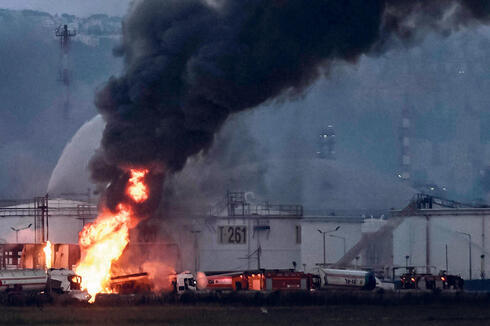
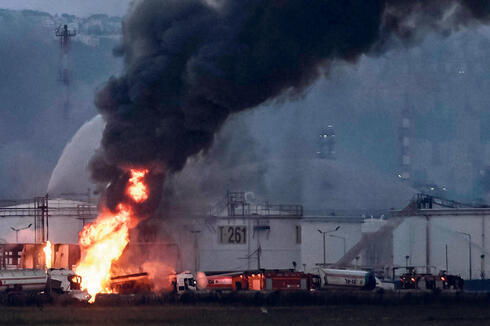
For the second time since the outbreak of the current war with Iran, the Haifa Bay refinery was struck on Monday. Fragments from a missile intercepted by Israel’s air defense systems hit two locations within the sensitive compound. One impact ignited a fire in a tank used to store thousands of cubic meters of gasoline, while another damaged an industrial building belonging to Bazan.
Within minutes, thick smoke rose from the burning tank, visible for miles across the Haifa Bay area, as strong gasoline odors spread throughout the region. The Ministry of Environmental Protection said there was no indication of a leak of hazardous materials from the tanks used in Bazan’s production processes.
This was not an isolated incident. About a week and a half earlier, fragments from another Iranian missile struck the Bazan complex, damaging infrastructure belonging to the Israeli Natural Gas Lines company and forcing a shutdown of gas supply to the refinery’s production units for approximately two days.
During the previous war with Iran in June, three missiles hit the Bazan complex. One of those strikes killed three employees and completely destroyed an internal power plant used to produce steam. At the time, the damage was estimated at $220 million.
Yesterday’s strike, the third within less than a year, came as the Haifa Bay Rehabilitation Administration published a report stating that the evacuation of the hazardous industrial complex will only be completed by 2031, around two years later than the government’s original target.
Further south, an Iranian missile hit the Adama plant (formerly Makhteshim-Agan) in the Neot Hovav industrial zone near Be’er Sheva on Sunday. A warehouse containing finished goods, including agricultural pesticides, caught fire and burned for hours. Workers in the area were instructed to remain in protected spaces amid fears of exposure to hazardous materials.
The targeting of energy infrastructure and sensitive industrial facilities reflects what officials describe as Iran’s retaliatory strategy: responding to Israeli strikes on its own energy, oil, and military industries with similar attacks. In anticipation of such scenarios, Israeli energy officials say that, even before the war, hazardous materials were reduced at exposed sites and fuel redundancy for electricity generation was increased.
Israel, for its part, has been linked to strikes on key Iranian energy assets, including the nuclear facility in Bushehr. In the early days of the war, attacks on fuel storage sites triggered prolonged fires that filled Tehran’s skies with soot, followed by what witnesses described as “black rain.” Iranian leaders subsequently threatened to target critical infrastructure in Israel and across the Persian Gulf.
Iran has also launched attacks beyond Israel. In the opening days of the conflict, missile barrages and hundreds of drones were directed at energy facilities in the United Arab Emirates, Qatar, Kuwait, Saudi Arabia, and Bahrain. According to the Institute for National Security Studies (INSS), Iran has struck at least eight oil, gas, and fuel facilities since the fighting began, in addition to ports, airports, data centers, and factories.
The INSS data does not include detailed accounts of attacks on Israel, due to military censorship. However, occasional images and videos posted by civilians have revealed attempts to hit critical infrastructure. These include a missile strike near the Orot Rabin power station in Hadera and another incident in which a missile hit a satellite communications facility in the Valley of Elah. In recent weeks, missiles or interception fragments have also struck other sensitive sites, including Ben Gurion Airport, where three executive jets were heavily damaged.
Since the start of the war, the IDF has not released comprehensive data on the number of missiles launched toward Israel or interception rates. Other government bodies have also limited disclosures regarding infrastructure damage. Early in the conflict, the Ministry of Energy stopped publishing regular updates on the country’s electricity generation mix, following the prolonged shutdown of the Karish and Leviathan gas rigs.
According to data revealed by Calcalist, each day the Karish rig remains offline costs NIS 2.3 million, while the shutdown of Leviathan results in daily losses of NIS 5.2 million for its partners. As the conflict continues, it appears unlikely that operations will resume soon, due to the significant security resources required to defend active offshore rigs, which are considered particularly vulnerable.
Authorities have generally disclosed damage only in cases of significant destruction or casualties. Officials argue that limiting information is necessary to prevent Iran from improving the accuracy and effectiveness of its attacks. However, this policy of restricted transparency risks eroding public trust, particularly when it contrasts with official statements highlighting operational successes.
In the early days of the war, unnamed security sources suggested that around 70% of Iran’s missile launchers had been destroyed. Yet, now in the fifth week of fighting, millions of Israelis continue to seek shelter daily, raising questions about the gap between official assessments and the reality on the ground.
While the military has described Iranian fire as limited or sporadic, the continued frequency of attacks tells a more complex story. Many of the missiles used carry cluster warheads, which are less destructive than heavier payloads but can create dozens of impact sites across wide areas.
Defending against such threats relies heavily on adherence to Home Front Command instructions. However, the volume of attacks places increasing strain on Israel’s air defense systems, forcing adjustments in interception strategies.
Whereas previous confrontations relied primarily on Arrow 3 interceptors outside the atmosphere, the current campaign has also seen expanded use of the David’s Sling system. While effective, these systems can result in interception debris being scattered across large areas.
Despite these challenges, the Air Force maintains that interception rates in the current conflict exceed those recorded in the previous war with Iran.



