










Israel’s hypersonic interceptor goes public as the U.S. and Iran race to develop advanced missiles
Rafael has displayed a full-scale model of Sky Sonic, more than three years after announcing the project. The unveiling comes as Washington invests billions in offensive hypersonic weapons and broader missile defenses, while Russia helps Iran develop supersonic cruise missile technology.
Rafael has offered a rare public look at its Sky Sonic interceptor, displaying a full-scale model at the Association of the United States Army’s annual defense exhibition in Washington. The appearance brings renewed attention to a project announced in June 2023, although the company has yet to publicly disclose key details about its testing, performance or expected deployment.
Sky Sonic is designed to intercept hypersonic missiles, which travel at more than five times the speed of sound and can maneuver during flight. Their speed and flight profiles can make them difficult to detect, track and intercept, creating a challenge for existing missile defense systems.
The display provides a clearer view of the interceptor, but leaves important questions unanswered. Rafael has not publicly provided a detailed account of the system’s test record, interception range, operational timeline or cost. Nor has it released enough technical information to independently assess its performance against different types of hypersonic weapons.
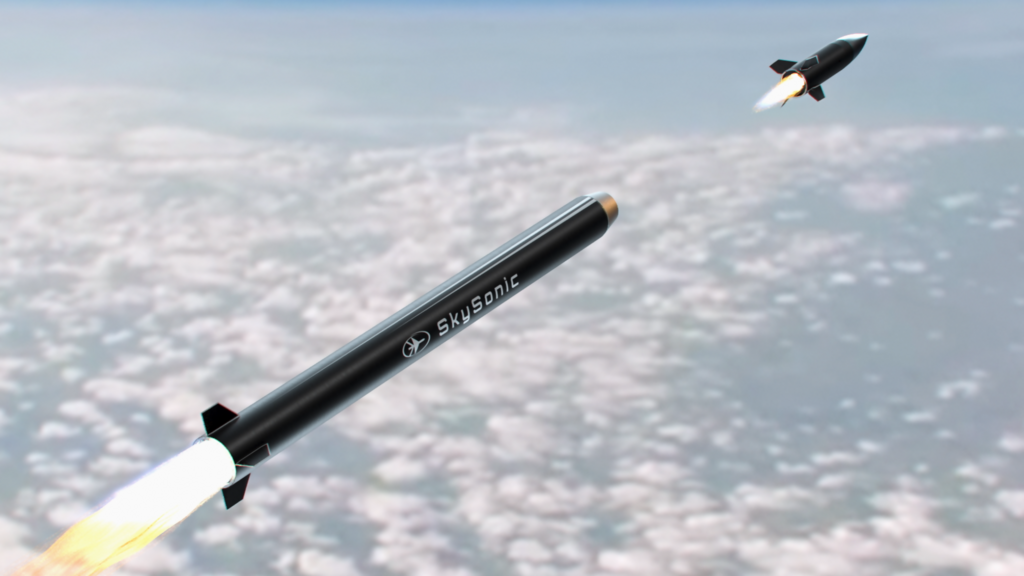
A full-scale model is not evidence that a weapon is operational. The central question for Rafael is how far Sky Sonic has progressed beyond development and whether it can demonstrate the ability to intercept a maneuvering hypersonic target under realistic conditions.
The unveiling comes as the United States invests in both advanced offensive weapons and defenses against them. The proposed U.S. fiscal 2026 defense budget included more than $3.9 billion for hypersonic weapons programs, supporting development and procurement efforts across the military services.
The same budget proposal included an initial $25 billion investment in Golden Dome, President Donald Trump’s broader missile defense initiative. The Pentagon said the effort would address threats including ballistic and hypersonic missiles, cruise missiles and other advanced aerial attacks, with funding for interceptors, sensors, command-and-control systems and potential space-based capabilities.
According to a recent report in the Financial Times, Russia has been secretly helping Iran develop supersonic cruise missile technology. The program could eventually provide Tehran with a new way to threaten U.S. warships, including aircraft carriers, although the reporting did not establish that a Russian-assisted missile has entered operational service.
The Financial Times said that Russia’s assistance to Iran is being carried out under a covert program code-named C430L, which began in 2023. The effort involves Russia’s state arms exporter Rosoboronexport and missile manufacturer NPO Mashinostroyeniya, whose specialists have worked with Iranian counterparts on ramjet propulsion.
A ramjet engine draws in and compresses air through the forward motion of the missile, allowing it to sustain powered flight at supersonic speeds. The technology is difficult to develop, and expertise in its design and operation could help Iran improve its own missile capabilities rather than relying solely on imported weapons.
According to the Financial Times, leaked correspondence, travel records and military patents show Russian officials and experienced missile engineers making repeated trips to Iran and analyzing technical data from an Iranian flight test. Russian specialists raised questions about the propulsion system’s fuel supply, combustion stability, air intake and engine nozzle, suggesting that their involvement extended to troubleshooting the technology.
The investigation found that the cooperation continued into 2026, including discussions about further technical work after the start of the U.S.-Israeli war against Iran. The reported program is intended to help Iran develop a new class of cruise missiles, potentially for anti-ship and land-attack missions.
Supersonic missiles travel faster than the speed of sound, but do not necessarily exceed Mach 5, the generally accepted threshold for hypersonic flight. The C430L program, as described in the reporting, is focused on supersonic cruise missile technology.
The Financial Times reported that Iran had already built and flight-tested a ramjet propulsion system, but found no evidence that a cruise missile developed with Russian assistance had entered operational service.
The development of faster missiles has intensified the challenge facing defense companies and military planners. But speed is only one part of the problem. Some advanced weapons can maneuver during flight, making their trajectories harder to predict and complicating the calculations required to guide an interceptor toward them.
Hypersonic weapons also encompass different technologies, including glide vehicles released from rockets and powered cruise missiles. Their propulsion systems, flight profiles and operating conditions differ, so an interceptor’s effectiveness against one type cannot automatically be assumed to extend to all the others.
An effective defense requires a chain of capabilities. A system must detect a launch, establish and maintain a reliable track, predict the weapon’s trajectory and guide an interceptor to the point of interception. Maneuvering targets can complicate that process, while the time available to respond may be limited by the missile’s speed and flight path.
Rafael has presented Sky Sonic as an answer to the hypersonic threat, but the public information available about the program is insufficient to establish how it addresses each of these challenges. Without detailed test results, it is not possible to independently evaluate its interception performance or compare it directly with other missile defense systems.
The next milestone for Sky Sonic will be evidence of what the system can do, rather than how it looks on an exhibition floor. Until Rafael releases more details about testing and performance, the interceptor remains a potentially important component of Israel’s response to advanced missiles, with its operational capabilities still largely undisclosed.



