










Boarding Pass
How a family trip to Greece inspired the next generation of firefighting technology
Using AI-powered acoustic sensors that can “hear” the unique sound signatures of combustion, the Israeli startup Firewave is looking to usher in the next wave of ultra-early fire response.
“Most current systems, such as cameras and satellites, usually identify fires only after visible smoke or flames appear — which can already be too late, especially in dense forests, mountainous terrain, or at night,” explains Dr. Jenia Yurkovsky, Co-Founder and CEO of Firewave.
Dr. Yurkovsky founded the company in 2024 alongside co-founder and CTO Eduard (Edi) Grinberg. The idea came about after a family trip to Greece in 2021 shortly before the devastating Evia wildfire broke out. Today, the startup has raised $500,000 in Pre-Seed funding and has an active MVP product that is being used for pilots and first commercial installations in Israel and the United States.
1 View gallery
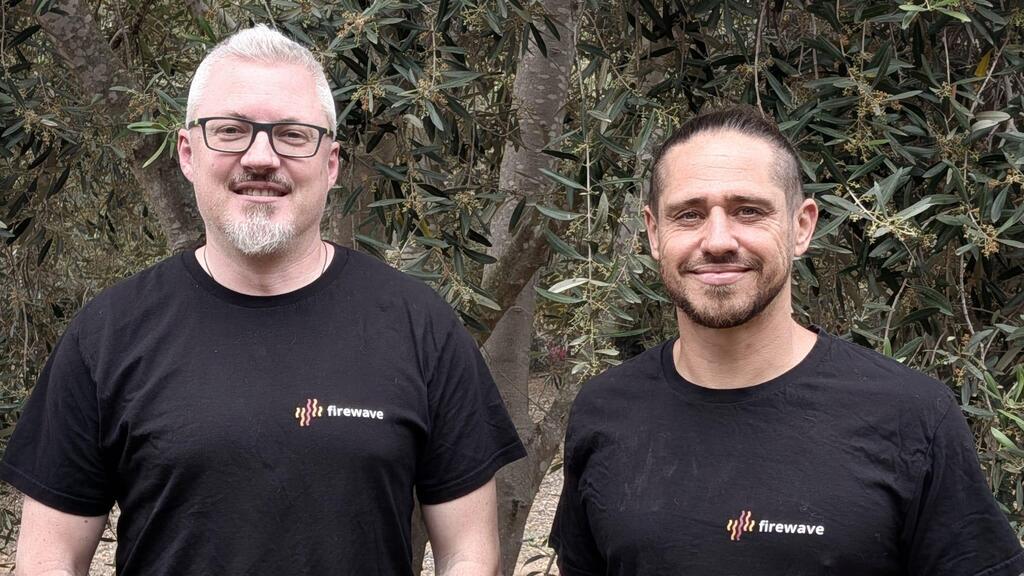
Dr. Jenia Yurkovsky and Eduard Grinberg Firewave, co-founders, Firewave.
(Photo: Firewave)
“Our system identifies the unique sound signature of combustion and can detect small fires within minutes, often before they generate enough smoke to be reliably seen by cameras or satellites,” adds Dr. Yurkovsky.
You can learn more about the company below.
Company Name: Firewave
Sector: FireTech, Climate
Product/Service description:
Firewave develops AI-powered acoustic sensors for ultra-early wildfire detection. Our system identifies the unique sound signature of combustion and can detect small fires within minutes, often before they generate enough smoke to be reliably seen by cameras or satellites. Because sound does not require line of sight, Firewave can operate effectively in dense vegetation, complex terrain, and low-visibility conditions.
The system consists of autonomous solar-powered field sensors, cloud-based AI analysis, and a real-time alerting platform. When a potential ignition is detected, alerts are sent immediately to enable rapid verification and response while the fire is still small and easier to suppress.
We are initially focused on protecting wildfire-prone communities, camps, wineries, resorts, utilities, and other businesses located near vegetation, where fires often start close to people and infrastructure. By reducing time to detection, Firewave helps lower suppression costs, reduce damage, and improve resilience in wildfire-prone areas.
Founder Bios:
Dr. Jenia Yurkovsky, Co-Founder and CEO: Yurkovsky holds a Ph.D. in Physics from Tel Aviv University and brings deep multidisciplinary R&D experience across physics, AI, and complex systems. Before founding Firewave, he led development in the medical device industry, helping take products from prototype through clinical studies, FDA approval, and production. At Firewave, Jenia leads strategy, product vision, and business development.
Eduard (Edi) Grinberg, Co-Founder and CTO: Grinberg holds a B.Sc. in Physics and Computer Science from Tel Aviv University and has nearly two decades of experience in software engineering, real-time analytics, cloud systems, and audio technologies. He has led R&D teams and built large-scale, mission-critical systems. At Firewave, Edi leads technology development, system architecture, and AI implementation.
Year of Founding: 2024
Last Investment Round: $500K
Last Investment Stage: Pre-Seed
Date of Last Investment: 07/01/2025
Total investment to date: $1,250,000
Investors: Techstars, Tonbo Ventures, Angels and grant from Israeli Innovation Authority
Current number of employees: 5
Open positions: No
Website: https://www.firewave.earth/
Social Media: LinkedIn
How was the idea born?
The idea for Firewave was born following a family trip to Greece in 2021. We were visiting the country shortly before the devastating Evia wildfire broke out. Watching the images of more than 30,000 people being evacuated while massive fires spread in the background left a very strong impression on me.
It made me think deeply about the nature of wildfires and the importance of timing. Once a wildfire grows beyond a certain point, suppression becomes dramatically more difficult, expensive, and dangerous. I realized that the best way to fight wildfires is to detect and suppress them while they are still small.
Coming from a multidisciplinary background in physics, engineering, and complex systems, I began exploring why existing technologies often struggle to detect fires early enough. Most current systems, such as cameras and satellites, usually identify fires only after visible smoke or flames appear — which can already be too late, especially in dense forests, mountainous terrain, or at night.
That led to a simple but powerful question: “What if fires could be detected before they become visually obvious?”
This idea eventually evolved into Firewave — AI-powered acoustic sensors designed to recognize the unique sound signatures of combustion and detect wildfires within minutes, enabling much faster response and helping stop small ignitions before they become catastrophic wildfires.
What is the need for the product?
The need for Firewave comes from the growing threat of wildfires and the critical importance of rapid response. As climate change makes wildfires more frequent and destructive, communities and critical infrastructure located in high-risk areas are becoming increasingly vulnerable.
The most important use cases for Firewave are scenarios where there is a need to protect high-value infrastructure or settlements located in wildfire-prone regions — such as WUI communities, power infrastructure, communication facilities, resorts, camps, wineries, and industrial sites near forests or wildland areas.
In these environments, timing is everything. Existing detection systems often identify fires only after they have already grown large enough to produce visible smoke or flames. By that stage, suppression becomes far more difficult, expensive, and dangerous.
Firewave was designed to enable extremely rapid response by detecting fires while they are still very small — sometimes only a few square meters in size. Detecting the ignition at such an early stage can allow suppression to begin immediately, even using light equipment or local response teams, without necessarily waiting for large firefighting forces to arrive.
This capability is expected to become even more important in the near future as autonomous wildfire suppression technologies continue to evolve. Systems such as firefighting drones and autonomous suppression platforms are highly effective against small fires, but they are limited in their suppression capacity. For these systems to succeed, fires must be detected within minutes, before they grow beyond the point where a lightweight autonomous response can contain them.
A delay of only a few minutes may determine whether the event remains a small controllable fire or develops into a catastrophic wildfire requiring evacuations and massive suppression efforts.
Firewave addresses this need using AI-powered acoustic sensors that can “hear” the unique sound signatures of combustion and provide ultra-early alerts, including in dense forests, mountainous terrain, and at night where traditional camera-based systems may struggle. The goal is not to replace existing technologies, but to complement them and compress the time between ignition and suppression.
How is it changing the market?
Firewave is helping shift the wildfire market from reactive response to ultra-early intervention.
Most existing systems detect fires only after visible smoke or flames appear, when suppression is already becoming difficult and expensive. Firewave focuses on detecting ignitions within minutes, while the fire is still small and potentially suppressible with light equipment or rapid local response.
This changes the operational model from fighting large wildfires to stopping small ignitions before they escalate. It is especially important for protecting high-value infrastructure and communities in wildfire-prone areas.
Firewave also supports the next generation of autonomous suppression technologies, such as firefighting drones and robotic systems, which are only effective if fires are detected extremely early.
Rather than replacing existing technologies, Firewave adds a new sensing layer — AI-powered acoustic detection — helping create a faster and more integrated wildfire response ecosystem.
How big is the market for the product and who are its main customers?
The wildfire protection market is large and rapidly growing as climate change increases wildfire frequency and severity worldwide. Economic losses from wildfires in the U.S. alone are estimated at roughly $400B–$800B annually. In addition, around 2.6 million U.S. homes are located in high wildfire-risk areas, representing an estimated $1.3T in rebuilding value.
Our initial focus is on high-risk areas where rapid detection can directly protect communities and valuable assets. The primary customers at this stage are WUI communities and SMBs located near forests or wildland areas — including summer camps, hotels, resorts, wineries, and vineyards. In these environments, even a small fire can quickly become catastrophic, making ultra-early detection especially valuable.
As the company grows, we plan to expand toward larger-scale customers such as utilities, fire departments, and government agencies responsible for protecting critical infrastructure and large territories. We also see strong future potential in partnerships with insurance providers, where early detection technologies can help reduce wildfire-related losses and improve resilience in high-risk regions.
Does the product exist already?
Yes. Firewave already has an active MVP product that is being used for pilots and first commercial installations in Israel and the U.S. The system has been tested in real forest environments and demonstrated the ability to detect small fires within minutes.
Currently, the MVP is primarily supporting pilot deployments and early customer validation. At the same time, we are developing our second-generation product, designed for improved scalability, robustness, lower power consumption, and easier deployment.
Over the coming months, we expect to establish semi-mass production capabilities for the Gen2 system. This will allow us to scale installations and become fully commercialization-ready toward the end of summer 2026 and ahead of the following wildfire season.
Who are the main competitors in this sector and how big are they?
The wildfire detection market includes companies working with cameras, satellites, drones, and environmental sensors. Some of the leading players are Pano AI, which focuses mainly on AI-powered camera systems, OroraTech with satellite-based monitoring, and Dryad Networks with gas-sensing IoT devices.
Firewave’s approach is complementary rather than directly competitive with many of these companies. For example, camera-based systems such as Pano AI are highly effective in open areas, but they require line of sight and therefore can be less effective in dense forests, mountainous terrain, or other complex environments where smoke or flames may remain hidden during the early stages of a fire.
Firewave focuses on ultra-early acoustic detection of small ignitions, enabling detection within minutes even in environments where visibility is limited. We believe future wildfire protection systems will combine multiple technologies together, with Firewave serving as an additional sensing layer that helps detect fires before they grow into large-scale wildfire events.
What is the added value that the founders bring to the company and the product?
Firewave’s founders bring a multidisciplinary combination of scientific, engineering, and operational experience that is highly relevant for building a deep-tech wildfire detection company.
I come from a background in physics, complex systems, and medical device development. Before Firewave, I worked as a team leader within the R&D department of a medical device company and was involved in multiple aspects of bringing products from prototype stage toward real-world deployment — including clinical studies, production setup, quality assurance processes, and customer-oriented product development. This experience provided strong foundations in managing complex technological projects and transforming advanced technologies into practical products.
Grinberg brings many years of experience in software engineering, cloud infrastructure, and real-time data analysis systems. His background is especially important for developing scalable AI-driven sensing and monitoring systems that can operate reliably in real-world environments.
In addition, Michael Ben Aharon joined Firewave later as CRO, bringing significant business development and strategic partnership experience. Ben Aharon is a serial entrepreneur and was part of the team that won the XPRIZE AI for Good competition through work focused on malaria elimination. His experience in international partnerships, impact-driven technologies, and market development helps support Firewave’s commercialization and global expansion efforts.
Together, we combine expertise in physics, AI, signal processing, IoT systems, cloud architecture, product development, and business strategy. Through pilots, accelerators, and collaborations, we have also established growing connections with forestry organizations, fire agencies, wildfire technology companies, investors, and ecosystem partners in both Israel and the United States.
This multidisciplinary approach is one of Firewave’s core strengths and enables us to approach wildfire detection from a different perspective than traditional fire industry companies.
What will the money coming in from the round be used for?
The seed funding will primarily be used to accelerate product development and support Firewave’s commercial scale-up in the U.S. market.
On the technology side, the investment will support further R&D of the next-generation system, including edge AI capabilities, improved communication infrastructure, enhanced acoustic models with higher sensitivity and lower false positive rates, and expansion toward detection of additional environmental anomalies beyond wildfire ignition.
A significant portion of the funding will also be dedicated to building operational and commercial capabilities in the U.S. This includes expanding business development and marketing activities, supporting pilot deployments and customer onboarding, establishing scalable production and operational workflows, and growing the team to support commercialization and future large-scale deployments.
In the "Startup Boarding Pass" section, CTech will cover the (relatively) small investments made in companies during the early stages of their existence - and the entrepreneurs and startups who have not yet had the opportunity to reveal their stories to the world. Please use the linked form and fill it out according to the guidelines. This form is intended for startups raising between $500,000 and $3 million from venture capital funds, angels, or official grants from Israeli and foreign institutions. If relevant, someone at CTech will be in touch for follow-up questions.



