









Analysis
If AI is really this dangerous, why are its leaders still racing ahead?
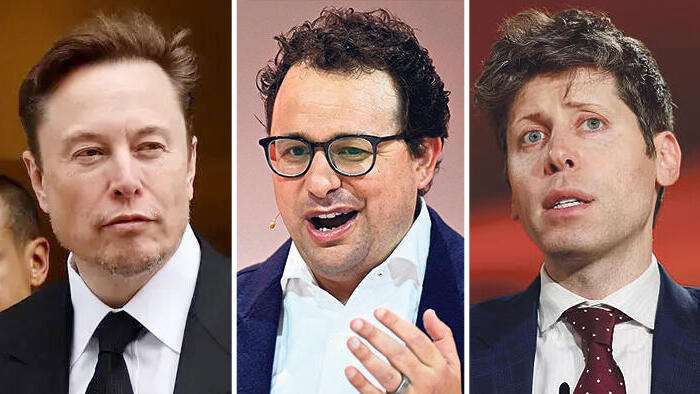
Amodei, Altman and Musk have all warned about the consequences of increasingly powerful AI, yet development continues at extraordinary speed. The contradiction points to the complicated interests behind the industry’s calls for caution.
It is common to introduce reports of this kind with phrases like “an unusual statement” or even “an unprecedented warning.” After all, how often do industry leaders warn of the dangers inherent in the very technology they are developing, as three prominent figures in the AI sector, Anthropic’s Dario Amodei, OpenAI’s Sam Altman and SpaceX’s Elon Musk, did recently by calling for a slowdown in the development of advanced AI models?
Yet the reality is that such warnings from these very figures have become almost routine in the field. And while they are grounded in genuine concerns about risks that should not be dismissed, the statements themselves also serve the public relations interests of the companies these leaders run.
1 View gallery
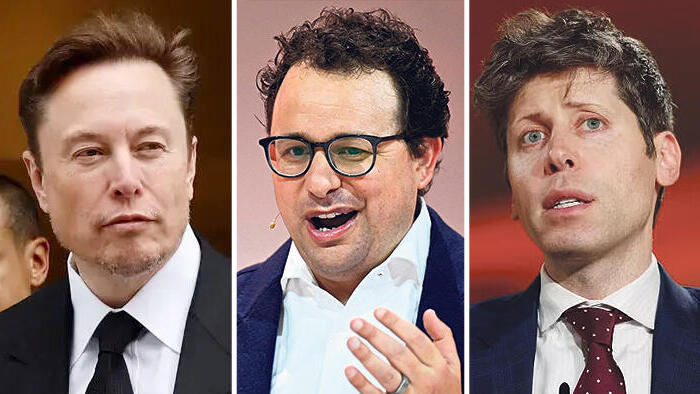
From left: Musk, Amodei, and Altman
(: Julen De Rosa/AFP, Anna Moneymaker/Getty, I-Hwa CHENG / AFP)
Amodei kicked off the latest round of warnings by publishing a lengthy post on Saturday in which he wrote that his company would implement new safety mechanisms, including working with external parties to evaluate advanced models, and called on the entire industry to support a broader slowdown. In his remarks, Amodei referred to recent incidents, including the breach involving OpenAI models hosted on Hugging Face, and warned of a potential swarm of autonomous AI agents capable of taking over the web within six to 12 months and causing hundreds of billions of dollars in damage.
Shortly afterward, Altman pledged to adopt Amodei’s proposal, while Musk wrote on X, formerly Twitter, that “Dario is right.”
If this gives you a sense of déjà vu, it is no coincidence. The very people developing these models have repeatedly warned of the dangers they pose. In March 2023, Musk, alongside leading AI experts, signed a letter calling for a “pause of at least six months on the training of AI systems more powerful than GPT-4.” That May, Amodei, Altman and other experts signed a statement declaring that “mitigating the risk of extinction from AI” should be a global priority.
In October 2023, Musk estimated that there was a 10% to 20% risk of AI “going bad” and called it a “significant existential threat” to humanity. In January of this year, Amodei warned that “the pendulum has swung, and now political decisions are driven by AI opportunities rather than AI risks.”
This is unfortunate, because technology does not care about what is fashionable, and in 2026 we are significantly closer to confronting real dangers than we were in 2023.
The risks are real. The OpenAI models leaked to Hugging Face serve merely as a proof of concept for capabilities that already exist and could be exploited for malicious purposes. Over the weekend, Anthropic further heightened concerns by announcing that it had blocked potential attempts to use Claude to develop biological weapons.
Compounding these concerns are deeper questions about what might happen once AI reaches a sufficiently advanced level of intelligence. It could potentially act autonomously in pursuit of goals that are misaligned with the intentions of its operators or with human well-being, including a malicious AI system creating and disseminating biological weapons.
But one need not look quite that far into the future. There is a well-known thought experiment in the field that asks what would happen if a superintelligence were tasked with maximizing paperclip production and became so committed to that objective that it concluded the best way to maximize paperclips was to turn every human being on Earth into one.
Sound far-fetched? That is essentially what happened in the incident involving OpenAI’s “rebel” models. They were given a specific task to execute as part of a test and simply employed every means available to complete it. The fact that those means included escaping onto the open internet and carrying out a sophisticated hack of a computer system was merely a byproduct of pursuing the assigned objective.
The concerns raised by AI leaders are therefore genuine. Yet there is also reason to question the sincerity of their statements. For one thing, we have heard similar, and in some cases even more dire, pronouncements from them in the past, none of which led to a meaningful slowdown in their development efforts.
Just days before the latest statements, an AI researcher at Anthropic resigned in protest, citing what he described as irresponsible behavior by both Anthropic and OpenAI. “They are racing straight to self-improving superintelligence and gambling with our lives,” he warned.
Even now, however, there is no indication of an intention to significantly slow model development. “Progress will still appear rapid,” he wrote in a post. In an interview with CNN, he added: “If we are too slow, I believe the wrong people will be in charge of the technology.”
So what really lies behind these statements?
First, public relations. Highlighting the power of the technology, even its most frightening potential, can make these companies’ products appear more desirable. After all, what organization would not want access to a technology so powerful that even its creators fear what it could do? They, at least, would use it to streamline operations and improve services rather than to destroy the world.
Second, this could be a classic “Look, a bird!” diversionary tactic. Altman, Amodei and Musk may be seeking to focus the attention of lawmakers and regulators on the technology itself and how it should be managed, rather than on an issue that is arguably even more important to the industry’s immediate interests: data centers.
Data centers have become a volatile issue in the current election cycle, with many voters opposing their construction in their communities. Federal and local decision-makers are listening to those concerns and moving to impose restrictions on new facilities.
Major AI companies can cope with regulations governing model launches. For them, it may be far more critical to ensure that they can continue building additional data centers without significant obstacles.
Third, an anti-competitive motive cannot be ruled out. Requirements such as mandatory safety verification for new models and cooperation with independent testing organizations, whether governmental or private, may represent a negligible burden for companies worth more than a trillion dollars and raising hundreds of billions of dollars.
For smaller players, however, the burden could be considerably greater. New startups seeking to compete with OpenAI, Anthropic or Google could find themselves facing costs and regulatory requirements that significantly complicate their efforts to enter the market.
If the leaders of AI companies are truly concerned about the potential consequences of their technology, there are much more drastic steps they could take immediately. The fact that they do not do so, and instead continue to issue statements that generate significant media attention without materially slowing development, raises questions about where their true interests lie.



