










BiblioTech
CTech's Book Review: A practical guide to flipping the traditional pricing model on its head
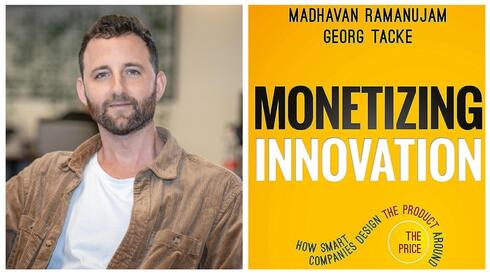
Erez Agmon, CEO and Co-Founder at Vayu, shares insights after reading “Monetizing Innovation: How Smart Companies Design the Product Around the Price”, by Madhavan Ramanujam and Georg Tacke.
Erez Agmon is the CEO and Co-Founder at Vayu, an AI revenue management platform. He has joined CTech to share a review of “Monetizing Innovation: How Smart Companies Design the Product Around the Price”, by Madhavan Ramanujam and Georg Tacke.

Title: Monetizing Innovation: How Smart Companies Design the Product Around the Price
Author: Madhavan Ramanujam and Georg Tacke
Format: Tablet
Where: Other
Summary:
Monetizing Innovation dismantles one of the most common and fatal mistakes in the technology and business world: building a product first and trying to figure out how to price it later. The authors, partners at the renowned pricing consultancy Simon-Kucher, draw on over 10,000 projects to show why 72% of new product innovations fail to meet their financial targets.
The book provides a practical guide to flipping this traditional model on its head. It advocates for having pricing discussions with customers early in the development cycle to determine their actual willingness to pay. By making price the driving force behind product design, features, and target audience, companies can avoid building products that nobody wants or is willing to pay for, ultimately ensuring sustainable growth and true market fit.
Important Themes:
At the core of the book is a radical paradigm shift in how organizations perceive value and product development. The most prominent theme is the concept of "designing around price". The authors argue that price is not just a number attached to a product at the end of a long R&D cycle; rather, it is the most direct metric of a customer's perceived value. If you don't know the price, you don't know the product.
A crucial theme explored is the fallacy of the "one-size-fits-all" approach. The book emphasizes that customers have drastically different needs and willingness to pay. Forcing a single product configuration and price point inevitably leaves money on the table and alienates potential users. This leads into the theme of intelligent segmentation and packaging, demonstrating how offering tiered options aligns product capabilities with specific customer segments.
Furthermore, the book explores the psychological and organizational barriers to effective monetization. It highlights how fear of rejection or a fundamental misunderstanding of the market often drives companies to underprice their innovations or over-engineer products with useless features (a phenomenon they term "feature shock").
By weaving together behavioral economics and hard data, the book establishes that monetization is not merely a financial exercise managed by the CFO, but a strategic imperative that must be cross-functional, involving R&D, product, sales, and marketing from day one.
What I’ve Learned:
As someone who spends every day deep in the mechanics of software monetization and billing infrastructure, this book profoundly validated and sharpened my approach. In the current B2B SaaS environment, where the shift towards usage-based and hybrid pricing models is accelerating rapidly, the lessons here are more critical than ever. I learned that pricing is actually a core product feature in itself. It is the vital bridge between the value a company creates and the revenue it captures.
Before, it was easy to view billing systems merely as back-office operational necessities. Monetizing Innovation taught me to view them as strategic enablers. When I speak with founders today, I often see the exact pain points described in the book: amazing technology that struggles to find its financial footing because the pricing model is rigid or misaligned with actual customer usage.
I learned that agility in monetization is a massive competitive advantage. If a company cannot easily iterate on its packaging, introduce new usage metrics, or test different pricing tiers without rewriting its entire backend, it is fundamentally hindering its own innovation. This book reinforced my belief that the infrastructure supporting revenue must be as flexible and sophisticated as the software product itself. It taught me that successful tech companies don’t just innovate in what they build; they must innovate in how they charge for it.
Critiques:
While the book provides an incredible framework, it occasionally leans on traditional, large-enterprise examples (like Porsche or consumer goods) which might require some translation for early-stage B2B startups operating in hyper-agile environments.
Additionally, the authors are so passionate about their methodology that some of the case studies can feel a bit repetitive. However, this repetition effectively hammers home the core principles.
This is also a strategic playbook for the C-suite, not a technical manual for implementation.
Who Should Read This Book:
This is mandatory reading for Founders, CEOs, Chief Product Officers, and CFOs, especially those in the tech and SaaS sectors.
If your company is about to launch a new product, transition to a usage-based pricing model, or feel a disconnect between the value your software provides and the revenue it generates, this book is your roadmap. It bridges the gap between engineering and finance, ensuring that innovation actually translates into measurable business success.



