










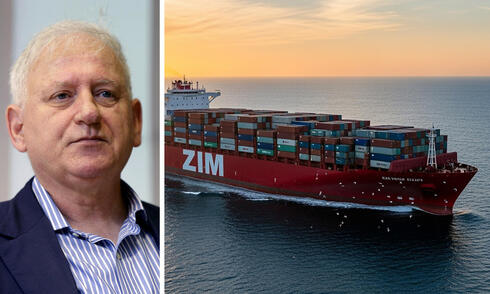
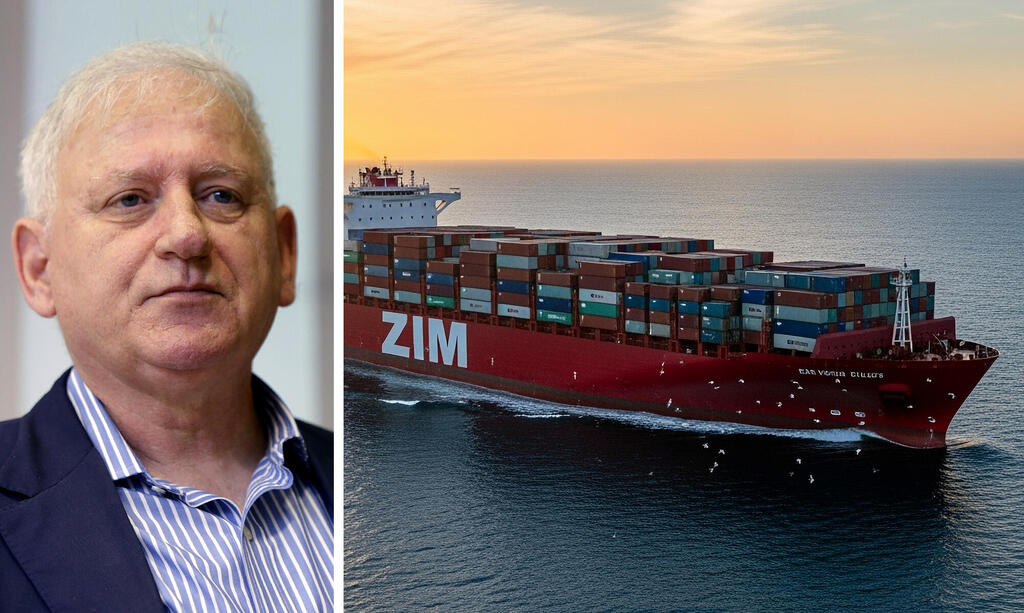
Zim deal faces new hurdle as shareholders demand vote on revised terms
The investor group says a new framework with Hapag-Lloyd and FIMI cannot be approved by the board alone.
Another front has opened in the battle over Zim's proposed sale. A group of the company's shareholders is organizing to demand that any new deal structure be submitted to a shareholders' meeting for approval.
The demand follows a letter sent to Zim's board of directors two days ago by the Government Companies Authority, previously revealed by Calcalist. The Authority said it had concluded its review of the original proposal submitted by Hapag-Lloyd and FIMI and that, should the parties submit a new structure, the review process would begin again from the start.
The shareholder group, which says it represents more than 10% of Zim's shares, worth approximately $345 million, sent a letter to the company's board, chaired by Yair Seroussi. The shareholders argued that because the Authority has concluded its review of the original proposal, any materially different structure must be brought before the shareholders' meeting for approval.
"Given that Zim has raised the possibility of submitting a new or updated deal structure that differs materially from the original, the Authority requires that any such structure be subject to approval by Zim's competent bodies," the shareholders wrote.
They argue that approval by the board alone would therefore not be sufficient and that any substantially revised proposal should be submitted to the shareholders for a vote.
Zim reported the Authority's letter to the New York Stock Exchange on Tuesday, noting that Hapag-Lloyd had informed the company of its intention to submit a revised proposal and once again seek approval from the State.
"We expect the board members and those acting on their behalf to do everything possible to maximize shareholder value," the shareholders wrote, signaling their belief that a higher valuation for Zim could potentially be achieved through a new sale process. Their position is driven in part by the rise in shipping rates over the past year, amid disruptions in the Gulf and Red Sea and other international challenges.
Zim was originally slated to be sold for $4.2 billion to Germany's Hapag-Lloyd and Israeli investment fund FIMI. The proposed structure faced opposition from the relevant government bodies, although the Economy Ministry's position could still change given Minister Nir Barkat's support for the transaction.
The Government Companies Authority, which is responsible for deciding whether to approve the transaction based on the positions of the various government bodies, stopped short of formally rejecting the deal. Instead, it concluded its review of the original proposal while leaving the door open to a restructured transaction.
Earlier this month, FIMI and Hapag-Lloyd approached the Authority seeking a 45-day extension to submit a new proposal addressing concerns raised by government ministries and professional bodies. Among the issues raised were FIMI's reliance on Hapag-Lloyd, which would effectively compete with Zim Israel, the entity FIMI would acquire, on North American routes; the involvement of Qatar and Saudi Arabia in Hapag-Lloyd; and the exclusion of the Far East route from the routes that Zim Israel would receive.
The opposition has been led by the Finance Ministry and the Prime Minister's Office, acting on the recommendation of the National Security Council, as well as the Shipping and Ports Authority.
The dispute now raises a separate question over who must approve any revised transaction. It appears that Zim's board cannot legally oppose a new framework if it does not adversely affect the company's position under the deal. The shareholders, however, are challenging that interpretation, arguing that the Government Companies Authority's reference to approval by Zim's "competent bodies" means that shareholders must also approve a materially revised framework.
The Authority could potentially refuse to consider a new proposal unless it has first been approved by the shareholders' meeting. In that respect, the shareholders' position could reinforce the Authority's own requirements.
The shareholder group has also reportedly conveyed another demand to the board, although it was not included in the letter: that Zim distribute a significant portion of its cash reserves, which total nearly $2.5 billion, to shareholders as a dividend.
Zim has so far refrained from making a large dividend distribution, a position that was largely associated with former CEO Eli Glickman. The company is now led by Chen Lichtenstein, who was appointed several months ago to replace Glickman.
The current shareholder campaign also echoes an earlier battle for influence at Zim. Before the proposed sale, a group that included More Provident & Pension Funds, Reading Capital, and Sparta 24 organized to secure the appointment of new directors and prevent the board from selling the company to a management group led by Glickman.
Those shareholders had demanded a meeting to appoint three directors of their choosing and require the company to distribute dividends. At the time, Glickman had proposed acquiring Zim alongside businessman Rami Ungar for slightly more than $2 billion, a proposal that alarmed shareholders.
Shortly before the meeting, Seroussi reached an agreement with the shareholders, represented by attorney Ofir Naor, under which two of their three proposed candidates, Ron Hadassi and Ran Gritzerstein, were appointed to the board.
Those two shareholder-appointed directors remain on the board as the current dispute unfolds.
Zim's board is therefore facing competing pressures. On one hand, its agreements with FIMI and Hapag-Lloyd restrict its ability to oppose a new proposal as long as the revised structure does not harm Zim. On the other, the Government Companies Authority and the shareholder group are arguing that a materially revised transaction should go before the general meeting.
Even if a shareholders' meeting is ultimately convened, however, it is not certain that investors would reject a new proposal. Much would depend on the terms and valuation of any revised transaction.
Zim's shares are currently trading around 20% below the value implied by the proposed transaction, adding another layer to the shareholders' argument that the company should seek to maximize the value it receives.



