










The hidden commodity at risk in the Iran war: Sulfur
Disruption in the Strait of Hormuz is beginning to ripple through a market vital to fertilizers, fuel refining and chipmaking.
While the world closely monitors oil prices, shipping rates, and potential disruptions to gas supplies, another industrial resource is beginning to feel the effects of the conflict largely under the radar: sulfur, one of the most basic raw materials of the global industrial economy.
If oil is the fuel that powers the system, sulfur is one of the materials that allows it to functionת in agriculture, fuel refining, metal processing, pharmaceuticals and even personal care products. With the Strait of Hormuz effectively blocked, the sulfur market is also beginning to feel the strain.
1 View gallery
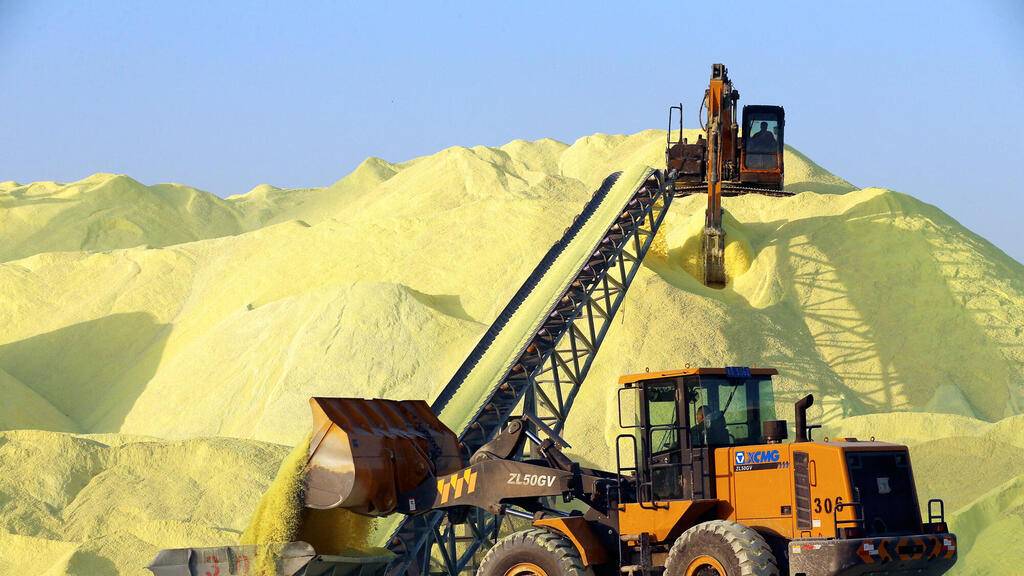
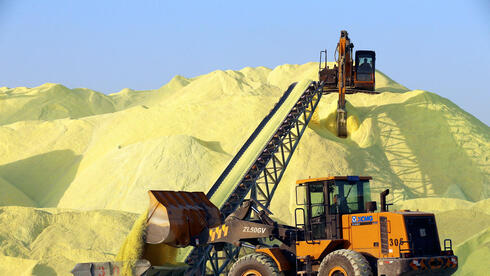
Sulfur cargoes at Nantong Port in China, the world's largest sulfur market
(Reuters/China Stringer Network)
The reason is simple. The Gulf is not only a hub for oil and gas, but also one of the most important centers of global sulfur production and trade.
In recent years, the Middle East’s share of the global sulfur market has steadily increased, and by 2024 it accounted for nearly half of the world’s tradable sulfur supply. A closer look at the Gulf states reveals an even sharper concentration. Saudi Arabia, the United Arab Emirates, Qatar, Kuwait and Iran together form a production and export bloc responsible for roughly 45% of global sulfur trade.
As a result, disruption to shipping through the Strait of Hormuz affects not only oil tankers but also one of the most essential raw materials in modern industry.
Most of the sulfur consumed globally is used to produce sulfuric acid, one of the most widely used industrial chemicals in the world.
Its most important application is the production of phosphoric acid, which is used to manufacture phosphate fertilizers. That creates a direct link between the sulfur market and the cost of agricultural production.
But sulfuric acid’s importance extends far beyond agriculture. It is also used in fuel refining, particularly in processes that improve gasoline quality. It plays a critical role in metal processing, helping extract metals from ores and forming an essential step in the production chains of copper, nickel and cobalt, three key metals used in batteries.
The chemical is also indispensable in the semiconductor industry. Companies such as TSMC, Intel and Samsung use sulfuric acid to clean silicon wafers, the foundation on which modern computer chips are built.
Even everyday consumer products rely on sulfur compounds. They are found in medical treatments for skin infections and in anti-dandruff shampoos, making sulfur one of the rare industrial materials that connects heavy industry with daily consumer life.
The first signs of stress in the sulfur market are already appearing.
In the early days of the conflict, sulfur prices began rising in East Africa, an important trading hub for the commodity. At the same time, prices surged in China, the world’s largest sulfur market.
The increase illustrates how a conflict geographically centered in the Gulf can quickly ripple through markets in Africa, China, India and other industrial economies far from the region.
Recent pricing decisions from Gulf producers highlight how central the region remains to the sulfur market.
The vulnerability of the sulfur market was highlighted by a recent incident in Ruwais, in the United Arab Emirates, where a drone struck a large sulfur refinery complex and caused a fire.
The refinery was temporarily shut down as a precaution. There is currently no indication that the sulfur production units themselves were damaged, making it too early to determine whether the Emirates’ sulfur output has been affected.
But the shutdown of one of the Gulf’s most important industrial complexes, and one of the largest refining centers in the world, demonstrates how exposed the sulfur market has become to the same risks now affecting oil and liquefied natural gas.
There are alternative sources of sulfur, but they offer only limited relief.
Most of the world’s sulfur is not mined directly. Instead, it is produced as a byproduct of oil refining and natural gas processing. Additional supply comes from countries such as Canada, Kazakhstan and Mexico, while sulfuric acid can also be generated as a byproduct of metal smelting or recovered through recycling.
But none of these sources can quickly replace a region that accounts for nearly half of global sulfur trade.
For now, oil remains the dominant story of the conflict in the Gulf. But sulfur may emerge as one of its most consequential side effects, precisely because it connects so many parts of the global economy, from fertilizers and fuels to metals, chips and everyday consumer products.



