










After Khamenei: Iran enters a new and uncertain era
Succession battles, oil chokepoints and digital blackouts reshape the region’s future.
The second day of Operation Roaring Lion unfolded across multiple fronts, from the global shockwaves following the dramatic announcement of the assassination of Iran’s Supreme Leader, Ali Khamenei, to the tragedy in Beit Shemesh and the mounting economic consequences of the conflict. The dominant global headline is clear: Iran is entering a new era.
After 37 years at the helm, Khamenei was eliminated. Iran is a state built on institutions and does not depend on a single individual, but Khamenei was more than a supreme leader. He was the central symbol of the Shiite axis. His removal is therefore not merely symbolic, it is a strategic blow.
Because Iran is institution-based, Khamenei’s successors moved quickly to project continuity. Within hours of the announcement, authorities declared the formation of a temporary leadership council to assume his powers until a new supreme leader is selected.
Senior Iranian officials have suggested that the succession process could last only a few days, as the constitution requires the supreme leader to be a cleric. Several names are circulating, though no clear frontrunner has emerged. One prominent candidate is Alireza Arafi, a cleric from Qom who was appointed within hours of the assassination to serve on the interim council alongside President Masoud Pezeshkian and Judiciary Chief Gholam-Hossein Mohseni-Eje'i.
Other names mentioned include Mojtaba Khamenei, the son of the assassinated leader, unless reports that he too was killed in the raid prove accurate. Former President Hassan Rouhani and Hassan Khomeini, the grandson of the Islamic Republic’s founder, have also been cited, along with other senior clerics.
The current leadership’s desire to stabilize the system quickly could shorten the military campaign. But success is far from guaranteed. Khamenei’s removal could energize protest movements seeking historic change after 47 years of Islamic Republic rule. It could also expose succession rivalries and internal fractures that were long suppressed under his authority.
Public reactions underscore this uncertainty. Alongside official mourning and demonstrations of solidarity, social media revealed expressions of celebration among segments of the population, highlighting the deep polarization within Iranian society. For some, the assassination represents a potential turning point toward improved living conditions and long-sought political change.
After Khamenei: Iran’s Economic Crossroads
Iran’s economic trajectory now hinges on whether the regime consolidates power or fractures.
Three broad scenarios emerge:
First: Regime continuity.
A weakened leadership, heavily dependent on the Revolutionary Guards and hardline ideology, focuses on internal control. External confrontation may continue, though potentially at lower intensity. Sanctions persist, foreign investment remains absent, and pressure on the currency and cost of living continues.
Second: Pragmatic recalibration.
Faced with instability, the leadership, or its successors, could reduce external friction, manage succession smoothly and reopen diplomatic channels, potentially seeking partial sanctions relief.
Third: Succession struggle and fragmentation.
Internal divisions among religious, political and military factions could destabilize governance. In this case, an already strained economy would deteriorate more rapidly, intensifying domestic distress and regional instability.
2 View gallery
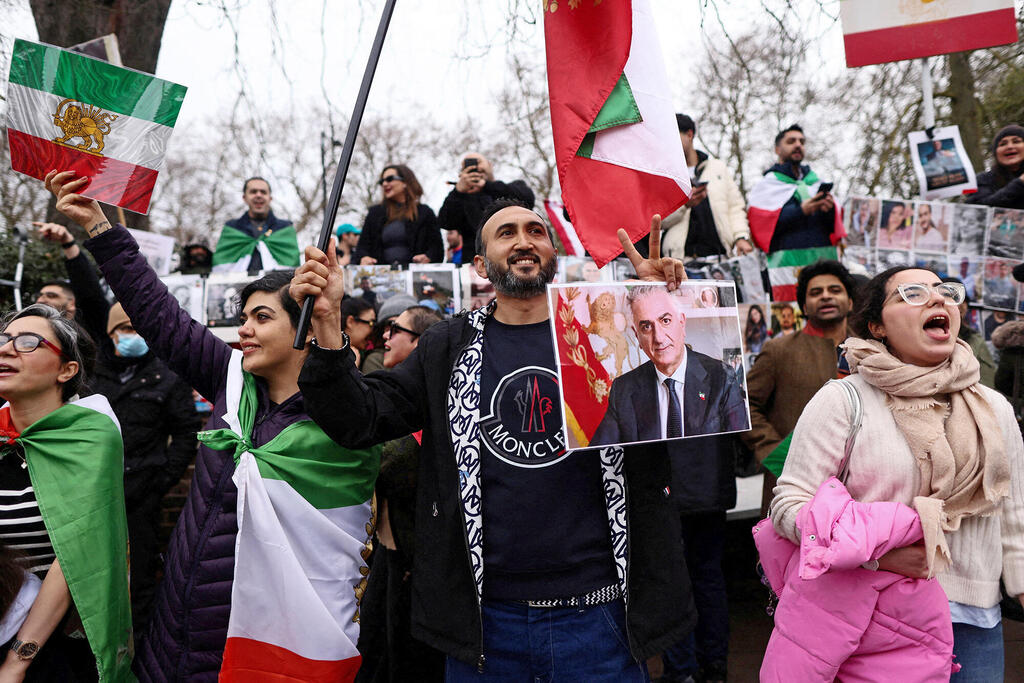
Rally in support of Reza Pahlavi, son of the last Shah of Iran, in London 1.3.26
(Reuters/Jack Taylor)
Threats to Hormuz and Bab al-Mandab
The economic drama rivals the political one.
If earlier assessments suggested the Strait of Hormuz would remain open, the assassination appears to have shifted the calculus. Iranian officials declared navigation through the strait prohibited. Reports indicated at least two tankers, one flying the flag of Palau and another of the Marshall Islands, were attacked after allegedly violating the “ban.”
The commercial response was immediate. Roughly 150 tankers carrying oil and liquefied natural gas reportedly anchored near Egypt, while companies froze traffic pending clarity. Major shipping firms, including Hapag-Lloyd, suspended transit through Egyptian routes until further notice.
Markets now fear that oil could rise toward $80 per barrel, with analysts warning of $100 if disruption persists or production facilities are targeted. Even labeling a route “dangerous” imposes costs, through delays, war-risk insurance and rerouting, feeding directly into energy prices, transport costs and ultimately consumer inflation.
According to the International Energy Agency, around 20 million barrels per day, roughly 20% of global oil consumption, passed through Hormuz in 2024, along with about 20% of global LNG supply, largely from Qatar.
Asia stands on the front line. Approximately 84% of crude and condensate and 83% of LNG that moved through Hormuz flowed to Asian markets in 2024, with China, India, Japan and South Korea accounting for roughly 69% of the total.
The United States is less directly exposed, importing about 500,000 barrels per day from the Gulf via Hormuz in 2024, roughly 7% of its crude imports. But oil is globally priced; a spike would transmit inflationary pressure worldwide, an unwelcome development in a midterm election year.
Pipeline bypasses exist but are limited. Saudi and Emirati pipelines provide roughly 2.6 million barrels per day of alternative capacity, modest compared with the 20 million barrels transiting Hormuz daily. A prolonged closure could remove 8-10 million barrels per day from global supply.
Qatar would be especially vulnerable. Without pipeline alternatives, it could lose an estimated $100-200 million per day in export revenue.
Meanwhile, the Red Sea has reemerged as a flashpoint. Reports indicate Iran may have instructed Houthi forces to escalate activity in Bab al-Mandab. If Hormuz is the oil faucet, Bab al-Mandab is the logistical choke point feeding Suez.
During earlier Red Sea disruptions, oil flows through Bab al-Mandab fell to roughly 4 million barrels per day in early 2024, down from 8.7 million in 2023. Traffic shifted around the Cape of Good Hope, lengthening voyages and increasing costs.
The combined threat to both straits raises not only the price of oil, but shipping costs, vessel availability and insurance premiums, all classic inflation channels.



