










Opinion
What happens to Google and Amazon when AI agents become the customers?
"The next phase of the internet could reward companies that control infrastructure, supply and attention," writes CTech Editor-in-Chief Elihay Vidal, "all while putting pressure on businesses built around intermediation."
2027 could be a defining year for the internet giants. For two decades, companies such as Amazon, Booking, Shopify, Spotify, Airbnb and Google have built much of their power around one thing: controlling the point of interaction between the user and the product. Now that point of interaction is changing.
If AI agents become the internet's new users, they could search, compare prices, book flights, purchase products and manage services on behalf of humans. In that world, controlling the interface may no longer mean controlling the channel.
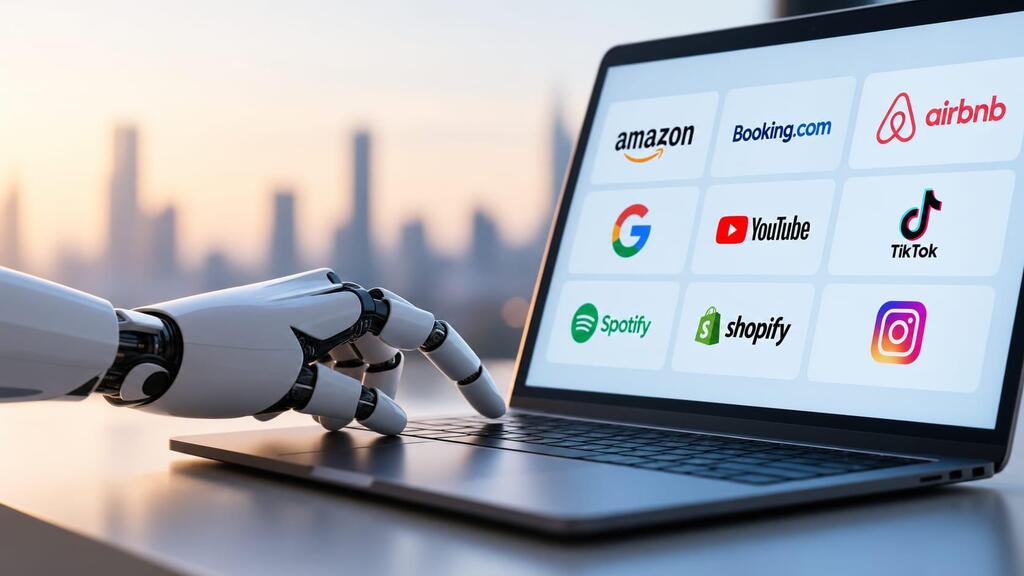
For the biggest internet companies, the outcome could fall into three broad categories: those that may gain strength because they provide infrastructure agents need; those that may remain powerful because they control assets that are difficult to replicate; and those whose business models are more exposed to agents bypassing the point of interaction on which their businesses were built.
The shift to an agent-driven internet does not necessarily spell the end of the major aggregators. In some cases, it could turn them into infrastructure providers.
Amazon is perhaps the clearest example. Even if an AI agent is the one choosing a product for a consumer, someone still needs to hold the inventory, operate the warehouses, handle logistics and deliver the order. Amazon's advantage is not simply the website where the search takes place, but the infrastructure that makes the transaction possible.
The same principle could apply in other sectors. Companies that control unique supply, physical infrastructure, hard-to-replicate data or the ability to execute transactions at scale could become critical backend infrastructure for the agentic internet. In that scenario, the agent is not necessarily the aggregator's enemy. It becomes a new customer.
A second group includes companies whose power comes from assets that are not entirely dependent on the user interface. Platforms such as Instagram, Facebook, TikTok and YouTube control an asset that is difficult to hand over to an agent: human attention.
Even if an agent manages a user's purchases, people are still likely to consume content, watch video and spend time on these platforms. That means the shift to agents does not necessarily mark the end of the advertising era. If automation saves people time on everyday tasks, some of that time could even flow back into content consumption.
Companies such as Amazon could also fall into this category because they control both the relationship with consumers and the physical infrastructure behind it. For them, the question is less whether agents will reach them and more what role they will play when they do. The greater risk may lie with companies whose core value comes from intermediation.
Google is the clearest example. For years, it has served as a gateway to information, commerce and services on the internet, building a vast advertising business around search. But if users can ask an AI agent to find a lawyer, hotel or product and receive the answer directly, part of the process on which Google has historically captured value could shift to another layer.
Travel companies such as Expedia, Booking and Airbnb face a similar question. Today, a consumer visits a platform, searches, compares options and books. Tomorrow, an agent could potentially handle that entire process itself.
But there is an alternative scenario. These companies could become the suppliers that agents turn to. In that case, they do not disappear, but the relationship with the customer moves into someone else's hands. That distinction may ultimately be more important than whether users continue to visit the websites themselves.
That is why the discussion around 2027 should not focus simply on which companies will gain or lose traffic. The more important business question is who will hold the power when the agent becomes the new gatekeeper.
Companies with physical infrastructure, unique supply, hard-to-replicate information or direct access to human attention may find themselves in a very different position from companies whose value is based primarily on being the gateway through which users pass.
The boundaries between these groups are not fixed, either. A company can be vulnerable to disruption at the interface while simultaneously becoming more important as infrastructure behind the scenes. Another can retain a massive audience while losing some control over the purchasing process.
This could create a new division in the internet economy. The companies that once competed to own the customer relationship may instead compete to become the systems that agents rely on to fulfill the customer's request.
That shift is already visible in the emerging infrastructure around agents. New companies are building tools for agents to search the web, interact with applications, retain context and execute tasks, suggesting that a new layer of infrastructure is developing between AI models and the businesses they interact with.
Ultimately, 2027 could mark the beginning of a shift from a model in which the user comes to the platform to one in which the agent comes to the platforms. In that world, the central question will no longer be who owns the most popular website or app. It will be who controls the assets that agents cannot bypass, and who discovers that the value once captured at the point of interaction with the user has moved somewhere else.



