










Iran has survived sanctions before. This time, Washington wants to close the escape routes
Tehran has spent decades building a parallel system of brokers, shadow oil networks, barter and alternative currencies. The new US strategy is aimed at making those workarounds increasingly expensive.
US President Donald Trump’s announcement last week of a dramatic escalation in the economic war against Iran was met in Tehran with two very different reactions. Publicly, the regime insists that the new measures will fail, as previous sanctions have. Inside the country, however, a far more sober discussion is underway: how long will Iran’s foreign currency reserves last, how can export revenues be repatriated, what happens if Dubai closes its doors to Iranian traders, and can the government continue subsidizing fuel at its current enormous levels?
This is where the latest American move could differ from previous rounds of sanctions. Iran has spent years building a system that allows it to operate under economic pressure, including by selling oil through brokers and a shadow fleet, using shell companies, money changers and accounts in other countries, conducting barter transactions, and relying on the Chinese yuan and local currencies. Washington’s challenge is to disrupt that circumvention system and, above all, convince banks, traders and governments that continuing to do business with Tehran carries a price.
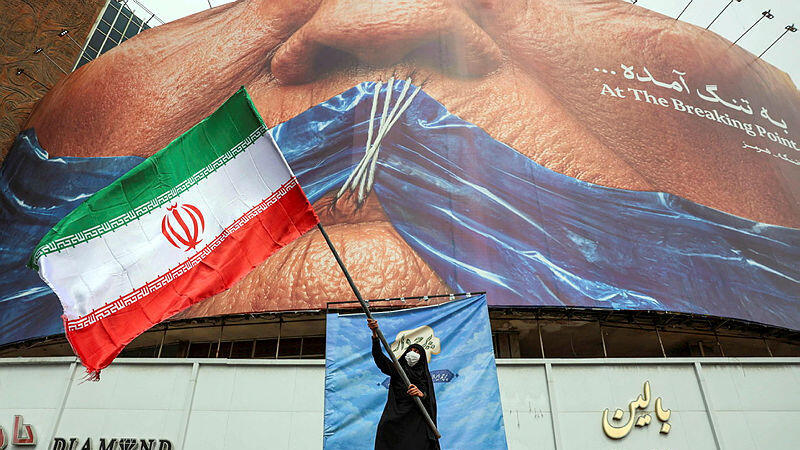
Iran is already preparing for that possibility.
The economic newspaper Donya-e-Eqtesad devoted an analysis over the weekend to what it described as a plan to strengthen the country’s foreign exchange reserves. According to data presented by the newspaper, in the first four months of the Iranian year 1405, which began in March 2026, about $7.5 billion in oil revenues was transferred to the Central Bank, 1.5 times the amount transferred during the same period a year earlier. Previously, according to Central Bank sources, about $4.5 billion had been added to foreign exchange reserves.
The newspaper estimated that these resources, together with additional foreign currency revenues, could allow Iran to finance basic needs and essential imports roughly until January 2027.
But that is not the same as solving the problem. The discussion in Iran is increasingly shifting toward how those reserves should be allocated, when foreign currency should be injected into the economy and how much should be held back in case of another shock. The Central Bank is simultaneously trying to narrow the gaps between exchange rates and force exporters to return their foreign currency earnings to the official system more quickly.
In other words, Iran is gradually shifting from crisis management to inventory management under siege.
Food, medicine and essential raw materials are being prioritized, while less essential industries and imports are likely to be pushed down the list. During the war, the Central Bank significantly reduced foreign currency allocations to the Ministry of Industry, while prioritizing food, medicine and medical equipment.
The regime will also try to diversify its trade and financial routes as quickly as possible. Iraq is becoming more important both as a source of foreign currency and as a market for Iranian exports. Local-currency transactions, barter deals and land routes to the north and east could reduce some of Iran’s dependence on the dollar.
Even before Trump’s announcement, Iranian officials had been calling for a greater share of trade to be shifted toward northern and eastern corridors in order to reduce dependence on a limited number of foreign trade ports.
But every alternative comes with a cost.
Longer routes make transportation more expensive. Money changers and brokers charge commissions. Barter reduces flexibility. And the yuan is not a substitute for the dollar. If the United States succeeds in extending the threat of sanctions to the foreign entities facilitating these transactions, the cost of every dollar that reaches Iran will rise.
The potential damage to the UAE channel is particularly troubling for Iranian economic policymakers. The Emirates announced a cutoff following continued Iranian attacks on its assets. Donya-e-Eqtesad estimated that the UAE is connected to roughly a third of Iranian imports and that Dubai has served for years as a major hub for the movement of goods, money and foreign-exchange services into Iran.
From Tehran’s perspective, alternative routes can be found. What is much harder to replace quickly is the commercial and financial infrastructure that has been built over decades.
The most difficult trap, however, lies inside Iran itself.
President Masoud Pezeshkian illustrated the dilemma on Friday when he asked why the government needs to buy gasoline at 130,000 tomans per liter, about 69 cents, and sell it to the public for 1,500 tomans, less than one cent. Pezeshkian linked the subsidy directly to the government’s lack of resources to finance food aid, payments to farmers, insurance, workers and pensioners.
The obvious economic solution, reducing fuel subsidies, is also among the most politically dangerous options.
Higher fuel prices quickly feed into transportation, food and other consumer prices in a country already suffering from severe inflation. That creates a direct conflict between the government’s need to stabilize its finances and the public’s ability to absorb another increase in the cost of living.
Iranian Parliament Speaker Mohammad Bagher Ghalibaf urged caution over price shocks during wartime in remarks to businessmen in Baghdad on Friday.
“No matter how much military power we have,” he said, “if people are hungry and there is no money circulation, economic growth and national production, we will not survive.”
Can economic war bring down the regime?
Economic pressure alone does not guarantee political collapse. For four decades, Iran has demonstrated its ability to pass a large part of the cost of sanctions on to its citizens, reduce consumption and prioritize defense and security spending over other government needs.
The danger to the regime rises if several crises converge at once: a rapid loss of foreign currency earnings, growing difficulty financing basic imports, erosion of subsidies and wages, another spike in prices, widespread protests and, at the same time, a struggle within the political elite over how to end the crisis.
The first signs of that tension are already visible.
The Foreign Ministry insists that sanctions will fail. Ghalibaf warns that military power is insufficient without a functioning economy. The Central Bank is accumulating foreign currency and reducing allocations. And Pezeshkian has called for an end to the war while Iran is still, in his words, “strong and honorable.”
The real test of Washington’s strategy, therefore, is not simply whether it can impose more sanctions. It is whether it can systematically reduce Iran’s economic escape routes.
If it can, every decision Tehran makes will become more expensive, whether the cost is paid from the government’s reserves, by citizens through higher prices, or through the country’s political stability.



