










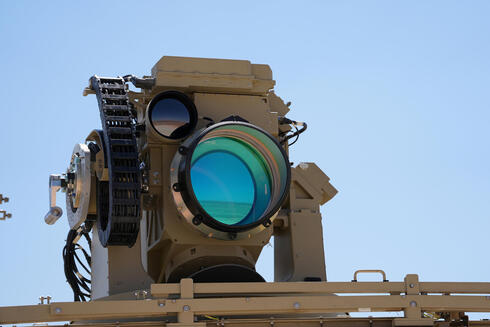
Iron Dome and Iron Beam developer Rafael's IPO may be years away as IAI moves toward the market
Despite repeated calls from Chairman Yuval Steinitz, Rafael has no government decision to launch an IPO and is unlikely to begin preparations before the next government is formed.
Rafael Chairman Yuval Steinitz has been pushing the government to move forward with an IPO of Israel's second-largest defense company. But while Israel Aerospace Industries is already deep into preparations for a stock-market listing, Rafael's own offering does not appear likely to happen anytime soon.
The gap between the two companies is becoming increasingly significant. IAI is the most advanced of Israel's three government-owned defense companies in preparations for an IPO, following a government decision in late 2020. Rafael and Tomer, the manufacturer of missile and rocket propulsion systems, have expressed interest in going public, but the government has yet to make a decision on either company.
Even if a decision is eventually made to advance Rafael's IPO, preparations are expected to take time. Given the upcoming elections, the process is unlikely to move forward before a new government is formed, if the next government decides to pursue it at all.
That leaves Rafael in an increasingly uncomfortable position. IAI could become a publicly traded company while Rafael remains wholly state-owned, potentially giving its rival access to financial and compensation tools that Rafael does not have.
Steinitz has warned government ministries about precisely this scenario. In recent weeks, he has said on several occasions that an IAI IPO without a similar move for Rafael would weaken his company and put it at a competitive disadvantage.
One of his main concerns is employees. Rafael and IAI compete for many of the same engineers, scientists and other highly skilled workers. Steinitz has warned that a public IAI could offer employees better compensation and create a genuine "brain drain" from Rafael to the company being floated.
The concern comes at a particularly important moment for Israel's defense industry. Years of war and heightened geopolitical tensions have generated exceptionally strong international demand for weapons, leaving the country's major defense contractors under pressure to expand production, invest and compete for contracts around the world.
Access to the capital markets could therefore become more than a question of financial convenience. For a company such as Rafael, an IPO could provide additional capital for expansion while also giving it greater flexibility in competing for and retaining talent.
But for now, Rafael appears to have little ability to influence the timing.
IAI's IPO preparations are already advanced enough that regulators are dealing with a different problem: how to allow the company to become publicly traded while protecting classified information.
IAI has operated as a reporting corporation since 2007, when it issued bonds to the public. It was subsequently granted an exemption from disclosing information whose publication could harm state security. The arrangement allowed IAI to raise money in the capital market while keeping significant portions of its classified activities confidential.
The planned transition from bonds to shares has forced regulators to revisit the arrangement. A shareholder is exposed directly to a company's performance, profitability and risks in a way that differs from a bondholder, raising questions about whether the existing confidentiality mechanism can continue unchanged after an IPO.
The Israel Securities Authority's position, according to sources familiar with the matter, is based on a broader principle: Government companies that enter the capital market must comply with the same disclosure and corporate governance requirements as other public companies, even when they are controlled by the state and operate partly under national-security restrictions.
That principle could become important if Rafael eventually moves toward an IPO. It would have to confront the same fundamental tension between the need to protect classified information and the obligation to provide investors with material information.



