










“This painting is not merely a symbol of loss”: The long journey to recover a Nazi-looted family heirloom
After an eight-year search, Paul Laporte helped recover a 19th-century painting stolen from his great-grandmother, Sofie Heilbronner, as the Nazis stripped her family of its home and possessions. Its return offers a rare measure of restitution and reconnects a family with a past that had nearly been lost.
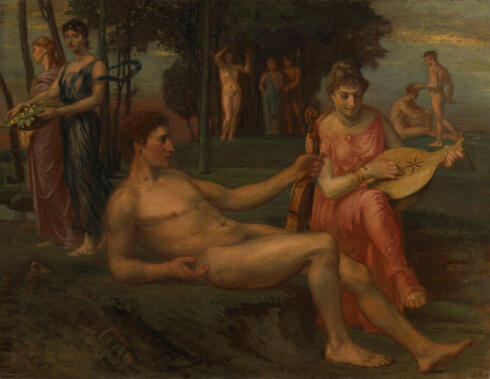
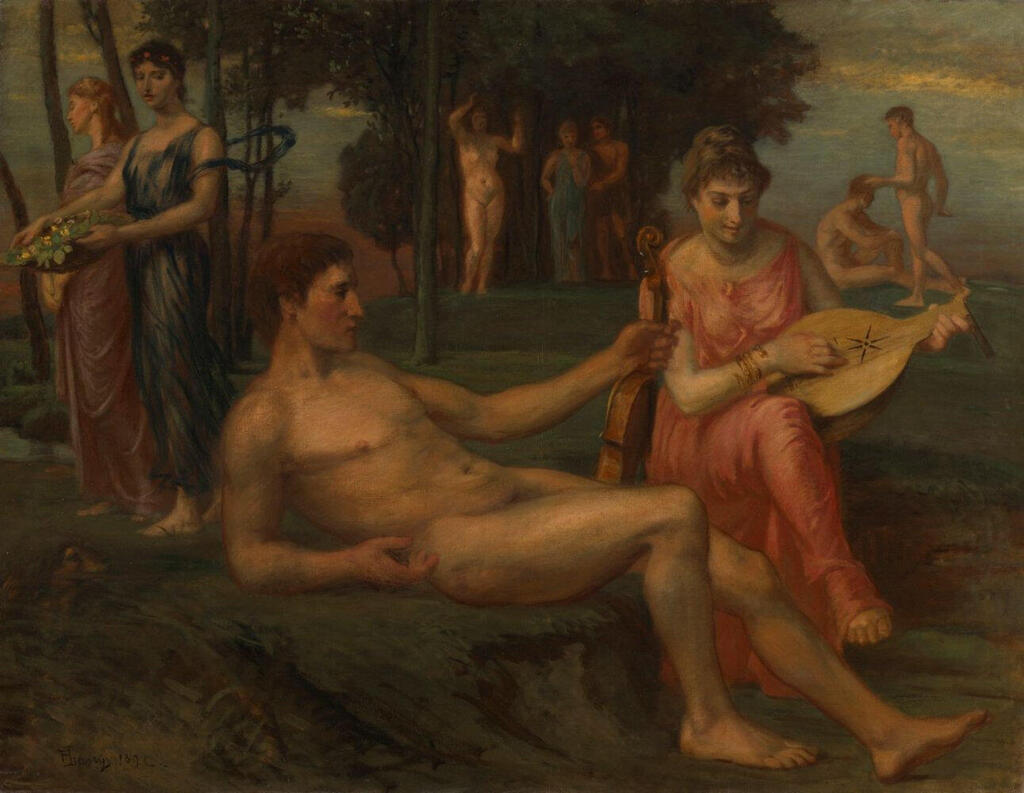
Until a month ago, hardly anyone in the world had heard of The Music (Arcadian Scene). The 19th-century painting depicts a Greek banquet and had languished in storage in Munich, Germany, for decades. Its creator, Albert Lang, was not particularly well-known, and the painting’s estimated monetary value is modest, between $2,000 and $10,000. Yet Paul Laporte, a Jewish-American retiree, spent eight years and thousands of dollars trying to recover it.
The story behind The Music has little to do with art or money. Rather, it is about historical justice: a belated act of restitution for a family driven from its homeland by the Nazis, who also plundered its possessions. It also represents a rare opportunity for the son of a Holocaust survivor to reconnect with his late father and learn about the family he never had the chance to know.
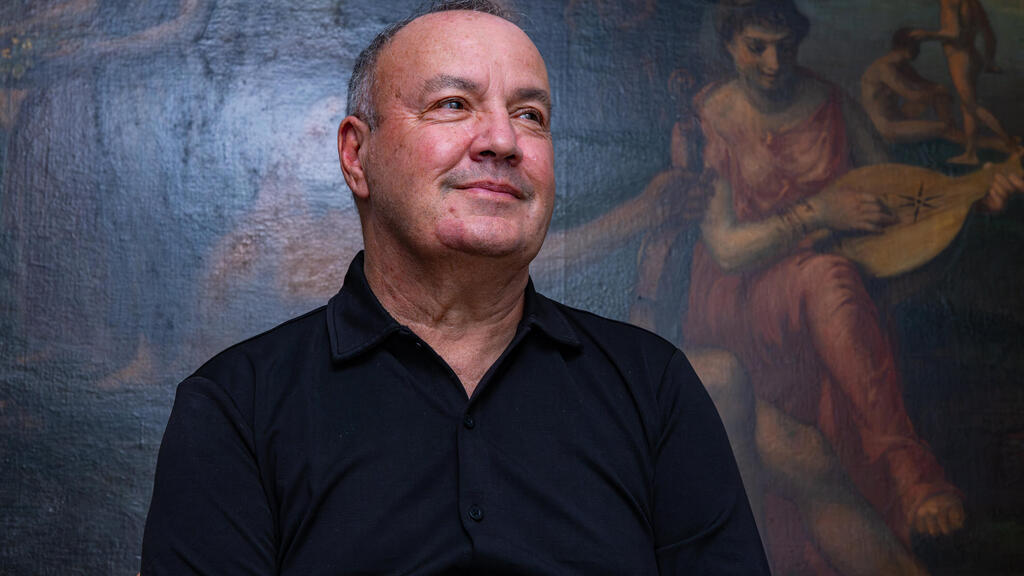
“This painting is not merely a symbol of loss,” says 71-year-old Laporte in an interview with Calcalist’s weekend supplement. “It is a testament to an entire life that existed before the events that changed everything.”
From Munich to Puerto Rico
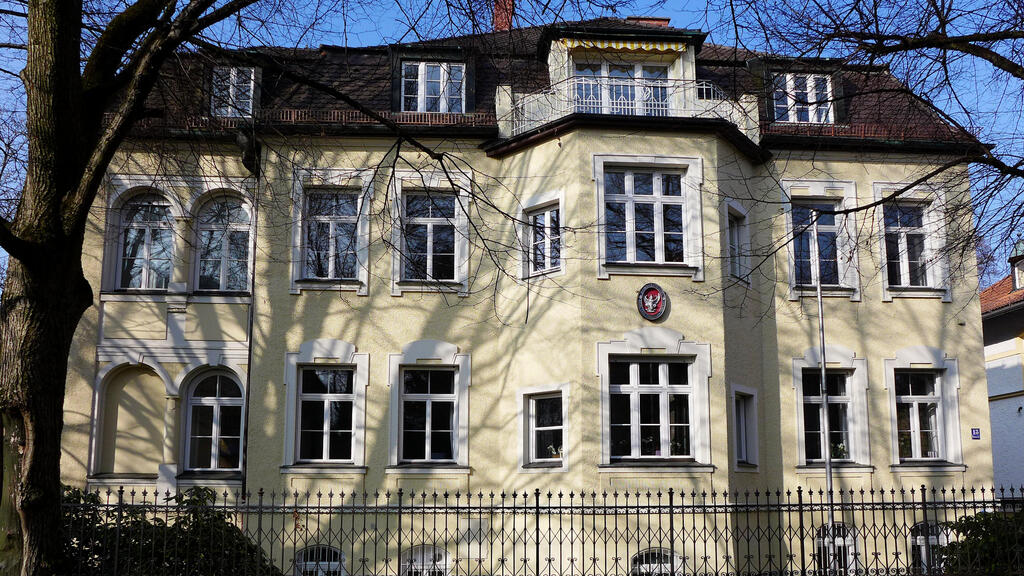
Sofie and Hugo Heilbronner were wealthy Jewish bankers who owned A.M. & J. Heilbronner and lived in Munich in the early 20th century. They enjoyed the finer things in life. At their sprawling estate, they frequently hosted large parties. Once the festivities ended, the couple would retreat to their second home to rest, leaving their staff to clean up. Their extensive possessions included two limousines and an art collection that featured The Music.
However, the Heilbronner family’s lifestyle did not last. Hugo died in 1929. Four years later, the Nazis rose to power and, within a few years, seized the family’s bank. Realizing she could no longer remain in Germany, Sofie fled in 1938, just weeks before Kristallnacht, also known as the “Night of Broken Glass” or the November Pogroms. She took two of her three sons with her and eventually settled in the United States. Her youngest son, Paul Heilbronner, had escaped Germany three years earlier. The Nazis confiscated and sold off most of the family’s assets, including Sofie’s art collection.
Not everyone in the family managed to escape in time. Paul left behind his only son, Johannes, who was born in 1928, and his ex-wife, Johanna Sauer, the daughter of a Lutheran pastor. Johannes and his mother continued to live at Sofie’s estate, where his grandmother also played an active role in his upbringing. But when Johannes was 11, a year after his grandmother had fled Germany, he lost his mother to breast cancer and went to live with his grandfather, a pastor.
Johannes suffered because of his origins. Under Jewish law, he was not considered Jewish. Under the racial laws of Nazi Germany, however, his background was sufficient grounds for his expulsion from school. Nevertheless, at the age of 16, he received a conscription order for the Nazi army. It was 1944, and many Jews remaining in occupied Europe had already been murdered, deported to camps or forced into hiding. Despite the danger, Johannes responded to the order with the almost unfathomable words: “I cannot serve in the German army, because I am a Jew.”
Why tell the Nazis you are Jewish?
“By 1944, Germany had already suffered heavy losses on the Eastern Front,” says Laporte, Johannes’s son. “He may have calculated that the risk of declaring himself Jewish was lower than the risk of joining the army.”
Following his admission, Johannes was sent to two labor camps, where he remained until the end of the war.
“It pains me greatly to recount this, because my father wept when he spoke of it,” says Laporte. “But upon returning home, he discovered that his house had been bombed and everyone inside had been killed, presumably including his grandfather, the pastor.”
With the assistance of a Jewish-American organization, Johannes sailed to the United States. There, he briefly reconnected with his father, Paul, who had remarried and become a renowned artist and art historian. Paul taught at Olivet College in Michigan and famously sparred with Albert Einstein in a series of public exchanges about the relationship between Cubism and the theory of relativity.
Johannes worked as a model for a life-drawing class at the same college, where he met Dorothy Weber, a young Jewish woman from Chicago. The two married in 1948, had two children and moved to Puerto Rico. Sadly, Johannes’s life there was also cut short. He died of cancer at the age of just 50.
“During my father’s final days, I flew to be with him from the United States and recorded him speaking for about an hour. I even managed to rig up a video recording setup, something that didn't really exist back then,” Laporte recounts. “It’s very difficult for me to revisit that recording, because he was extremely ill, and the chemotherapy seems to have affected him mentally. In it, he claims he isn't Jewish—arguing that he was born to a Lutheran mother, which saddens me. While I don't lead a Jewish lifestyle, I do consider myself Jewish by birth.”
Discoveries in boarding house records
As the son of a Holocaust survivor, Laporte knew little about his father’s past.
“I only knew the broad outlines of his experience,” he recounts. “I knew he had been held in two forced-labor camps, but not much else.”
Johannes had also been estranged from his father for years. Consequently, “I had no contact with my grandfather until after my father had passed away,” Laporte explains. This made piecing together the missing parts of the family’s history even more difficult.
Fifteen years ago, Laporte began exploring genealogical websites in the hope of uncovering what had happened to his family.
“I worked in graphic design, and later in my career, I found myself with some extra time,” he says. “Every now and then, I would type the names of various family members into an online search to see what might turn up.”
One of his first and most startling discoveries was that Sofie had lived in Los Angeles until 1965, by which time Laporte was already 10 years old. She had requested to be buried alongside her husband in Munich, and Laporte managed to find a photograph of her headstone.
“At first, I assumed the letters on the headstone had fallen off and been reattached in the wrong order, that the year of death was actually 1956,” he says. “But that wasn't the case.” Sofie was 89 years old when she died.
Laporte discovered the first photograph of Sofie on the blog of Richard Brook, an American genealogist from San Diego. In the 1930s, Brook’s relatives ran a guesthouse in Fiesole, Italy, that hosted dozens of Jews from Germany and other countries, including Sofie and Paul. Brook traced the fates of these guests by examining registration ledgers and municipal forms they had completed. In the process, he uncovered Sofie’s American naturalization document, which included her photograph.
Laporte and his sister, Melanie, discovered that all three of the Heilbronner sons had settled in the United States, and they established contact with their descendants. They learned, for example, that the eldest son, Erwin, had attempted to establish a branch of the family bank in Jerusalem. They also discovered that Sofie had remained a presence in the lives of at least some of her grandchildren, who called her “Moi.”
Then Laporte discovered something else: a painting.
“At a certain point, computer systems became capable of deciphering handwriting,” he recounts. “This made information accessible that previously couldn't be searched. So, one time when I typed in 'Sofie Heilbronner,' three images of catalog cards suddenly appeared on the screen, from a website documenting the history of the Heinemann Gallery, which operated in Munich until World War II. On such cards, a gallery professional would record the title of the artwork, the artist's name, the year it was painted, and the name, address, and phone number of the person who brought it in. And that is exactly what I found: a record of three artworks that had belonged to Sofie.”
“I called my wife and my sister, feeling incredibly excited,” he says. “We had already visited Sofie’s home in Munich, so we were aware of the family members and their wealth, and we had other information as well. But this was different.” In this case, “it involved an object that could be seen, touched, and perhaps even recovered.”
4 View gallery
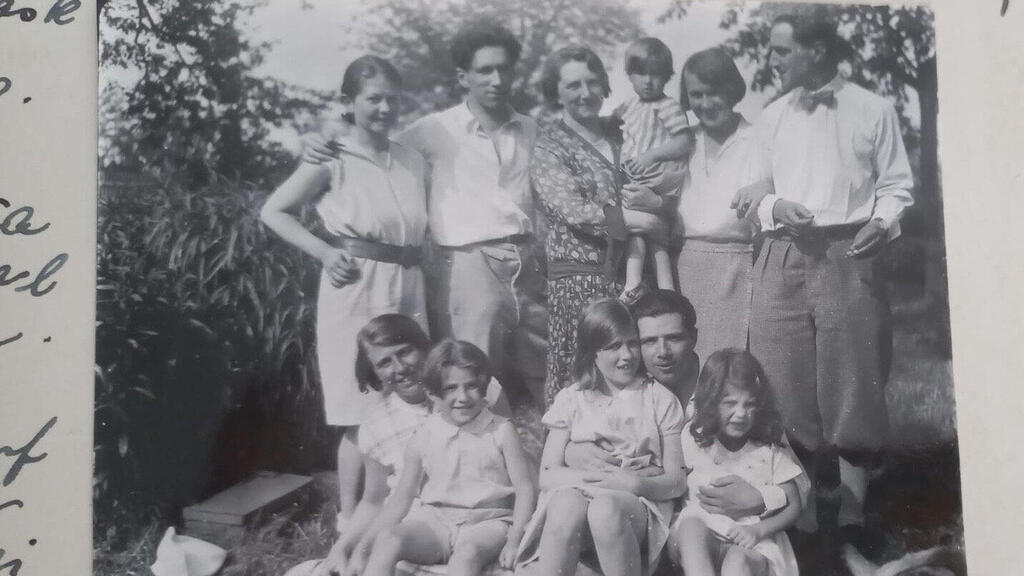
From right: Paul, Johanna, and Johannes in the arms of grandmother Sofie, in Munich, Germany, 1930.
(Courtesy of Paul Laporte)
The problem was that Laporte did not know what had become of the artworks after the gallery closed. Every so often, he searched for their names on Google, thinking, “Perhaps one day, as if by magic, they will turn up,” he says.
As luck would have it, this happened less than a year later. One day, The Music appeared in the German Lost Art database, which documents cultural assets looted by the Nazis or suspected of having such an origin. The painting, which Sofie had kept in her Munich home, was found in the Bavarian State Painting Collections.
“It wasn't what I had imagined.”
Laporte did not know whom to contact to request that a foreign state return a painting looted 80 years earlier. That changed when he attended a lecture by journalist and author Dina Gold, who had succeeded in recovering a commercial property in East Berlin for her family, an experience she documented in her book Stolen Legacy. Laporte briefly told her about Sofie and the painting, and she directed him to the New York State Holocaust Claims Processing Office (HCPO).
The HCPO provides free assistance to survivors and their heirs in locating and recovering bank accounts, insurance payouts, artworks and other assets seized during the Nazi era. There, Laporte met Rebecca Friedman, an attorney and art historian specializing in restitution claims.
On the surface, the case appeared exceptionally straightforward. Yet in the world of art restitution, even a simple, well-documented claim can drag on for years.
Friedman and her team had to prove that Sofie owned the painting, that it had been taken from her as a result of Nazi persecution, and that the Bavarian State Painting Collections had not acquired it through a legitimate transaction. Evidence of ownership emerged from documents preserved in the archives of the German galleries Heinemann and Hugo Helbing, which linked Heilbronner to the artwork. These records also revealed that, after the war, the painting had moved from a warehouse in Munich to the Bavarian State Administration for Property and Compensation, an agency notorious for the obstacles it placed in the path of survivors trying to reclaim their property. The painting subsequently entered the Bavarian State Painting Collections.
However, establishing ownership was only half the task. Since Sofie and her three sons had all died, it was necessary to identify all her living heirs, including relatives Laporte knew of only through the internet and had never met in person. The family tree had to be reconstructed, and each individual was required to provide a birth certificate, inheritance documents or other evidence tracing their lineage through their parents and grandparents back to Sofie.
The Bavarian authorities acknowledged that the painting did not belong to them but to Heilbronner’s heirs. All that remained was for Laporte to secure the consent of all the heirs to have the painting transferred specifically to him, a step that, he notes, “was not particularly difficult to resolve.”
While the painting is not worth a fortune, it is large, heavy and delicate. Shipping it from Munich to Washington cost thousands of dollars. Ultimately, the family agreed that Laporte would take possession of it and safeguard it on their behalf.
On July 26, 2026, eight years after he first encountered the painting, a large wooden crate arrived at Laporte’s home. Inside was a 134-year-old oil painting on canvas, measuring 1.5 meters in width and weighing 21 kilograms.
“It wasn't exactly what I had imagined,” Laporte admits with a smile. “Given all the memories bound up in it, I expected something with a more serious and dignified character. Instead, what met my eyes was an imaginative scene from ancient Greece, filled with figures in a classical style—including quite a few nudes, which brought a smile to my face.” Yet, he adds, “when I finally hung it up in my home, it stirred a deep emotional response in me.”
Laporte hung the painting in a room where it could be seen from the kitchen. During the first few days, he made a point of walking past it just to say hello. Sometimes, he would say, “Hello, Sofie.”
On September 22, a ceremony was held at the German Embassy in Washington to mark the painting’s return to its rightful heirs. The painting stood in the room, wrapped in a wide satin ribbon that read: “Welcome Home.”
After so many years and so many unanswered questions, Laporte felt a sense of closure. One of the few remaining relics of his family’s golden age, from the days before the great catastrophe, had finally been restored to its rightful place. Moreover, the family’s story had been shared with the world.
“This is a very significant event in my life, ranking alongside my marriage and the birth of my children,” he says. “A painting is discovered that was stolen by the Nazis, and 80 years later, it returns to the family. It is a truly momentous thing.”



