










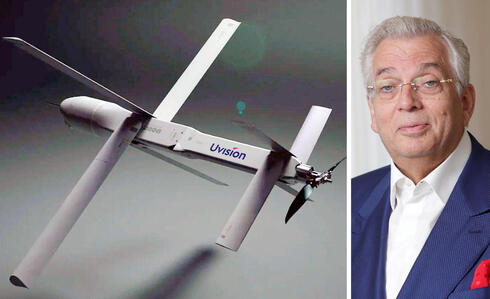
UVision weighs foreign investor as $4 billion IPO target comes under pressure
The company owned by Aaron Frenkel has postponed its planned offering to November after institutional investors valued it well below its target. A private investment similar to Fibrotex’s could delay the IPO.
The decline in the market value of publicly traded Israeli defense companies could delay the planned IPO of UVision, the loitering-munition maker owned by Aaron Frenkel. The offering, originally scheduled for August, has already been postponed to November. JPMorgan is expected to lead the IPO.
Frenkel and the company are reluctant to accept a valuation below $3.5 billion to $4 billion or to compromise on the listing venue. Industry sources say the Tel Aviv Stock Exchange could be a suitable venue for an offering of this kind, potentially attracting global investors already active in Israeli companies. Frenkel, however, is currently insisting on a U.S. listing.
UVision aims to raise $500 million to $600 million in new capital. Part of the proceeds would be used to repay shareholder loans Frenkel has provided over the years, while most of the money would go toward developing new products and expanding production capacity. The company’s flagship product is the Hero-120 loitering munition, often referred to as a suicide drone, which has gained traction in conflicts around the world.
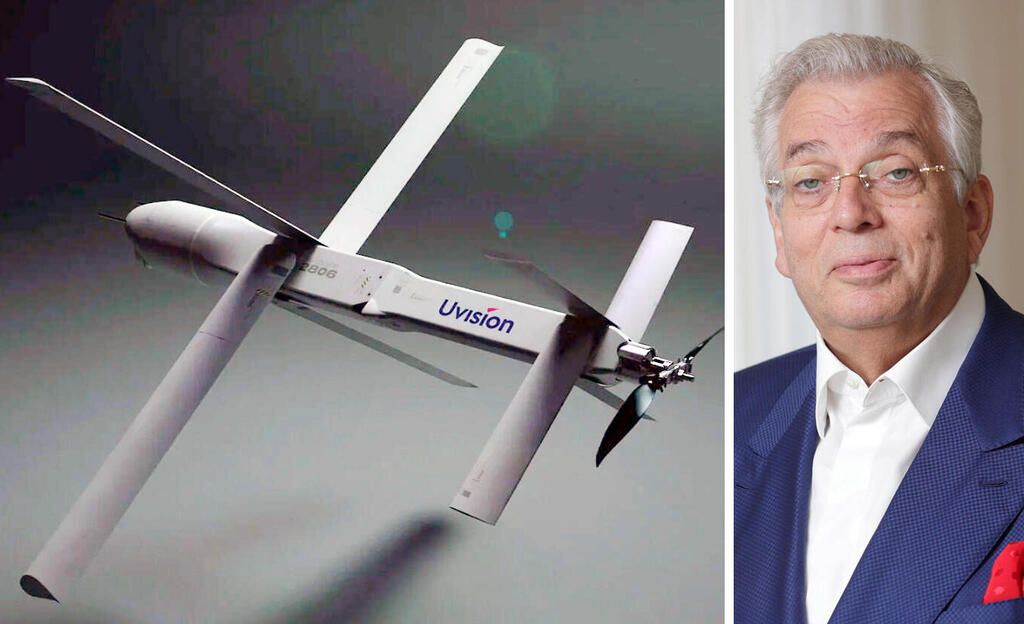
UVision is regarded as having a strong product, but deteriorating market conditions could eventually prompt Frenkel to reconsider a Tel Aviv listing if demand in the United States falls short of expectations.
Frenkel has made at least two attempts to raise capital from institutional investors ahead of the planned IPO. Investors were willing to value the company at only $2.8 billion to $2.9 billion, even before the recent decline in defense stocks. Another option under consideration is to bring in a foreign financial investor, as Fibrotex did, and postpone the IPO.
UVision’s new CFO, Eyal Rubin, is leading the review of the available options. An IPO would be a challenging undertaking, with the company’s annual revenue of $250 million potentially complicating efforts to secure the desired valuation. UVision said that “all options are being considered.”
One of the defense companies hit by the recent market downturn is NextVision, whose shares fell 25% last week, reducing its market capitalization to approximately NIS 18 billion, less than half its peak valuation.
The decline followed an unusual decision by U.S. investment fund Fidelity to sell its stake in the company, which it had acquired only a year to a year and a half earlier. Fidelity hired Goldman Sachs to handle the sale, involving shares worth approximately NIS 1.3 billion.
According to capital-market estimates, particularly among foreign institutional investors, Goldman Sachs committed to buying the shares itself with the intention of selling them on. The bank reportedly struggled to complete the sale amid weak demand from Israeli investors.
To limit the risk of sharp price swings, market estimates suggest that Goldman sold most of the shares during the trading sessions following Calcalist’s report on Fidelity’s move. Those sessions saw daily trading volumes worth hundreds of millions of shekels. The bank is believed to have gradually sold its remaining holdings afterward.
NextVision also recorded relatively heavy trading yesterday, with turnover reaching hundreds of millions of shekels. After opening weakly and continuing to decline, the stock recovered to trade around its previous closing price, prompting speculation that Goldman may have completed its sale. The company said there had been no adverse change in its business operations.
Frenkel acquired UVision in 2010 through his private company, Magnus. The company has operated in its current format since 2011.
For the past year and a half, UVision has been led by Ran Gozali, who was previously considered a candidate for the position of CEO at Rafael after nearly three decades at the defense company. During his tenure there, Gozali served as a senior executive vice president and member of the management team, overseeing areas including research and development, engineering operations, and global business activities across land, naval and multidomain warfare.
Gozali succeeded Avi Mizrahi, who served as UVision’s CEO for five years.
The company’s chairman is Ilan Gifman, a long-time associate of Frenkel who has also represented him on the boards of Gav-Yam and Alony Hetz. The board also includes Yedidya Yaari, a former commander of the Israeli Navy and former CEO of Rafael, as well as Yair Ramati and Yair Dubester.



