










Trump's Iran deal prioritizes economics over strategy
The agreement could lower oil prices today while creating larger geopolitical risks tomorrow.
The agreement signed between Washington and Tehran contains a glaring asymmetry that makes it appear implausible, if not illusory. Under its current wording, nearly all of Iran’s demands are expected to be fulfilled immediately, and Tehran receives concessions it could hardly have expected to secure. In contrast, everything Iran is supposedly required to give in return is deferred to the future and subject to vague negotiations.
The formula is straightforward: sanctions relief, the release of frozen assets, immediate authorization for oil exports, and a commitment to a $300 billion reconstruction program, all delivered now. The Strait of Hormuz will be reopened, effectively restoring conditions that existed before the war. Iran also receives assurances regarding future discussions on its nuclear program, ballistic missile arsenal, regional activities involving Lebanon, and other issues. All of this is granted in exchange for a 60-day arrangement that can be extended.
1 View gallery
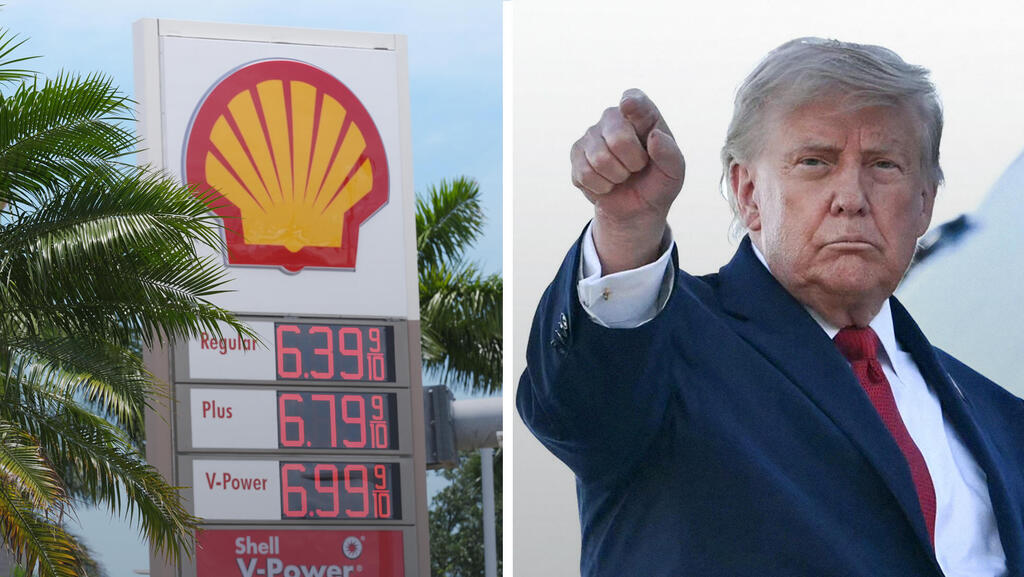
US President Donald Trump next to a gas station in Miami, Florida with a price per gallon over $6
(Marta Lavandier/AP, Mandel Ngan/AFP)
Put simply: open Hormuz, and we will give you what you want, and more. Anyone looking at the document can see an imbalance that is impossible to ignore. This is not the structure of an agreement between equals; it resembles the structure of a concession. What is particularly striking is that the side making the concessions is supposedly the one that emerged victorious from the conflict.
Economically, the agreement amounts to a major transfer of resources to a hostile regime. The proposed $300 billion reconstruction effort would benefit the same Islamic Republic that, over four decades and with the help of oil revenues, built a nuclear program, a formidable military apparatus, and an authoritarian system that has suppressed domestic dissent.
The money is not even separated from that reality. Every dollar that enters under the banner of civilian reconstruction potentially frees up resources that can be redirected toward the same institutions and power structures the regime has prioritized for years.
The complete lifting of sanctions, including secondary sanctions on third parties that conduct business with Tehran, goes far beyond temporary relief. It would reopen Iran to the global economy, transforming it from a largely isolated state into a legitimate financial and commercial actor.
And who will ultimately finance this process? The agreement refers to regional partners and mechanisms that will be defined in a future settlement. The message to taxpayers in the United States and the Gulf states is difficult to miss: they may end up helping to finance the rehabilitation of a long-standing adversary.
The economic logic becomes even more questionable when viewed through the prism of incentives. The same regime that threatened shipping through Hormuz, supported attacks via the Houthis in the Bab el-Mandeb Strait, financed regional militant groups, disrupted global trade, and contributed to energy-market instability is now being rewarded for reopening routes it helped close.
The larger prize is even more significant: Iran retains influence over one of the world's most important energy chokepoints. If global economic stability depends on an open Hormuz, Tehran understands that it continues to hold considerable leverage over international markets. This begins to resemble not the resolution of a crisis, but the payment of a premium to restore normality.
An Economic Irony
The agreement also raises broader geopolitical questions.
The United States deployed significant military assets, spent tens of billions of dollars, imposed a blockade, and exerted enormous pressure on Tehran. Yet the result appears to be an arrangement centered on restoring shipping and economic flows.
From the perspective of deterrence, critics argue that such an outcome could weaken the credibility of future American threats. If rival powers conclude that economic pressure can ultimately force Washington to settle for less ambitious outcomes, the long-term consequences may extend far beyond Iran.
President Donald Trump presents himself as a realist. Realism traditionally places great emphasis on deterrence, credibility, and the projection of power. Critics of the agreement argue that it weakens all three.
The irony becomes even sharper when viewed through the lens of U.S.-China competition. China remains the dominant buyer of Iranian oil, accounting for roughly 90% of Tehran’s exports. By facilitating a recovery in Iranian oil sales, the agreement does not weaken the Sino-Iranian relationship; rather, it may strengthen an economy that remains closely tied to Beijing.
Washington has repeatedly identified China as its primary strategic competitor. Yet the agreement could ultimately contribute to stabilizing and strengthening an important Chinese partner.
From this perspective, critics contend that the agreement runs counter not only to economic logic but also to the broader strategic framework that has guided Trump's foreign policy rhetoric. Rather than strengthening American leverage, they argue, it risks financing an adversary while eroding deterrence vis-à-vis both China and Russia.
What Really Pressured Trump?
This apparent contradiction raises a fundamental question: how could a rational actor sign an agreement that appears to run against its own economic, security, and strategic interests?
There are two possible explanations.
The first is that it represents a strategic error of historic proportions.
The second, and perhaps the more plausible one, is that the document was never intended as a comprehensive settlement, but rather as a temporary mechanism designed to buy time and stabilize both the global and American economies.
If the agreement appears so economically and strategically imbalanced, perhaps it should not be viewed as a final arrangement at all.
Seen through that lens, the key question is not what Washington achieved with Tehran, but what domestic pressures influenced Trump's decision-making.
The answer may lie in two risks that economists and international institutions have repeatedly highlighted: weaker economic growth and rising inflation.
“We have to prevent an economic disaster,” Trump said at the G7 summit in France over the weekend, acknowledging his concern about being remembered not as a successful president but as another Herbert Hoover, the president associated with the deepening of the Great Depression.
From a domestic perspective, the timing matters. Inflation climbed to 4.2% in May, its highest level since April 2023, driven in part by higher energy prices. By reopening Hormuz and restoring oil flows, the agreement could help ease those pressures.
Trump also understands that lower inflation would create room for Federal Reserve Chair Kevin Warsh to reduce interest rates. So far, Warsh has disappointed the White House by keeping rates unchanged in his first policy decision. If inflation remains elevated, markets are already beginning to price in the possibility of another rate increase later this year.
With midterm elections approaching in November, the political implications are significant.
A Growing Concern for Israel
Viewed through a long-term strategic lens, the logic behind Washington's move becomes clearer.
Trump may have decided, at least temporarily, to replace a confrontation with Iran with a battle against inflation and slowing growth. Hormuz is open, oil is flowing, fuel prices are easing, and inflationary pressures may subside. A window could emerge for lower interest rates and a stronger economic backdrop heading into the midterms.
In effect, foreign policy becomes a tool of economic management.
From Israel's perspective, however, critics argue that the agreement creates serious risks. They contend that it leaves Iran with greater economic resources while key questions regarding its military and nuclear capabilities remain unresolved.
The broader lesson may be equally troubling. Israel could conclude that American strategic commitments are increasingly shaped by domestic political and economic considerations.
The agreement's 60-day timeline reinforces that concern. Article 3 explicitly allows the arrangement to be extended by mutual consent. As long as Iran continues to benefit from sanctions relief and renewed oil exports, it has little incentive to rush toward a permanent settlement. Extending the temporary arrangement may be more attractive than concluding a final agreement that imposes additional constraints.
Time, in that scenario, works in Tehran's favor.
Israel's hope is that the temporary arrangement ultimately produces a binding and verifiable nuclear agreement. If that happens, the current pause may prove to be a legitimate transitional phase.
If hostilities resume, the agreement will likely be remembered as a tactical effort to stabilize markets and buy time.
But if the final settlement closely resembles the current memorandum, critics argue that the implications would be profound. It would suggest that Washington prioritized short-term economic stabilization over a longer-term strategic solution.
At that point, the issue would no longer be Iran alone. It would become a broader question about American priorities, strategic planning, and the ability of the United States under President Trump to reconcile economic pressures with geopolitical objectives.
For Israel, that may be the most consequential question of all.



