










A year later, Israel is still paying the price of Iran’s missiles
From luxury towers to demolished apartment blocks, the aftermath of Operation Rising Lion continues to reshape cities across the country.
A year has passed since Operation Rising Lion, during which Israel and the United States struck targets in Iran, while the Israeli home front was exposed to a scale and intensity of damage not previously experienced due to ballistic missile attacks launched from Iran. The operation lasted only 12 days, yet the damage suffered by Israel was more severe than that caused during Operation Roaring Lion, which lasted longer.
Amid the series of security events that have accompanied Israel since then, Rising Lion may already seem like distant history. However, for many Israelis, its consequences are still felt every day. Alongside buildings that were marked for rehabilitation, some of which have already been restored and reoccupied, there are still structures undergoing lengthy and complex repairs, as well as buildings that were demolished and are now being replaced through new reconstruction plans. In both cases, these are processes expected to continue for years.
1 View gallery
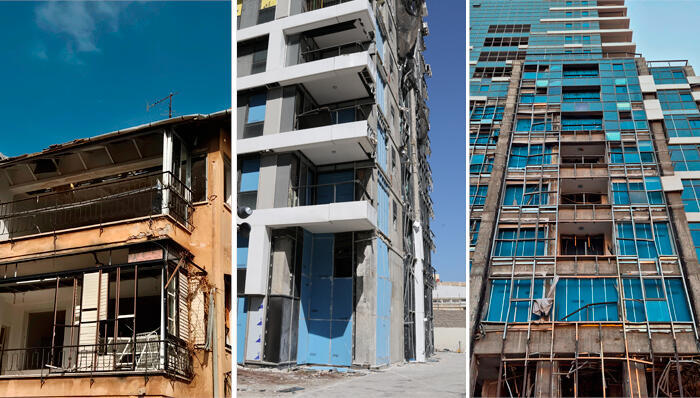
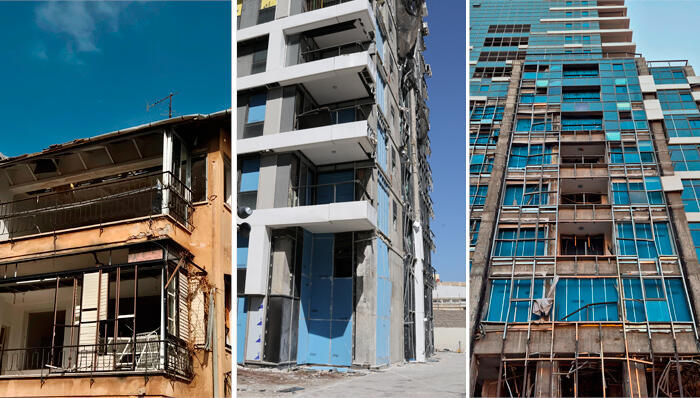
From right: Elite Tower in Ramat Gan, Da Vinci Tower in Tel Aviv, damaged Bat Yam building
(Orel Cohen, Avigail UZi, Yaron Katz)
Tax Authority data provided to Calcalist illustrate the enormous sums the state has spent so far on direct compensation and rental assistance. However, these are not final figures, and it will likely take years before all damaged buildings are restored and the state can stop funding alternative housing and rehabilitation efforts.
According to the Tax Authority, 39,715 claims have so far been filed with the compensation fund for damage to buildings, of which approximately 2,800 are classified as requiring long-term rehabilitation. By city, Tel Aviv leads by a significant margin, with 10,160 claims for building damage. It is followed by Ramat Gan with 6,654 claims, Rehovot with 3,969, Bat Yam with 3,254, and Petah Tikva with 3,055.
Tel Aviv Municipality data regarding property tax exemptions for uninhabitable apartments further illustrate the severity of the impact. Following Operation Rising Lion, 336 apartments are currently exempt from property taxes, compared with 193 apartments following Operation Roaring Lion.
Of all the claims filed, 3,329 cases have received rental assistance payments totaling NIS 187.2 million. This amount is also not final, and the Property Tax Authority has not yet estimated future costs, which will depend on factors including the pace of building restoration and families' return to their homes. The Tax Authority notes that in some cases, rental payments exceeded market rates due to sharp increases in housing costs. In addition, 50,174 claims were filed for direct damage, primarily to the contents of apartments, and approximately NIS 3.7 billion has been paid out so far.
Tel Aviv
The Complex Case of Da Vinci Tower
Tel Aviv was the city hardest hit, both in terms of financial damage and the number of affected apartments. According to municipal data, 56 buildings were declared dangerous, and as of today, that designation remains in effect for 24 of them. Two preservation buildings on Pinsker Street (Nos. 4 and 6) were designated for demolition, and permit applications have already been submitted.
The damage to Da Vinci Tower, together with the damage sustained by the Elite Tower in Ramat Gan, is considered among the most complex building restoration projects in Israel. The damage to Da Vinci Tower, which had been occupied for only a year and a half before the strike, required the replacement of its expensive curtain-wall façade, a process never before carried out on such a scale in Israel and perhaps even globally, creating significant engineering challenges.
A source involved in the restoration process recently said that professionals spent considerable time developing a suitable methodology for the project. As things stand, residents are not expected to return before 2028. The Tax Authority recently estimated the cost of repairing the damage to the Da Vinci and Elite towers at a combined NIS 1 billion, roughly NIS 500 million for each tower.
Another issue concerns compensation for apartment contents, which is currently capped at around NIS 100,000 per family, depending on household size. Naturally, the value of possessions in luxury apartments is often substantially higher, creating frustration among some residents who lost their homes and believe they were not fully compensated for their property.
Ramat Gan
The Buildings on Tirza Street Were Demolished
Following Operation Rising Lion, five demolition orders were issued for buildings on Tirza Street. All five buildings have since been demolished, and reconstruction plans are currently advancing through the approval process. Repair orders were also issued for six additional buildings that suffered blast damage.
Project management company Efrati Madpis was selected to oversee the restoration of the Elite Tower on Jabotinsky Street. Yoni Efrati, one of the company’s owners, said work is already underway in coordination with the Property Tax Authority.
"We are a year after the missile strike. We managed to get the project back on track, and it is now in the restoration phase with full cooperation from the Property Tax Authority," he said.
According to Efrati, the restoration is expected to take about two years, with the main challenge stemming from the need to replace the tower’s aluminum exterior shell.
"The removal and installation of the new aluminum façade are highly complex processes that take time. These are not projects you learn to do in engineering school. I truly hope this remains a one-time project."
Efrati estimated that the final cost would be lower than the Property Tax Authority’s assessment of approximately NIS 500 million.
Bat Yam
481 Families Still Out of Their Homes
Bat Yam is among the cities where there is an urgent need for legislation to accelerate urban renewal projects following severe damage.
After Operation Rising Lion, 52 dangerous-building notices were issued. Three have since been revoked after repairs were completed and occupancy was restored.
Most of the heavily damaged buildings are expected to undergo demolition and reconstruction. Progress on these projects depends on the state formally declaring the sites eligible for demolition and redevelopment. So far, 11 buildings have been designated for demolition, two of which have already been demolished by the municipality because they posed immediate safety risks.
As of today, approximately 481 households remain displaced due to the damage, the highest number among the affected cities.
Petah Tikva
Full Reconstruction Expected Within About Six Months
Despite several severe strikes, reconstruction efforts in Petah Tikva are relatively advanced.
The most significant damage occurred on Asirei Tsiyon Street, where four residential towers and a shared community building were hit. The relatively new complex will not be demolished but instead undergo extensive rehabilitation and renovation.
The two inner buildings, Nos. 17 and 19, sustained direct damage. The outer buildings, Nos. 15 and 21, suffered blast-related damage, have already been repaired, and their residents have returned.
As of today, 160 families from the two directly damaged buildings remain in alternative housing. Reconstruction is expected to be completed within approximately six months.
Be’er Sheva
Most Residents Expected to Return by the End of 2026
Be’er Sheva experienced four missile impact sites during the conflict. A total of 111 buildings were damaged, seven of which were declared dangerous.
One building on Johanna Jabotinsky Street was demolished and is currently in the planning stages for reconstruction. Most buildings designated for rehabilitation are already under repair, or their residents have returned, and all restoration work is expected to be completed by the end of 2026.
Two additional houses that were declared dangerous are expected to be demolished, with their owners currently advancing demolition and reconstruction permits.
In total, about 95 residents remain displaced. Of those, 59 are expected to return within approximately two weeks, while the remaining 36 are not expected to return to permanent housing for roughly three years.



