











Opinion
The backlog-to-revenue gap: Why the next defense winners will be built on delivery speed
"The companies that can iterate at software speed, in the domains that matter most right now, are the ones that will define the next layer of the stack. Israel has already run this playbook once. Defense can be next," writes Asaf Schreiber, an Associate at Viola Ventures.
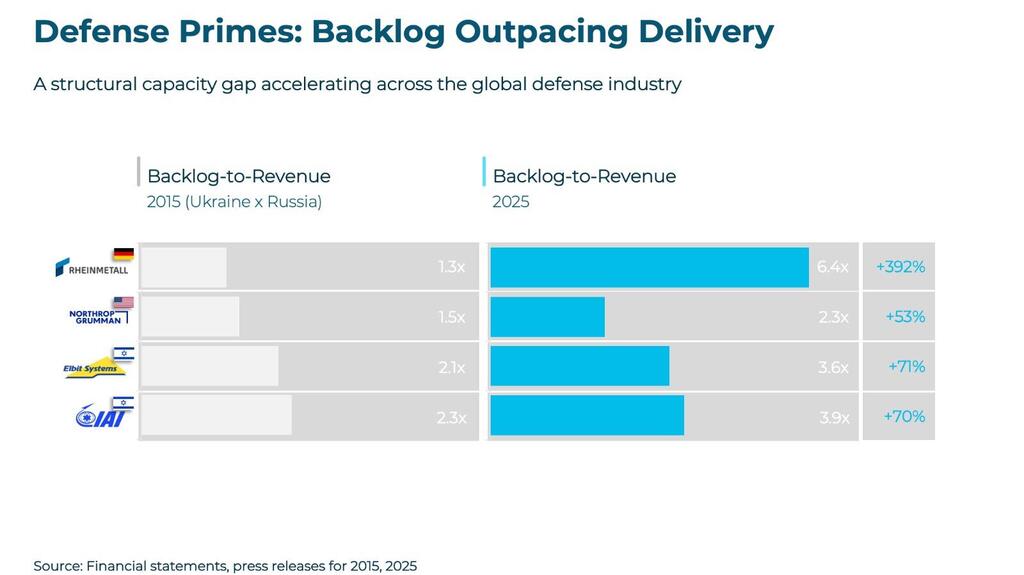
A few days ago, Elbit Systems published its annual results. $28B backlog. 3.6x their annual revenue.That ratio was 2.1x a decade ago.
I started digging to check if this was an Elbit-specific story. It isn’t.
IAI’s backlog-to-revenue ratio rose from 2.3x to 3.9x. Northrop Grumman from 1.5x to 2.3x. Rheinmetall, the most extreme case — went from 1.3x to 6.4x. Its backlog grew at 25% CAGR over the last decade. Revenue grew at only 7%.
Every major defense prime is winning contracts significantly faster than it can deliver them. The gap isn’t closing. It’s widening.
And it just got a hard deadline.

2029: The Clock is Running
Germany’s Defense Minister Boris Pistorius, warned that a war between Russia and NATO “could begin in 2029.” Germany has since quietly prepared a war blueprint envisioning itself as a NATO staging ground, with plans for 800,000 troops on a hypothetical eastern front. France has announced a new military volunteer program and warned it must be prepared to “lose its children” in a conflict with Moscow.
This isn’t just a geopolitical noise. It’s the forcing function behind the backlog.
Europe’s defense ministries are signing long-term contracts with Elbit, IAI, and Rheinmetall because they have a timeline to meet. Which makes the delivery gap not only a business problem for primes — but a national security problem for governments. And that changes the urgency of everything downstream.
Speed Becomes the Real Moat
Primes cannot simply buy their way into faster iteration through CapEx.
A 40-person startup building software-defined EW or AI-enabled C4 can ship a new capability in weeks, get real battlefield feedback in days in Israel’s current operational environment, and redeploy updated systems within the same conflict cycle. That loop — build, deploy, iterate, redeploy — is structurally inaccessible to a 20,000-person organization running multi-year fixed-price contracts.
This isn’t a criticism of primes. They’re doing exactly what their model allows. The point is that the model has a ceiling and the urgency of the 2029 timeline is pushing demand above that ceiling. The overflow has to go somewhere. The companies that can move at software speed, in domains where iteration matters more than factory floor, are where it goes.
The New Entry Playbook: Scaling Through the Backlog
The Backlog-to-Revenue gap established that there can be a real whitespace for startups. The question founders immediately ask is: how does a startup actually get in?
Distinct structural entry points exist, each presenting unique timelines, degrees of leverage, and associated risks. The two outlined below appear to offer the greatest potential:
Named subcontractor. The prime wins a large contract and carves out a scope for a sub-tier supplier. Better revenue visibility and a more durable relationship. Traditionally requires 12-36 month qualification cycles but those cycles are compressing. Primes under delivery pressure are onboarding suppliers they would have ignored three years ago.
Direct-to-MoD with prime endorsement. This is the uniquely Israeli model and it has been proven at scale since October 7. Rather than entering through the prime, the startup engages directly with Israel’s Ministry of Defense through DDR&D/MAFAT, and the prime acts as integrator or channel partner.
In H1 2025 alone, 12 Israeli startups signed export agreements in G2G (government-to-government) frameworks - a record, according to DDR&D data, that several years ago would have seemed like a distant dream. In 2024, Israel signed 21 G2G defense agreements. Three years ago that number was near zero.
The Israeli Advantage: A Living R&D Lab
Israel occupies an unusual position in this landscape — and not by accident.
The reason is structural. In most countries, defense innovation begins with a soldier’s pain point being translated slowly (and poorly) up a long chain to a civilian R&D team that’s usually never worn a uniform. In Israel, the soldier is the R&D team. Engineers who are reserve officers come back from the front with concrete operational gaps. Startups build solutions. The MoD deploys them. Then the founders raise their next round.
Israel’s defense exports hit a record $14.8B in 2024, the fourth consecutive record year, with Europe surging from 35% to over 50% of all sales. The primes (Elbit, IAI, Rafael) are increasingly acting as distribution channels for Israeli startups into NATO procurement, not purely as competitors. Top-tier global and Israeli funds are taking notice: Sequoia, Lux Capital, IQT, Founders Fund, and a16z have all made investments in Israeli defense tech startups in the past two years. The infrastructure that was missing three years ago is being built.
The Cybersecurity Parallel
We believe Defense is about to go through what cyber went through.
In cybersecurity, threat velocity outpaced legacy vendors. The established players had the distribution, the relationships, the government contracts. But they couldn’t move fast enough. A generation of startups rebuilt the stack and Israel produced a disproportionate share of them due to the best talent market fit in the world.
Defense is next. The primes own the distribution and the relationships. But the delivery model is under pressure; demand is simply outpacing the ability of incumbents to respond at speed.
The companies that can iterate at software speed, in the domains that matter most right now, are the ones that will define the next layer of the stack.
Israel has already run this playbook once. Defense can be next.
Asaf Schreiber is an Associate at Viola Ventures.



