










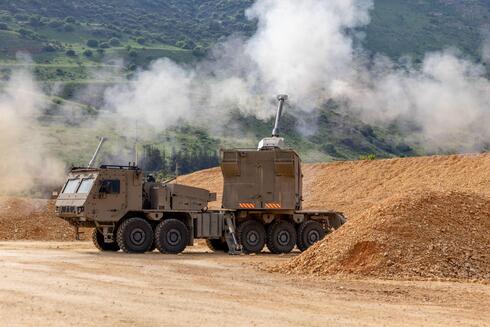
Israel’s new AI-powered artillery makes combat debut in Lebanon
Ro’em system signals shift toward faster, semi-autonomous battlefield firepower.
Israel’s military has taken a step toward a more automated battlefield, deploying a new artillery system that uses artificial intelligence to compress the time between identifying a target and opening fire.
The system, known as the Ro’em, was deployed by the IDF’s 282nd Artillery Regiment during operations in southern Lebanon, where it was used to strike Hezbollah rocket and anti-tank launch sites in support of ground forces. Military officials described the initial use as successful, citing both operational effectiveness and the system’s performance under real combat conditions.
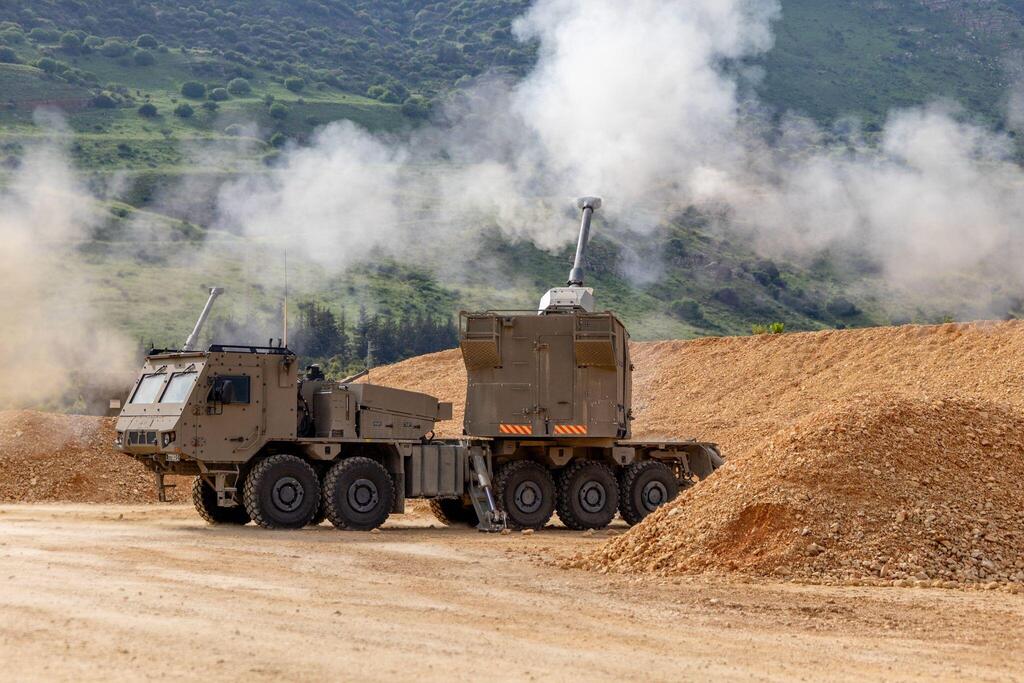
Developed over six years by the IDF in partnership with Elbit Systems, the Ro’em represents a significant departure from the decades-old artillery platforms it is intended to replace. Where its predecessor, the US-made Doher, relied on manual processes and large crews, the new system operates with a level of automation that brings it closer to a semi-autonomous battlefield machine.
At the center of that transformation is artificial intelligence.
Unlike traditional artillery, where targeting, loading and firing are largely manual, the Ro’em compresses these steps into a largely automated sequence. Once a target is designated by an operator or commander, the system can independently load ammunition, calculate firing solutions, aim and fire with minimal human intervention. It is also integrated into broader military command-and-control networks, allowing it to receive targets directly from intelligence systems or operational headquarters.
In practice, this means that decision-making cycles, often measured in minutes, can be reduced to seconds.
The system’s design reflects that emphasis on speed and survivability. Mounted on a wheeled platform rather than tracks, the Ro’em can reposition rapidly after firing, relocating within roughly a minute to reduce exposure to counter-battery fire. It can fire up to eight shells per minute, four times the rate of the Doher, and reach targets at distances of up to 40 kilometers, roughly double the range of the older system.
It is also capable of executing more complex firing patterns, including striking a single target from multiple trajectories and coordinating timed barrages with other units. These capabilities, long discussed in theory, are now embedded in a system that requires a crew of just three soldiers operating from a control vehicle, about half the manpower of earlier platforms.
The result is an artillery unit that functions less like a traditional battery and more like a networked, semi-autonomous node within a larger system of sensors and shooters.
Beyond Israel, the system has already attracted international attention. Elbit has established a production line in South Carolina and is competing in a US Army tender to replace aging artillery systems by 2032. It has also secured an export deal in the Asia-Pacific region valued at approximately $106 million, and is working with Germany’s Rheinmetall to offer a European variant. Several European countries, including Germany, the Netherlands and Hungary, have sent representatives to observe live-fire tests in Israel.



