










Stealth Israeli quantum startup Q-Factor emerges with $24 million in Seed funding and elite scientific team
Intel Capital-backed startup, founded by scientists from Weizmann and Technion, aims to move beyond current qubit constraints with neutral atom technology.
Israeli startup Q-Factor had operated largely under the radar until today, but it has already attracted significant attention within the industry due to its unusually strong academic pedigree.
The company, which is developing a full-scale quantum computer based on neutral atom technology, was founded by four leading physicists from the Weizmann Institute of Science and the Technion, each of whom heads a prominent laboratory in the field. It is now emerging from stealth with a $24 million Seed round, completed just months after its founding.
The round was led by NFX and TPY Capital, with participation from Intel Capital, Korea Investment Partners, Deep33, and the Matias family, along with a grant from the Israel Innovation Authority. The Technion - Israel Institute of Technology and Weizmann Institute of Science (through Yeda, its technology transfer arm) are also shareholders in the company, which was founded to commercialize decades of foundational research in atomic physics conducted in their labs.
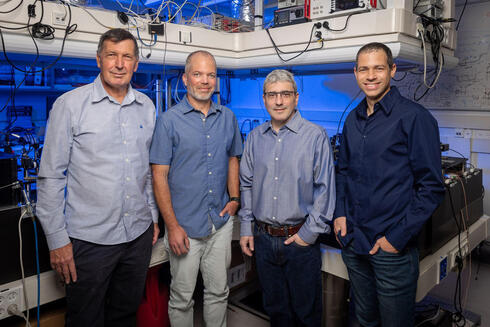
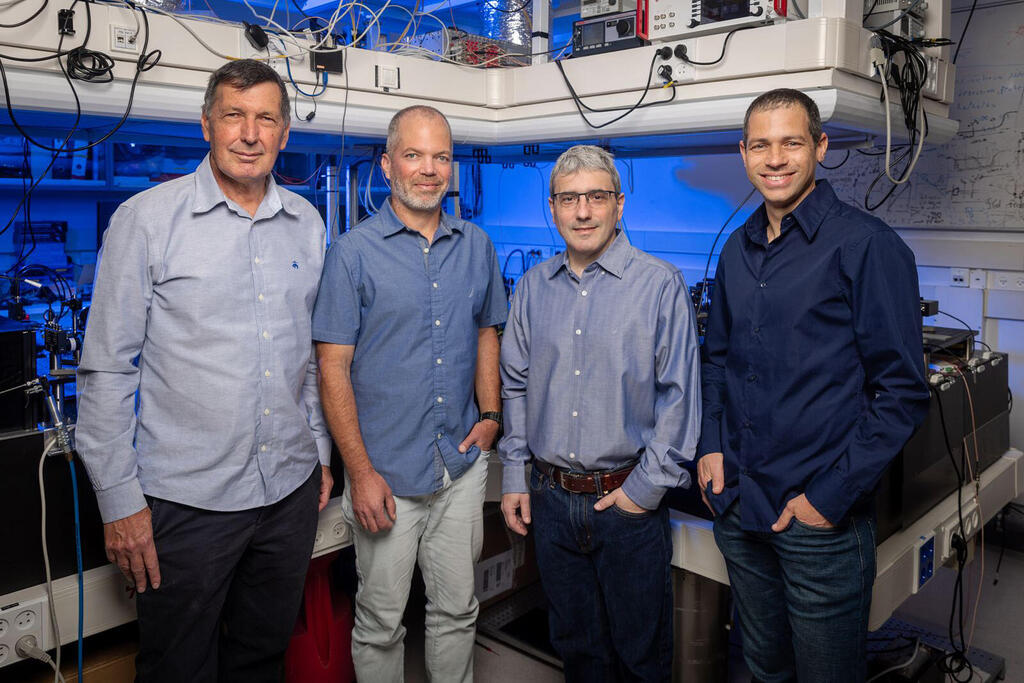
Founded in 2026, Q-Factor brings together Prof. Nir Davidson, a world-renowned authority in ultracold atoms with 280 published papers and former dean of physics at the Weizmann Institute of Science; Prof. Ofer Firstenberg of the Weizmann Institute, an expert in quantum optics and Rydberg atoms, formerly of Harvard and MIT; Prof. Yoav Sagi of the Technion, a leading authority in neutral-atom manipulation, formerly of JILA and the University of Colorado; and Dr. Guy Raz, a physicist with 20 years of technical leadership for multiple deep tech startups.
Q-Factor is pursuing an ambitious goal: building a quantum computer from the ground up using neutral atom technology. This approach is considered one of the most promising alternatives to more established methods such as trapped ions and photonic systems. While it remains unclear which technology will ultimately dominate, many in the field expect a single leading approach to emerge.
Recent developments have strengthened confidence in the neutral atom path. Google has moved to adopt similar technology for its own quantum computing efforts, signaling growing industry interest in the approach.
One of the central challenges in quantum computing today is scalability. Current systems are limited by the relatively small number of stable qubits - the quantum equivalent of classical bits - that can operate reliably without errors. Neutral atom systems aim to address this limitation through the inherent stability and neutrality of the atoms, potentially enabling machines that can scale to thousands or even millions of qubits.
According to the company, its team has identified key architectural bottlenecks that limit existing neutral atom systems and developed a new approach designed to overcome them. The goal is to enable scaling beyond one million qubits, a threshold that could bring quantum computing closer to commercial viability.
"The quantum computing industry needs a revolution, not an evolution," said Prof. Ofer Firstenberg, co-founder and chief scientist of Q-Factor. "Current systems are too small to deliver on the promise of quantum computing, and incremental improvements alone aren't going to close that gap. We've developed an architecture designed for continuous scalability, a Moore's Law-like trajectory that can take neutral atom systems from thousands of qubits to millions and beyond."



