










Germany fires Israeli Lora missile from warship in landmark test
The successful North Atlantic launch could pave the way for Berlin to acquire a long-range precision strike capability from Israel Aerospace Industries as it accelerates its military buildup.
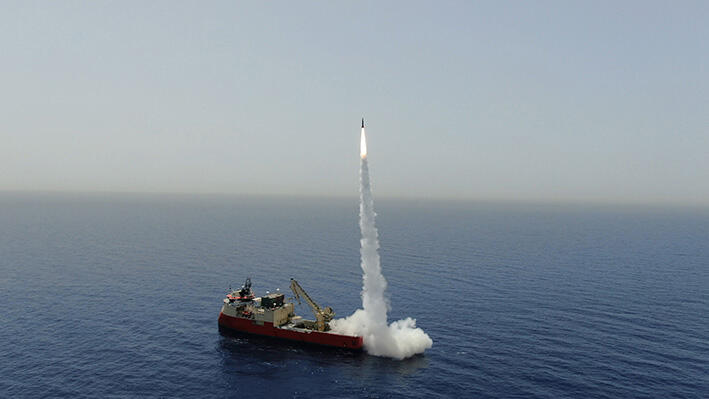
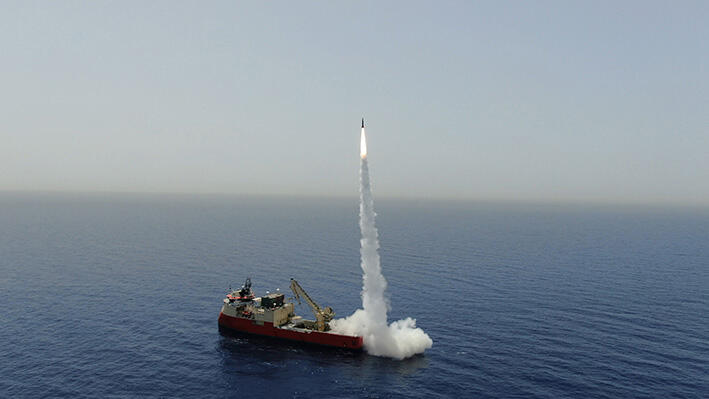
The German Navy successfully conducted a test firing of the Lora ballistic missile manufactured by Israel Aerospace Industries (IAI) on Tuesday night, as part of preparations for a possible German acquisition of the Israeli weapons system, according to reports in the German and European press.
The missile was launched from a German warship in the North Atlantic, between Ireland and Iceland. Following the successful test, the German Navy said it intends to advance plans to acquire the Israeli system. According to extensive reports in the German media this morning, preparations for the test were kept secret. However, because of the risks involved in the launch, aircraft and maritime traffic in the area had been restricted about a month and a half earlier.
"With the successful launch of a ballistic missile last night in the North Atlantic, we have made naval history. I am extremely pleased with this achievement," Navy chief Vice Admiral Jan Christian Kaack told dpa.
The significance of the test is that it could pave the way for the German Navy to acquire a long-range precision strike capability against land targets. According to reports in Germany, plans to purchase Lora will now move forward following the successful launch. The missile has a range of more than 500 kilometers. The size of the potential purchase, including the number of missiles and launchers Germany may acquire, has not yet been announced.
Lora, an acronym for Long Range Attack, is a precision ballistic missile that can be launched from land-based launchers and ships. It is designed to strike high-value targets deep inside enemy territory. More than a year ago, IAI unveiled the AIR Lora at the ILA defense exhibition in Berlin, a version designed to be launched from a fighter jet.
A potential Lora deal could significantly narrow a gap in Germany’s long-range precision-strike capabilities. Germany currently operates the Taurus cruise missile, which has an estimated range of more than 500 kilometers and is launched from fighter jets.
In Germany, the test is being viewed in the context of the Russian threat and Berlin’s acceleration of its military buildup since Russia invaded Ukraine in 2022. According to Kaack, the system "exceeds anything we have known before," adding that the test marked "a new chapter in deterrence and defence readiness at sea" to protect Germany and its allies.
The Lora test is also part of a broader German effort to expand its long-range strike capabilities. Berlin is promoting the acquisition of American Tomahawk missiles, which have a range of up to 2,500 kilometers, while also participating in efforts to develop European long-range systems.
If Germany ultimately purchases Lora, the deal could further deepen its defense relationship with Israel’s aerospace industry.
Germany has already become one of IAI’s most important strategic customers in recent years, particularly following two major deals involving the Arrow 3 missile defense system worth approximately $6.5 billion combined. The deals were part of the first export agreement for Arrow 3 and represented the largest defense export deal in the history of Israel’s defense industries.
IAI, managed by Guy Barlev and headed by Boaz Levy, is also at the center of a major defense agreement signed with Greece just two days ago, worth approximately €3 billion. Under the deal, IAI and Rafael will establish a multilayered air defense system for Greece, centered on Rafael’s David’s Sling and Spyder missiles and IAI’s Barak MX missiles and radars.



