










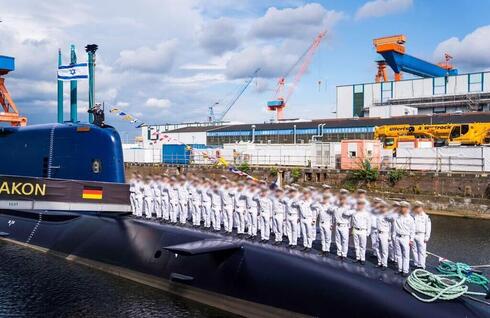
Israel’s “most advanced and complex weapons system” begins voyage home
The INS Drakon is sailing from Germany to Israel, where it will join a submarine fleet increasingly designed for longer-range and more covert operations.
Israel’s newest submarine has begun the journey home, marking the next step in the transition of the Israeli Navy’s underwater fleet toward a new generation of vessels.
The INS Drakon, Israel’s sixth submarine, departed Germany on Monday after years of joint construction and planning with German shipbuilder ThyssenKrupp Marine Systems (TKMS). A send-off ceremony at the company’s shipyard in Kiel marked the formal beginning of the voyage, with the Israeli flag raised aboard the vessel for the first time. The submarine is expected to arrive in Israel within weeks.
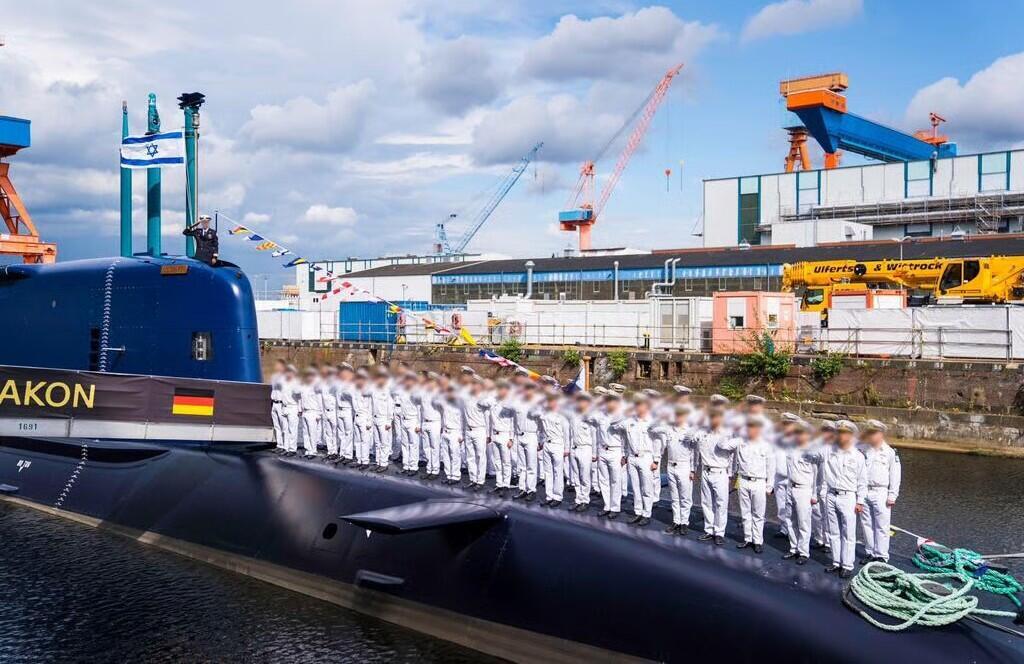
The departure comes about a month after Germany formally transferred the Drakon to Israel in a low-profile handover. At the time, the submarine left the TKMS shipyard under the Israeli flag to conduct sea trials in Kiel Bay, without a public ceremony or announcement.
Now, the Defense Ministry and IDF are publicly presenting the vessel's arrival as an important milestone for the Navy, and as a link between its current submarine fleet and the three Dakar-class submarines that Israel is developing with Germany for the next decade.
“The Drakon, together with three future Dakar-class submarines, will form a central part of the future of Israel’s submarine fleet,” Israeli Navy commander Vice Adm. Eyal Harel said at the ceremony.
The Drakon is the third and final submarine in the Dolphin-class air-independent propulsion, or AIP, series purchased by Israel. According to the IDF, it incorporates technologies intended to increase the Navy’s operational flexibility, range and endurance.
Harel emphasized the unusual nature of the missions the submarine's crews will undertake, operating covertly and far from Israel.
“They will bring more advanced capabilities, greater operational range, longer endurance on missions and significant operational power,” he said, referring to the Drakon and the future Dakar submarines.
He described crews operating “in the dark and in silence, far from home,” often in situations in which only those aboard would know what was happening around them and would have to make critical decisions.
That emphasis on endurance and covert operations reflects the role Israel has assigned to its submarine fleet for decades. The Dolphin-class vessels have been regarded internationally as an important component of Israel’s long-range strategic capabilities, although much of the fleet’s specific capabilities remain undisclosed.
The Drakon is particularly significant because it represents the final stage of the existing Dolphin program while also serving as a precursor to the Navy’s next generation.
At its naming ceremony in November 2024, Israel simultaneously marked the Drakon and the beginning of construction of the first Dakar-class submarine. The new vessels are scheduled to begin arriving at the start of the next decade.
The transition is therefore already underway: Israel is adding the Drakon to its existing fleet while preparing to replace the oldest generation of submarines with a new class designed around more advanced capabilities.
The Defense Ministry has previously described the Drakon as containing “unique systems” and “groundbreaking technologies,” but has not publicly detailed the systems that distinguish it from earlier vessels.
The submarine is also the product of a particularly deep defense relationship between Israel and Germany.
Zeev Landau, head of the Defense Ministry’s Procurement Directorate, called the Drakon “the most advanced and complex weapons system in the IDF,” describing its delivery as evidence of the strategic partnership between the two countries.
The two governments are already discussing additional joint projects, Landau said, potentially expanding their cooperation into new areas of development and production.
For TKMS, the departure represents the completion of another major stage in a program that has stretched across years of engineering and construction.
“This marks the successful completion of a complex program built on years of trust, technological expertise and shared responsibility,” TKMS CEO Oliver Burkhard said.
He described Israel as an important partner in the maritime arena and said cooperation would continue through the future Dakar-class program.
The Drakon will now make its way toward Israel, where a state ceremony is planned at the Haifa Naval Base following its arrival.



