










Day Zero approaches Iran
Iran faces escalating water collapse risks as climate change, mismanagement, and war pressures converge on its fragile system.
Last summer, Iran came close to what experts call “Day Zero.” This does not refer to the day the country acquires a nuclear bomb, but rather the day when water supplies can no longer meet domestic demand and the system begins to collapse. Iranian President Masoud Pezeshkian has repeatedly warned that residents of Tehran may need to be evacuated due to the worsening water crisis.
Water stress in Iran, driven by extreme climate change alongside failed and often corrupt water management, is among the highest in the world. The crisis has already contributed to social unrest and protests, many of which have been suppressed amid war-related conditions. Another summer is approaching, and the ongoing regional conflict threatens to further strain already limited water resources as government capacity and funding are diverted toward military needs.
1 View gallery
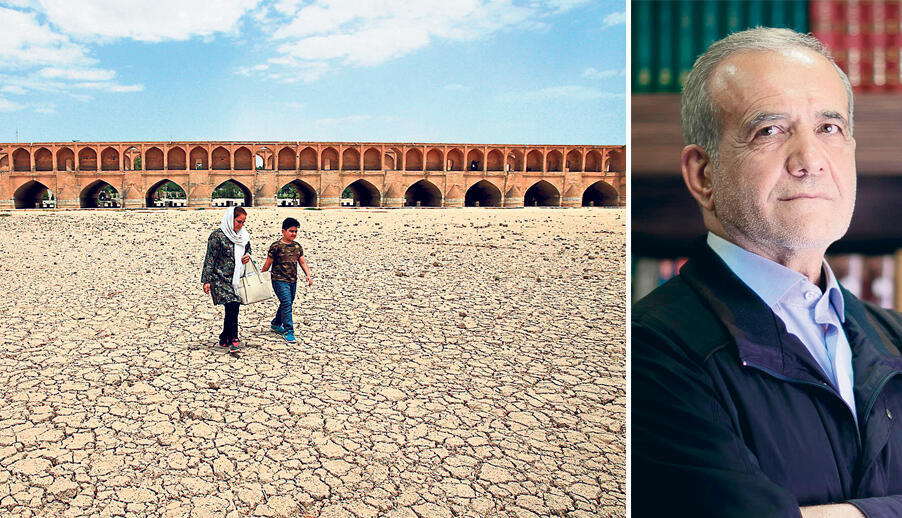
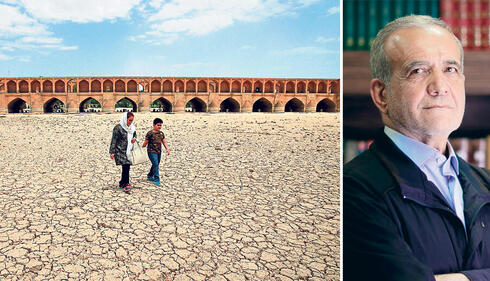
Iranian President Massoud Pezeshkian (right) and a dry river in Isfahan.
(צילום: Getty Images , Vahid Salemi)
Iran has almost no water. Addressing the crisis requires a fundamental transformation of agricultural practices.
In the shadow of worsening climate change over the past two decades, Iran’s renewable water resources have declined by more than a third, pushing the country toward severe water scarcity. Unlike other countries facing extreme water stress, such as Gulf states and Israel, Iran has almost no desalination capacity (only around 3% of water consumption comes from desalinated sources), and its facilities are outdated and inefficient.
Reversing the situation will require far-reaching reforms: major financial investment, a transformation of agricultural practices, the construction of modern infrastructure, and the repair of aging municipal pipelines. Without such changes, any heatwave, reservoir failure, or wartime damage to infrastructure could push the fragile system toward collapse.
Where water scarcity was once largely confined to rural and peripheral regions, it is now rapidly reaching major cities. The roots of the crisis are both historical and structural. Beginning in the 1930s, and accelerating under the 1960s “White Revolution,” Iran promoted water-intensive agriculture and industrial expansion without regard for its hydrological limits.
Today, around 90% of Iran’s water is consumed by agriculture, much of it through inefficient flood irrigation on arid land used to grow highly water-intensive crops such as wheat, rice, and sugar beets. Meanwhile, state investment in the water sector since the 1980s has often been directed through politically connected contractors, in what critics describe as a “water mafia.” These networks have promoted projects that served political interests while the underlying system deteriorated.
For example, the widespread granting of licenses for hundreds of thousands of wells, many of them unregulated, accelerated groundwater depletion. In some regions, aquifer levels have fallen so sharply that land subsidence has become irreversible, damaging roads, buildings, and farmland. The resulting mismanagement has eroded public trust and contributed to unrest.
Over time, authorities have also diverted water from rural to urban areas, deepening perceptions of neglect in rural regions. But even Tehran, once considered relatively insulated from crisis, is now facing severe shortages, with its 10 million residents dependent on mountain reservoirs increasingly threatened by shrinking snowpack and rising temperatures.
In Isfahan, the Zayandeh Rud River, which once formed the basis of the city’s development, has been dry for several years. Climate change has reduced rainfall by up to 85% in some areas, and Iran’s agricultural self-sufficiency is under threat: the country already struggles to feed its population of 92 million without imports.
Rising dependence on imported grain further exposes Iran to global price volatility, compounded by international sanctions and domestic hyperinflation.
Mass protests reflect perceptions that the government is deliberately worsening water shortages in some regions.
Although the Iranian regime has cracked down on protests, the water crisis has already driven residents into the streets. In 2021, Arab communities in Ahvaz, in the western province of Khuzestan, led what became known as the “Intifada of the Thirsty,” sparked by anger over water mismanagement and perceptions of deliberate deprivation.
In November 2025, student protests were reported in Tehran after water supplies to dormitories were cut off, alongside smaller local demonstrations in drought-affected areas. In January of this year, a broader wave of protests emerged amid the economic crisis, including water shortages and energy disruptions.
Amid ongoing war, the water crisis has been pushed further down the political agenda, and internal unrest has been increasingly suppressed. At the same time, Iran has also been accused of using water infrastructure as a strategic tool, threatening desalination plants and dams in Gulf states.
Iran has reportedly targeted facilities in Bahrain and Kuwait, while U.S. strikes have allegedly damaged Iranian infrastructure. Iranian officials have also threatened to destroy desalination plants in Gulf countries in response to U.S. President Donald Trump’s threats against its energy infrastructure.
Any damage to Iran’s dams or water systems could be catastrophic. Water shortages would also strain the energy sector, as power plants depend heavily on water for cooling and operation, meaning output must be reduced or halted even when oil and gas reserves remain abundant.



