










125 companies, over $10 billion raised: Mapping Israel’s Physical AI ecosystem
Defense and mobility form the densest clusters, while civilian applications remain numerous, fragmented and still taking shape.
For years, Israel's artificial intelligence reputation has been defined largely by software and cybersecurity. But a new analysis suggests the country's next AI wave may be taking shape in the physical world, where algorithms do more than generate text or images, they control robots, autonomous vehicles, defense systems and industrial machines.
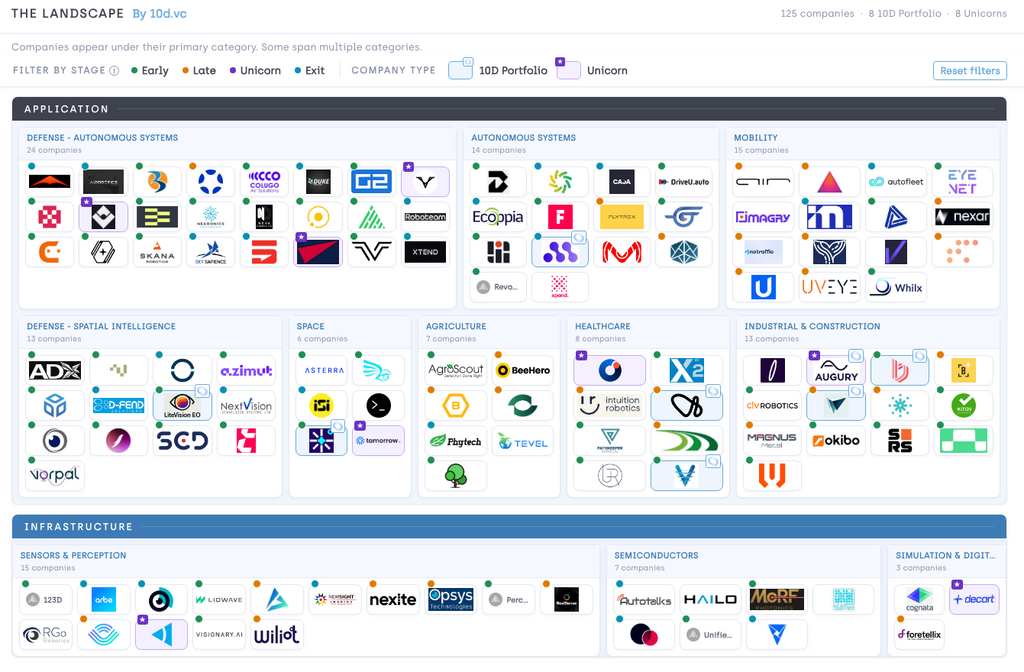
A new landscape compiled by Israeli early-stage venture capital firm 10D identifies 125 Israeli startups developing what is known as "Physical AI," companies that combine artificial intelligence with sensors, hardware and actuators to perceive, understand and act in real-world environments. Together, the companies have raised more than $10 billion, produced eight unicorns and generated 24 exits, pointing to what investors believe is an increasingly important segment of Israel's technology ecosystem.
Unlike traditional AI software, Physical AI connects machine learning models to hardware that can interact with the physical world. The category spans robotics, mobility, defense technology, semiconductors, industrial automation, healthcare, agriculture and space technologies.
According to 10D, 100 of the companies operate at the application layer, while 25 develop the underlying infrastructure. Those infrastructure startups focus on sensors and perception technologies, semiconductors, and simulation and digital twin platforms, providing the components that allow AI systems to sense their surroundings before making decisions and taking action.
The analysis highlights a striking concentration in defense technologies. The two defense categories account for 37 companies, nearly one-third of the entire landscape, with 24 companies focused on autonomous defense systems and another 13 developing defense spatial intelligence technologies. Mobility represents the second-largest cluster with 15 companies, while a separate autonomous systems category includes 14.
The dominance of defense reflects capabilities Israel has developed over decades in sensing, computer vision, software and control systems, supported by military technology units, research universities and multinational R&D centers. Companies such as XTEND and D-Fend illustrate how those technologies have evolved into autonomous systems capable of sensing their environment and acting independently in the field. Similar technologies are increasingly finding applications in medical devices, industrial equipment, agriculture and autonomous vehicles.
"The number of companies is significant, but the distribution tells a more interesting story," said Rotem Eldar, Managing Partner at 10D. "Israel already has real depth in defense. In civilian markets, we are not yet seeing the same concentration in a specific vertical or the kind of global market leadership Israel has previously built in areas such as mobility. Instead, activity is spread more broadly across markets that are still taking shape."
Beyond defense, the ecosystem remains fragmented across several emerging industries. The landscape includes 13 industrial and construction technology companies, eight healthcare startups, seven agricultural technology firms and six space companies. Among them is Mentee Robotics, which is developing general-purpose humanoid robots for industrial environments.
Related articles:
The report argues that the competitive dynamics of AI are also changing. While the industry's first phase rewarded companies capable of training increasingly powerful foundation models, those models are becoming more widely available. As a result, competitive advantage is shifting toward companies that can integrate AI with specialized hardware, sensors, proprietary data and domain expertise to create systems that perform reliably outside controlled laboratory settings.
That shift plays to areas where Israel has accumulated decades of experience, including semiconductors, communications, computer vision and complex defense systems. Earlier successes such as PrimeSense, which pioneered 3D sensing technology, and Mobileye, which built a global automotive perception platform, demonstrate the country's ability to commercialize technologies that bridge software and hardware.
The infrastructure layer identified by 10D includes 15 companies focused on sensing and perception, seven semiconductor startups and three companies developing simulation and digital twin technologies. Together, these technologies form the foundation for AI systems capable of perceiving their environment, making decisions and executing actions in the real world.
"As models become more widely available, differentiation moves to the system level," Eldar said. "The difficult part is connecting AI to sensing, hardware, data and domain knowledge, then making the full system work consistently outside the lab. The advantage comes from making those components operate as one reliable system, from perception through decision to action."



