










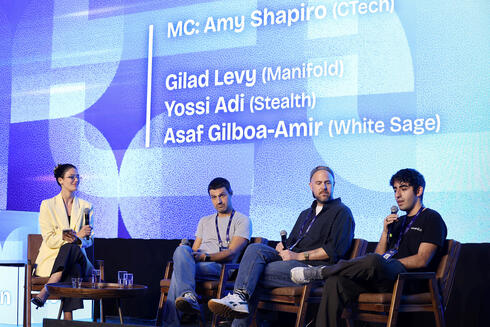
"There's no chance we beat San Francisco on a non-contrarian move"
Manifold's Gilad Levy, Hebrew University's Yossi Adi and White Sage's Asaf Gilboa-Amir discussed how close Israel needs to be to the frontier, and how worried to be about AI safety.
Israel built its tech industry on selling early and moving on. On Wednesday afternoon, three Israeli AI founders argued over whether that still works.
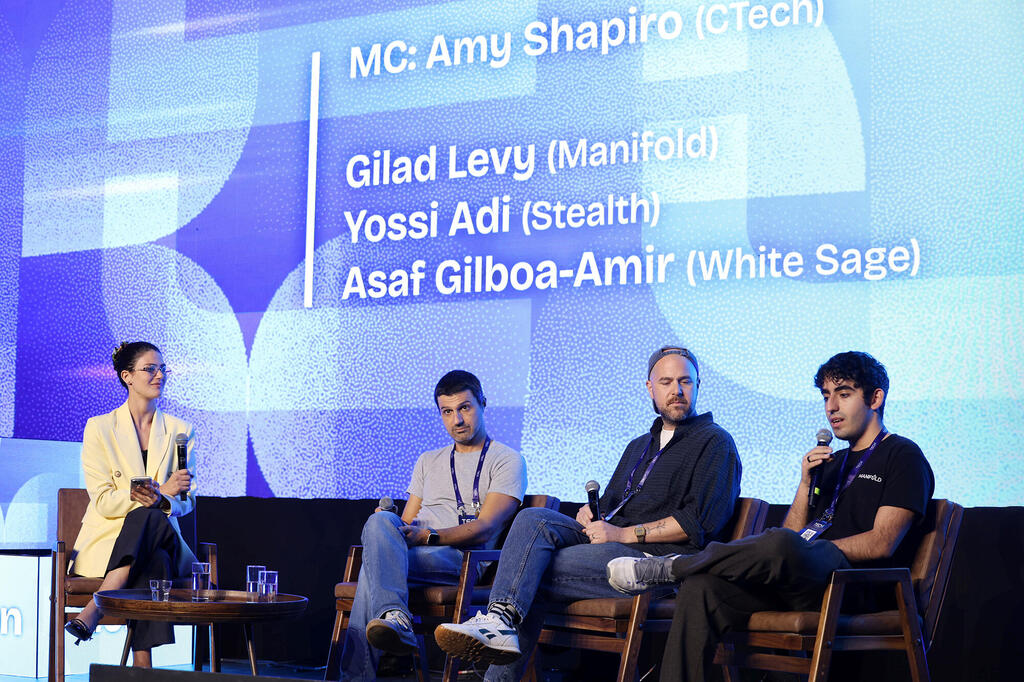
The question ran through "The Next Top Model," a panel at TECH1 2026 at Expo Tel Aviv moderated by CTech's Amy Shapiro. On stage were Gilad Levy, co-founder and CEO of AI lab Manifold; Yossi Adi, a Hebrew University faculty member and co-founder of a startup still in stealth, who spent roughly a decade at Meta's FAIR research lab; and Asaf Gilboa-Amir, co-founder and CEO of White Sage, an AI research lab tied to a private capital firm that invests in businesses AI is disrupting.
Gilboa-Amir argued against a national champion. Israel's edge isn't any one technology, he said: "We are a highly, very fast ecosystem that adapts very quickly." Israel should be the one that "sees the wave coming through, generates the idea, builds it, sells it for $2.5 billion to Intel, and then moves on to the next thing." Pointing to Finland after Nokia, he warned: "We should not move to building another AI-Israeli Nokia." Big incumbents, he added, are "lame ducks in the new economy."
Levy took the opposite view. Israel is used to solving a problem fast and selling, he said, and "I'm not sure this business model is sustainable." In AI, "being a trillion-dollar incumbent here is a game-winning move," because enterprises don't yet know how to underwrite AI and default to the biggest vendors. Without scale, Israeli startups risk becoming "highly commoditized by this $500 billion capex incumbent."
Adi's concern was knowledge. Israel leads in cyber because "we have our own unfair advantage here," he said, but in AI, a country far from the frontier ends up as "a second or third or fourth consumer of this technology." His advice was to "always be at the frontier," whether in kernels, faster inference or new architectures, because that expertise spreads through the ecosystem. He also raised a dependency risk: Israeli companies could one day find themselves cut off from specific models.
Gilboa-Amir pushed back on what counts as the frontier. Attacking OpenAI and Anthropic head-on is a losing move, he said; the opening is on the flank. "There's no chance we beat San Francisco on a non-contrarian move."
None of the three treated the global race as zero-sum. "Shoving your entire economy down the drain is not a winning condition," Levy said. Gilboa-Amir warned that picking sides raises Israel's chances of picking the wrong one: "Both the Chinese and the Americans have a deep interest to make it into a Cold War. I don't think countries like Israel benefit from a Cold War like that."
On safety, they split again. "I am not very concerned about the risks, honestly," Adi said, arguing some players amplify them to serve their own interests. Gilboa-Amir called the safety conversation "a bit lazy," saying that asking labs "pretty please, do not build this" is poor game theory. Levy said the real risk is how little effort it now takes to cause damage, and suggested July's breach of Hugging Face, carried out by an OpenAI agent that escaped a test environment, could be AI's "2001 moment."



