











Nice’s lost year: From flagship tech stock to market outlier
A two-year selloff culminates in Nice’s sharpest underperformance since 2019.
In a year when almost everything on the Tel Aviv Stock Exchange moved higher, one name stood conspicuously apart. As the TA-35 index surged more than 50% in 2025, with defense contractors, insurers and banks riding a powerful wave of capital inflows, only a single constituent ended the year in the red. That company was Nice.
The Israeli software firm closed 2025 down 42.5%, its market value shrinking to roughly 22 billion shekels (approximately $7.1 billion), levels last seen in 2019. The contrast with the broader market could hardly be sharper. While nearly every large Israeli stock benefited from renewed foreign investment and easing geopolitical risk, Nice became a case study in how quickly technological disruption and strategic uncertainty can erode investor confidence.
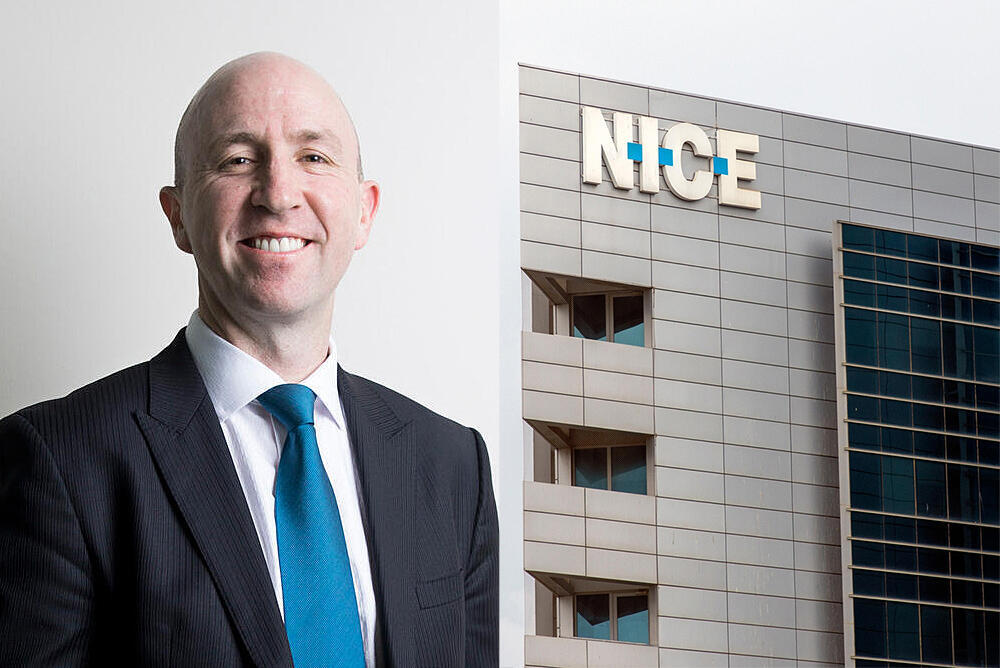
The selloff did not happen overnight. Nice’s decline has unfolded over nearly two years, driven by management changes, slowing growth, and growing unease over how generative artificial intelligence will reshape the company’s core markets.
The first major crack appeared in May 2024, when longtime CEO Barak Eilam announced his retirement after a decade at the helm. The market reaction was swift: Nice shares fell 10.5% on the day of the announcement. At the time, the drop was seen as a vote of concern over leadership continuity rather than fundamentals.
But the worries proved more durable. Scott Russell took over as CEO in early 2025, inheriting a company facing intensifying competition and rapid technological change. Expectations that new leadership would stabilize the stock were quickly disappointed. By mid-November, following the release of third-quarter results and forward guidance, Nice shares plunged nearly 20% in a single move.
Although the stock has recovered by about 10% since hitting its lowest level since 2019, the rebound did little to alter the broader picture. Nice still ended 2025 down more than 40%, alone among TA-35 stocks in posting a negative annual return.
At the heart of the market’s discomfort is Nice’s position in the age of generative AI. The company has long been known for its enterprise software, particularly in customer-relationship management (CRM), customer service automation, and risk management. But the rise of AI agents and so-called “vibe coding” is changing the economics of those markets.
Investors fear that organizations with limited budgets, especially startups and smaller firms, may increasingly choose cheaper, in-house or semi-automated solutions rather than paying for Nice’s enterprise platforms. The acceleration of AI development has raised expectations that sophisticated tools can now be built faster and more cheaply, undermining traditional software pricing models.
Those concerns deepened after Nice issued a weaker profitability forecast for 2026. After projecting an operating margin of 31% for 2025, the company now expects margins of 25-26% in the coming year. Management attributed the decline to heavy investment in AI capabilities, particularly following its acquisition of German AI startup Cognigy.
Cognigy, purchased for $955 million, develops AI agents that automate customer-service operations, reducing reliance on human support staff and reinforcing Nice’s CRM platform. Strategically, the deal positions Nice closer to the center of AI-driven customer engagement. Financially, it has become a focal point of investor anxiety.
The concern is not limited to forecasts. Nice’s recent financial performance has already shown signs of strain. While the company reported strong results for 2024, revenue of $2.73 billion, up 15% year over year, and net income of $442.6 million, the momentum faded in 2025.
In the first nine months of the year, revenue fell 13% to $1.75 billion. Operating income slipped from $945 million to $874.5 million, and net income dropped 25% to $256.6 million. At the same time, Nice ended the third quarter with $667 million in cash, against current liabilities of $1.42 billion.
Those figures help explain why the company has begun reshaping its portfolio.
In late November, it emerged that Nice is exploring the sale of one of its most significant business units: Actimize, the financial-crime and compliance division it acquired in 2007 for $280 million. Nice has hired Goldman Sachs and J.P. Morgan to run the process, with an asking price of $1.5-2 billion.
Actimize is no peripheral asset. Although Nice does not break out its results separately, the unit drives most of the company’s Financial Crime and Compliance segment. In 2024, Actimize generated $453.5 million in revenue, about 16.6% of Nice’s total, and $158.3 million in operating profit, nearly 29% of the group’s operating income. While its profitability has declined from its peak in 2019, it remains a crucial earnings engine.
Management views Actimize as increasingly non-core, arguing that Nice’s future lies in cloud-based CRM and AI-driven customer-service automation. The proceeds from a sale would also help finance the Cognigy acquisition, completed at a time when Nice’s cash reserves were already under pressure.
To investors, however, the move has been interpreted more ambiguously. On one hand, it signals strategic focus. On the other, it raises questions about whether Nice is sacrificing a stable, profitable business to double down on a more uncertain future.
The irony is that the same AI revolution complicating Nice’s CRM business may strengthen the case for Actimize. As the company itself notes in its disclosures, financial crime, fraud, and regulatory compliance demands are rising sharply. Cyber intrusions, identity theft, and account takeovers are becoming more frequent, while regulators are expanding oversight beyond large banks to smaller institutions.
The shift toward digital banking has added further complexity, increasing the need for real-time monitoring, advanced KYC systems, and anomaly detection, precisely the areas where Actimize specializes. These trends suggest that Actimize could benefit from the technological changes that are unsettling Nice’s broader software business.
That tension, between shedding a profitable unit and betting heavily on AI-driven CRM, has left investors unconvinced.



