










Israel accelerates weapons production while developing ‘new surprises’ for Iran
Defense officials say some capabilities may emerge within months.
Against the backdrop of the ongoing U.S.-Israeli war with Iran and the possibility that it could continue for several more weeks, Israel’s Ministry of Defense has instructed the heads of the country’s major defense industries to increase production of air-delivered weapons required to sustain the Israeli Air Force’s operational endurance across multiple fronts.
The bulk of these weapons and their critical systems are produced by Elbit Systems, Israel Aerospace Industries (IAI), Rafael Advanced Defense Systems, and Tomer. Their products are widely used by Israel in its strikes throughout Iran.

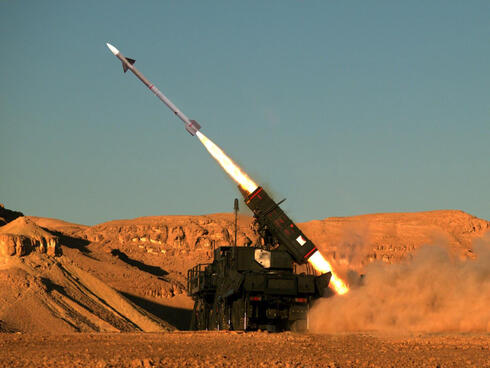
The weapons include air-to-ground bombs, glide bombs, advanced air-to-ground missiles, and interceptors for air-defense systems. Among the key systems are IAI’s Arrow 3 and Barak MX, as well as Rafael’s David’s Sling.
Earlier this week, Defense Ministry Director General Amir Baram convened the chief executives of the major defense companies for a situation assessment focused on the challenges of sustaining combat operations and maintaining production rates needed to replenish IDF stockpiles.
The discussions took place as the Israeli Air Force expanded its strikes in Lebanon, while Israel also heightened vigilance over the possibility that Yemen’s Houthi forces could join the fighting and resume missile attacks on Israel.
Production lines for weapons considered critical to the IDF have been operating around the clock since the outbreak of the October 7 war. The increase in output has been implemented alongside production commitments for foreign militaries, many of which are accelerating procurement amid a global arms race and shifting geopolitical tensions.
Investments made by defense companies during the war have enabled them in some cases to triple production capacity, allowing them to meet supply commitments to Israel’s Ministry of Defense while continuing deliveries abroad.
In the months since the 12-Day War with Iran, Israel’s defense industries and the research and development arms of both the IDF and the Defense Ministry have been working on what officials describe as “new surprises” intended for a future confrontation with Iran.
The reasoning is that some of Israel’s unique offensive capabilities, developed over roughly two decades, have now been exposed during the fighting, reducing the operational advantage they once provided.
When asked recently what kinds of new capabilities could be developed in as little as eight months, a defense source responded that “even the success of the operation that led to the assassination of Iranian leader Ali Khamenei is a surprise in every sense of the word.”
Development work on additional military capabilities is continuing at full speed during the war. Some systems may become operational within months, while others are expected to take years to mature.
Alongside the expansion of domestic production, the airlift of American weapons to Israel continued on Wednesday, including large quantities of different types of munitions.
The pace of U.S. deliveries has accelerated in recent days and is being carried out by both aircraft and ships under the supervision of Ze’ev Landau, head of the Defense Ministry’s Procurement Directorate, together with representatives of Israel’s procurement delegation in New York.
Officials describe the effort as a complex logistical operation requiring coordination among numerous suppliers. The Defense Ministry said the airlift of munitions from the United States will continue in the coming days.



