










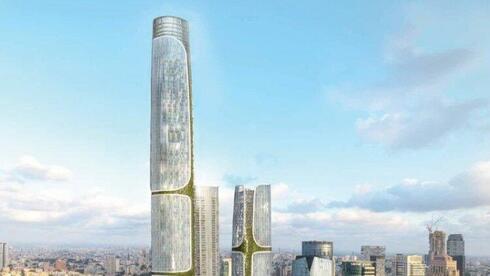
Israel’s tallest tower planned: 111 floors in Ramat Gan “Vertical City”
New development will redefine local skyline and include offices, housing, and student dorms.
Ramat Gan is set to redefine Israel’s skyline. The “Vertical City” project, currently under review by the Tel Aviv District Committee, is poised to feature the tallest tower in Israeli history, a 111-floor skyscraper that will dwarf existing high-rises and transform the Stock Exchange Triangle into a hub of residential, commercial, and educational activity. Alongside it, a 72-floor residential tower and a 60-floor office tower are planned, making the project one of the largest urban development initiatives in the country.
The Tel Aviv District Committee is scheduled to discuss in its meeting in approximately two weeks a plan initiated by the Ramat Gan Municipality to expand building rights for the “Vertical City” project, which is planned for the Stock Exchange Triangle. The proposal aims to include the Kern Bags building at 1-3 HaTa’as Street in the development. The plan also involves relocating Shenkar College from its existing complex on Anne Frank Street, covering roughly 12 dunams, to make way for a new school and kindergarten complex.
1 View gallery
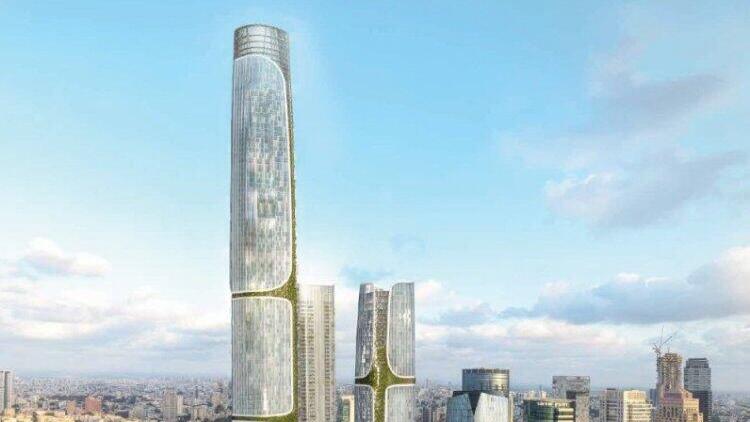
Vertical City visualization of the stock exchange complex in Ramat Gan
(dblk office and Raphael de la Fontaine and Ramat Gan Municipality)
According to a presentation prepared by the architectural firm Bareli Levitsky Kasif La Fontaine, the expanded area, approximately 11 dunams, will include two office towers of 60 and 111 floors and a 72-floor residential tower. The total built area of the project is expected to reach 354,000 square meters, including underground space. The development is promoted by Israel Canada (55.9%), BSR (19.6%), and Clal Insurance (24.7%).
Shenkar College will move into four floors of a low-rise building that also includes commercial and office spaces, connecting to the lobbies of the three towers. The residential tower will house 400 rental apartments and 350 student dormitory units.
Most of the land for the project was purchased from the Israel Land Authority in 2022 for NIS 936 million. Vertical signed combination agreements with the rights holders of 1-3 HaTa’as Street, with a condition that the new urban plan must be approved by December 2026. Additional land for parking was leased from the Ramat Gan Municipality.
According to Israel Canada’s 2025 annual report, the project’s marketing rate stands at 36%. In 2024, approximately 8,700 square meters of office space were sold; in 2025, only 1,718 square meters were marketed. The average price per square meter in signed contracts remains 25,000 shekels. Total expected revenue is estimated at 2 billion shekels, with a projected gross profit of around 534 million shekels.
If built as planned, the 111-floor tower would surpass Israel’s current tallest building. By global comparison, it would still fall short of the world’s tallest skyscrapers, such as the Burj Khalifa in Dubai (828 meters, 163 floors) or Shanghai Tower (632 meters, 128 floors), but it would place Israel on the map of nations embracing ultra-high-rise architecture.



