










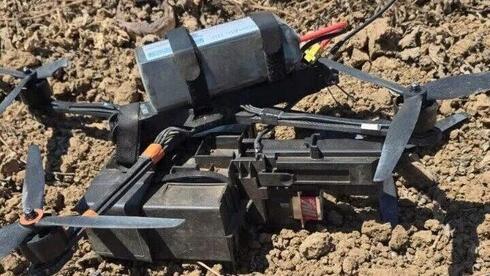
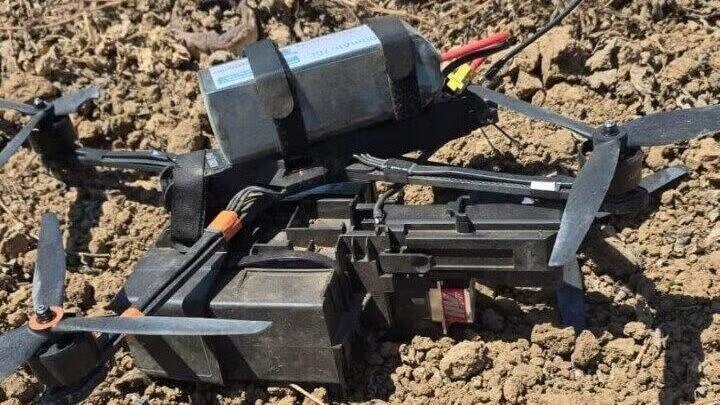
From battlefield innovation to deadly malfunction: The IDF’s Atalef drone
The military developed the system in months and is now investigating how one crashed inside an outpost and exploded.
The Israeli military has temporarily halted the use of attack drones for two days after one of its own unmanned aircraft crashed inside a Gaza outpost and exploded, killing two reservists who were operating it.
The incident involved the Atalef, or “Bat,” a family of attack drones developed by the IDF during the war that has rapidly become one of the military's most widely used tools across multiple fronts. The system was designed to be inexpensive, quickly produced and adaptable to different operational needs. It was developed in the Yiftach unit of the 99th Technological Brigade, with the first operational version ready just three months after development began.
Master Sgt. (res.) Nadav Kali, 24, of Har Halutz, and Master Sgt. (res.) Ofek Moalem, 23, of Jerusalem, were stationed at an outpost near Beit Hanoun and were operating two drones when the incident occurred.
The first drone was launched successfully and reached its target. The second was deployed but crashed inside the outpost. When the soldiers approached the downed aircraft, it exploded for reasons that remain unclear.
Both reservists were critically wounded. They received medical treatment at the scene before being evacuated by helicopter to a hospital in Israel, where they were pronounced dead.
The IDF has ordered an investigation into the incident, with an expert team led by a brigadier general from the Ground Forces examining the circumstances. The investigation will determine whether the explosion resulted from a technical malfunction or another cause, including the possibility of electronic warfare interference.
The military has not disclosed the cause of the incident. Pending the investigation, it has suspended use of the drone model for two days, after which it will conduct a renewed assessment of the situation.
The IDF has also distributed details of the incident and the lessons learned to battalions and brigades, with commanders and troops receiving the information yesterday.
The investigation comes at a particularly significant moment for the Atalef program. What began as a rapid wartime response to the need for small, mobile aerial weapons has evolved into a growing family of systems that the IDF says can be adapted for different missions.
The concept was inspired in part by the extensive use of FPV drones in the war in Ukraine. The IDF's Yiftach unit began developing the Atalef when the war created an urgent need for mobile systems that could be carried and flown by troops.
Within three months, the first version was ready for operational use. Soon afterward, the IDF recorded its first killing in Gaza using the system.
The drone is designed to carry a warhead and can track a target moving at speeds of up to 130 km/h. In June, the IDF published footage of an Atalef being used to kill a Hezbollah operative riding a motorcycle in southern Lebanon.
“The operators spot a suspicious target in the field, launch the ‘Atalef’, and before the enemy notices, the munition detonates,” Lt. Col. E., commander of Yiftach, said in the IDF's account of the system's development.
The system's appeal is not limited to its ability to attack targets. According to the IDF, its relatively low cost, weight, production rate and ease of training have made it useful compared with other means available to troops.
Its design is also deliberately modular. The IDF says the Atalef family has expanded from a single product into multiple versions adapted for different missions, with the ability to incorporate different components, including sensors and propellers.
The IDF says developers are now working toward drones that could identify and reach targets independently and operate alongside other drones as part of a coordinated “swarm.”
One concept described by the developers would allow a soldier to mark a suspicious window and have the drone enter and direct itself toward the target without requiring the same level of manual control.
The unit is also developing enclosed capsules that could store drones in the field and allow them to be launched remotely when needed.



