










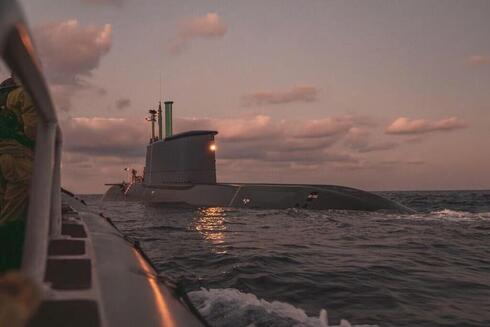
The submarine Israel built to extend its reach beyond the Middle East
INS Drakon brings longer underwater endurance and new intelligence and combat capabilities.
After nearly 14 years of planning, construction, testing and preparations, Israel’s sixth submarine arrived this week at the Haifa naval base, completing a roughly 24-day voyage from the German port of Kiel.
INS Drakon was formally welcomed Thursday in a ceremony attended by President Isaac Herzog, Defense Minister Israel Katz and IDF Chief of Staff Lt. Gen. Eyal Zamir.
The submarine’s arrival marks the completion of one of Israel’s longest defense procurement projects and the start of a new phase for the Navy’s submarine fleet.
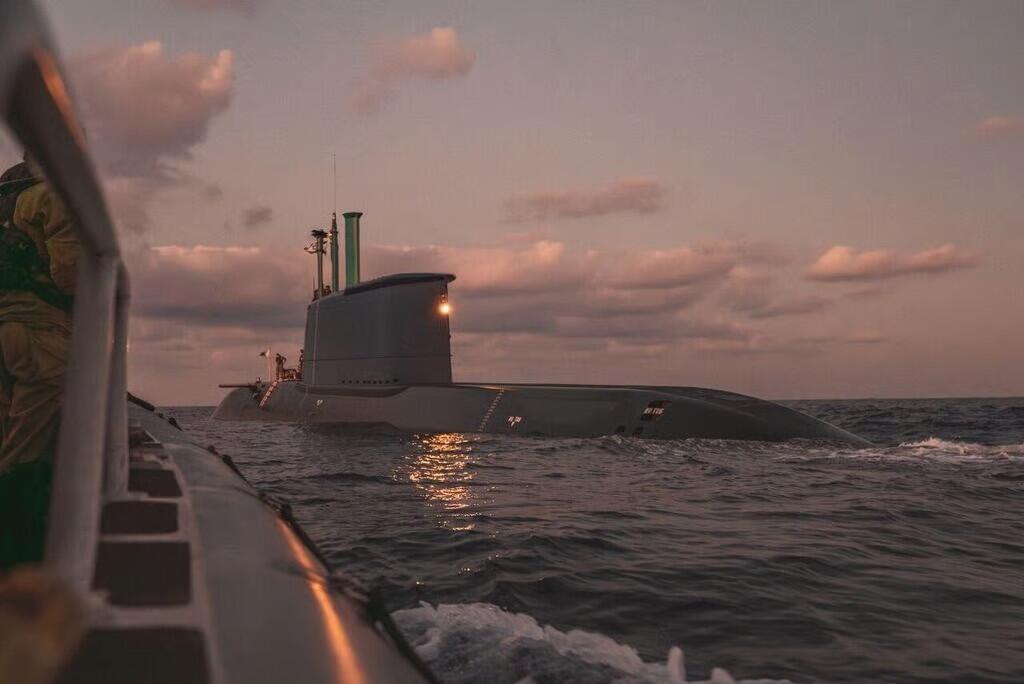
More than 70 meters long and weighing around 3,000 tons, Drakon is about 30% larger than the previous-generation Dolphin-class submarines. Its construction cost is estimated at around €500 million.
One of its key upgrades is an air-independent propulsion system, or AIP, which allows the submarine to generate power and recharge its batteries while submerged without drawing in outside air. The system is designed to extend underwater endurance while preserving the stealth that is central to submarine operations.
Drakon can operate at depths of hundreds of meters and has redundant systems designed to provide backup if equipment fails.
Some of its most important capabilities are still to be added. In the coming months, Israeli intelligence, sensing and combat systems developed by the country’s defense industries will be installed and integrated.
Foreign reports have said the submarine is capable of launching cruise missiles with a range of around 2,000 kilometers, a capability associated with Israel’s submarine fleet and its strategic second-strike doctrine. Israel does not officially disclose the weapons capabilities of its submarines.
Brig. Gen. Guy Levy, head of the Navy’s staff, described the basic concept behind Drakon as the ability to reach distant areas, remain undetected, gather intelligence and, if necessary, strike before disappearing again.
The Navy sees the new submarine as particularly relevant as maritime threats have expanded across the region.
Israeli officials point to Houthi attacks around the Bab el-Mandeb Strait and Iran’s military activity around the Strait of Hormuz as examples of the growing importance of operating far from Israel’s shores.
“The current war has demonstrated the paramount importance of maritime control,” Levy said.
Turkey is another concern for Israeli naval planners. Officers generally avoid naming the country directly, but point to a regional power that is building a naval force significantly larger than Israel’s.
The shift is notable given the military cooperation that once existed between Israel and Turkey, including joint naval exercises.
Drakon’s arrival also closes a controversial chapter in Israel’s submarine program.
The decision to acquire a sixth submarine was for years the subject of intense public debate and later became linked to the broader submarine affair and the state commission of inquiry.
The Navy is now looking beyond the sixth vessel. Navy Commander Maj. Gen. David Saar Salama has discussed the possibility of acquiring seventh and eighth submarines.
The aim would be to preserve the Navy’s ability to operate in distant theaters, including Yemen and the Persian Gulf. The future submarines would replace aging Dolphin-class vessels rather than permanently expand the fleet.
\The submarine’s arrival was preceded by years of preparation in Germany, where Israeli crews inspected the vessel system by system and participated in sea trials and deep-water testing.
The process was complicated by diplomatic restrictions in parts of Europe. Norway and Denmark at various points did not allow the Israeli submarine to enter their territorial waters, conduct exercises or receive spare parts, against the backdrop of the war in Gaza and its political sensitivities.
The crew therefore had to repeatedly sail from Germany to deep-water training areas between Norway, Sweden and Denmark before returning.
The Navy says the diplomatic difficulties did not ultimately compromise the training process and that it was able to find alternative solutions with the help of other countries and Israeli defense companies.
The technology is only one part of the challenge. More than 50 crew members will spend extended periods inside the submarine with no cellphones and almost no connection to the outside world.
Contact with home is limited, with the crew receiving a daily message summarizing the news.
Drakon has two showers and two toilets, as well as a gym and a “mood room” where sailors can watch television and spend time together. A dedicated chef prepares three hot meals a day.
But the basic reality remains unchanged: for weeks at a time, the crew cannot simply step outside. Navy commanders say the ability to function as a single team under those conditions is as important as the submarine’s technology.
Drakon’s name recalls INS Dakar, the Israeli submarine that sank in 1968 while sailing to Israel, killing all 69 members of its crew.
The name combines that legacy with the image of the dragon, a symbol of strength and power.
One crew member aboard the new submarine has also visited the wreck site of Dakar and raised an Israeli flag there, connecting the vessel lost nearly six decades ago with the submarine now entering Israeli service.
Drakon is not yet fully operational. In approximately two months, it is expected to enter a maintenance facility for the installation and integration of Israeli weapons and intelligence systems.
Only after that process will Israel’s newest submarine begin its operational life.



