










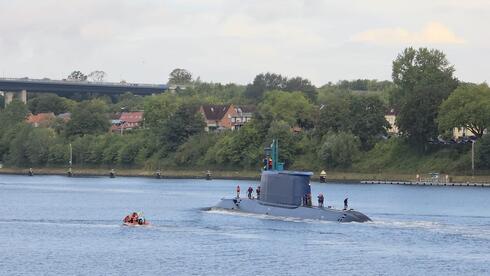
“Greater stealth, at greater distances and depths” as Israel’s new submarine arrives
IDF chief Eyal Zamir described the INS Drakon as a key step in the Navy’s force buildup and a boost to its operational reach.
Israel’s newest submarine arrived in Haifa on Thursday after a 24-day voyage from Germany, bringing a new element to a naval force that Israel says will have to operate farther from home and for longer periods in an increasingly contested maritime environment.
The arrival of the INS Drakon was marked by a ceremony at the Haifa Naval Base attended by President Isaac Herzog, Defense Minister Israel Katz, Chief of the General Staff Lt. Gen. Eyal Zamir and Navy Commander Maj. Gen. Eyal Harel. But it was Zamir’s remarks that offered the clearest indication of how the military views the submarine’s significance.
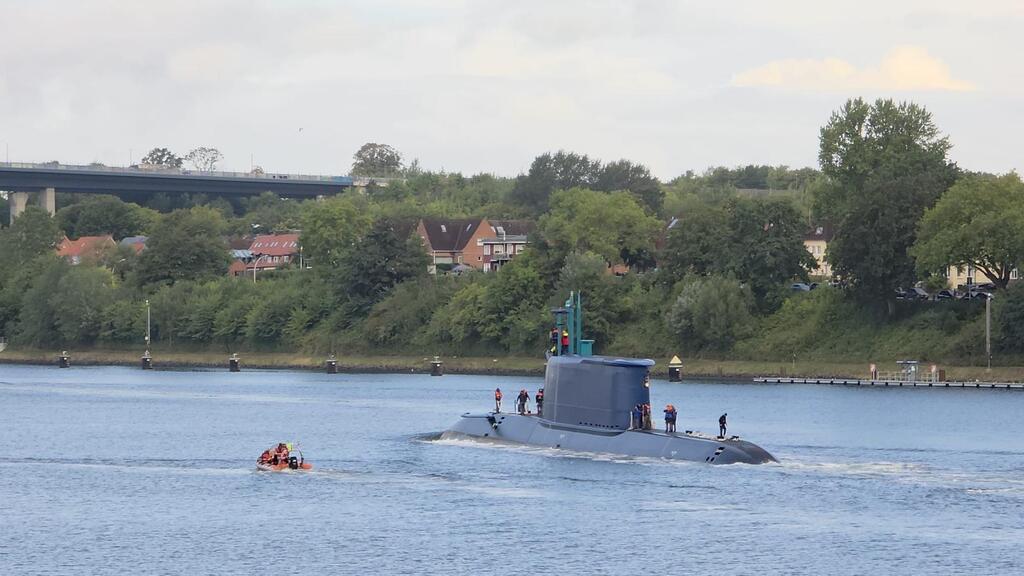
“Even now, we keep a watchful eye on the actions of Iran and its proxies; the Iranian regime is battered and bruised, yet fails to alter its intentions,” Zamir said. He described the Drakon as a major step in the IDF’s force buildup, saying its arrival would give the Navy an enhanced maritime posture and allow it to operate “with greater stealth, at greater distances and depths, and with increased lethality.”
Drakon traveled through the Mediterranean under heavy security, with its movements kept secret and the vessel operating at depth. Israel has not publicly detailed many of the advanced systems aboard the submarine.
The Drakon is Israel’s sixth submarine and the third and final vessel in the Dolphin air-independent propulsion, or AIP, series acquired by the Defense Ministry for the Navy. The 74-meter, 2,600-ton vessel is the largest and heaviest submarine ever to enter Israeli service. Its AIP system allows it to remain submerged for longer periods without needing to surface for air, fitting the Navy’s emphasis on covert, long-range operations.
The Drakon is the final submarine of the existing Dolphin program, while Israel is developing three new Dakar-class submarines with Germany that are expected to form the next generation of the fleet.
Much about what lies inside the submarine remains undisclosed. The Defense Ministry and IDF have described it as incorporating “unique systems” and “groundbreaking technologies,” but have not publicly specified the capabilities that distinguish it from earlier submarines.
That secrecy has extended to the vessel’s journey to Israel. The submarine’s passage from Germany was conducted under heightened security because of concerns that regional and global powers could attempt to collect intelligence on the new vessel. Its arrival followed years of construction, testing and preparation in Germany.
The journey was also delayed by difficulties during the testing phase. According to a senior military official, Norway and Denmark at one point prevented the submarine from sailing in their waters for training and testing, despite the vessel operating under the German flag.
“This caused a delay of several months in the preparations,” the official said. “The Navy also had to deal with embargoes and boycotts imposed by various countries due to the war.”
The Israeli and German crews ultimately had to conduct training in the waters between Sweden and Denmark.
The submarine will not immediately enter operational service now that it has reached Haifa. Israeli systems still need to be installed aboard the vessel, a process expected to take several months before it becomes operational.
“The sea will become an increasingly complex, crowded, and demanding arena,” Harel said at the ceremony. “Threats are evolving, technology is changing rapidly, and operational theaters are expanding.”



