










Boarding Pass
A third-generation stonemason is looking to transform construction with 3D printing
Born out of a veteran stone and marble firm, Israeli startup Shahaf PY is using advanced robotics to help construction sites print complex concrete elements independently, from custom housing to defense applications.
“The global construction industry is facing a multi-dimensional crisis: rising demand for infrastructure and housing, severe skilled labor shortages, increasing material costs, and heavy environmental pressure,” says Eran Carmi, Founder and CEO of Shahaf PY. Born out of the development department of veteran firm Shahaf Stone & Marble, the Israeli startup is building a new generation of 3D concrete printing systems designed to propel the industry toward smarter, highly scalable manufacturing.
“My career began working with my father in a basalt quarry in Tiberias. Both he and his father were stonemasons and taught me the value of craftsmanship,” Carmi explains. “Following in their footsteps, I dedicated my career to developing high-end building materials... Now, together with my team... we solve complex and unconventional architectural challenges by harnessing innovation.”
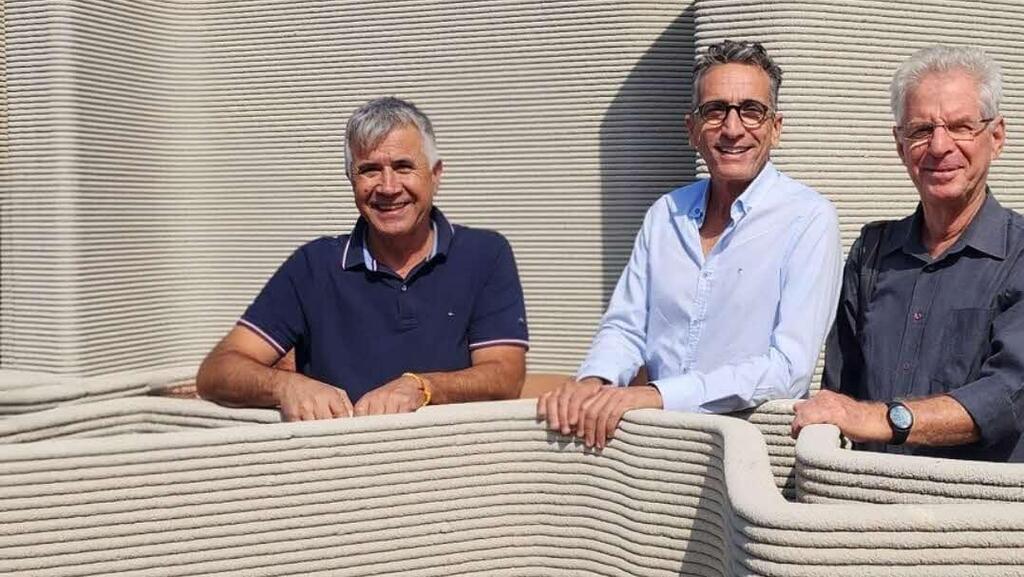
At the heart of Shahaf PY’s solution is the ability to print with standard local concrete, completely eliminating the need for expensive, proprietary mixes. The startup's product has been used in luxury architectural projects worldwide and has secured collaborations with the Ministry of Defense and foreign entities to develop advanced protective technologies.
Operating from Kibbutz Moran in the Western Galilee, the company takes pride in demonstrating that groundbreaking tech innovation can emerge far from the traditional tech hubs in Israel.
You can learn more about the company below.
Company Name: Shahaf PY
Sector: 3D Printing
Product/Service description:
Shahaf PY is an Israeli company developing advanced printing systems for defense, industrial, construction, and infrastructure applications. The company specializes in 3D printing of customized solutions and products tailored to client needs, and leverages a unique, AI-based technology currently in the process of being patented.
In addition, the company’s solutions cover the entire value chain – from the development of dedicated materials, through digital design and printing methodologies, to the development and manufacturing of robotic printing systems, and ultimately to on-site or factory-based production.
Founder Bios:
Eran Carmi (Founder and CEO, and lecturer at the Faculty of Architecture at the Technion) – My career began working with my father in a basalt quarry in Tiberias. Both he and his father were stonemasons and taught me the value of craftsmanship. Following in their footsteps, I dedicated my career to developing high-end building materials (concrete, stone, metal, wood, glass, and other elements) that are used in architectural projects all over the world. Now, together with my team at Shahaf PY and Snoonit, we solve complex and unconventional architectural challenges by harnessing innovation.
Alongside Carmi, the founding team also includes: Dr. Galit Agranati, who leads the development of advanced materials and concrete for industrial printing; Dr. Tom Shaked is responsible for robotics, software, and automation of the printing systems; Shimshon Bar-Ziv, a former Rafael executive who leads hardware engineering and complex industrial systems; and Yehuda Turgeman, who is in charge of developing sustainable cement and concrete materials.
Year of Founding: 2023
Last Investment Round: $1.5M
Last Investment Stage: Seed
Date of Last Investment: 01/01/2026
Total investment to date: $2.5M
Investors: Israel Innovation Authority and private investors
Current number of employees: 25
Open positions: N/A
Website: https://www.shahaf-py.com/
Social Media: LinkedIn
How was the idea born?
Shahaf PY was born out of the development department of its parent company, Shahaf Stone & Marble, a company with many years of experience in creating advanced manufacturing solutions for architectural and design elements in the construction industry. Through hands-on work in the field and deep observation of industry trends, it became clear that the future of construction requires moving away from traditional manufacturing toward smarter, more flexible, and scalable solutions.
The enormous potential of 3D concrete printing led to the establishment of Shahaf PY as an independent company focused on developing a new generation of printing systems. The company develops a holistic technology that integrates material, software, and hardware to enable precise, fast, and high-quality production, anywhere and under any conditions.
Shahaf PY’s vision is to lead advanced construction and enable its customers to build smarter, faster, greener, and with significantly higher efficiency.
What is the need for the product?
The global construction industry is facing a multi-dimensional crisis: rising demand for infrastructure and housing, severe skilled labor shortages, increasing material costs, and heavy environmental pressure.
In this reality, 3D concrete printing is shifting from an experimental trend to a genuine strategic solution. It breaks the direct link between complexity and cost, offering nearly unlimited design freedom at no additional expense, while delivering minimal material waste, reduced dependence on manpower, and lower on-site risks.
At the heart of Shahaf PY’s solution lies the ability to print with standard local concrete, without the need for special mixes. The system enables every construction site or factory to produce on its own, with full control from material to final product.
The technology also shifts the focus of R&D to the customers themselves, as we develop the R&D in close cooperation with veteran strategic partners in the fields of energy, infrastructure, defense, aviation, and maritime. Shahaf brings the technology and innovation, while the partners bring domain knowledge and precise needs, enabling new manufacturing processes and far more advanced, intelligent products than traditional methods can achieve.
Thus, alongside residential construction, the technology is also used for producing molds, roads, complex infrastructure elements, and defense applications.
How is it changing the market?
Shahaf PY is bringing a profound change to the market, one that begins at the technological level and ultimately redefines the entire value chain in the construction industry. The transition from experimental printing to a true industrial solution turns construction sites and factories into real-time smart manufacturing hubs. Instead of slow, labor-intensive, mold-dependent processes, a digital, precise, and flexible process emerges, one that responds to needs instantly.
The core change is the shift from a rigid production model to a completely dynamic one. Instead of “production for inventory” and dependence on expensive molds, on-demand manufacturing becomes possible, fully synchronized with project progress. This results in significant savings in time, space, and costs, while unlocking design possibilities that were previously unfeasible.
The fundamental difference between standard 3D concrete printing and Shahaf PY’s solution is what makes this transformation possible: while most existing solutions rely on expensive, proprietary mixes and closed systems requiring high expertise, Shahaf PY enables the use of standard delivered concrete in open, flexible systems. The printers are not limited to a single robotic platform and can be adapted to a wide variety of configurations according to need.
How big is the market for the product and who are its main customers?
The 3D concrete printing market is developing rapidly, moving from an experimental niche to a major industrial sector. It can be divided into two main segments: printing services and products, and equipment and hardware.
The services and printed products market is currently estimated at $3.5-4 billion (2024-2025) and is growing at an exceptional rate of 100%-115% annually in aggressive scenarios. Forecasts indicate the market will exceed $40 billion by 2030.
The printer and hardware market is currently smaller ($500-800 million) but is expected to grow at a similar pace as demand for printing services increases. Shahaf PY is well positioned in the equipment segment thanks to its technology that significantly lowers adoption barriers.
Its key target customers are:
- Construction and Infrastructure Companies seeking to shorten timelines and overcome labor shortages.
- Government and Defense Organizations that are focused on rapid response, logistics, and deployment in the field (temporary infrastructure, fortifications, disaster recovery).
- Precast Manufacturers and Design Firms looking to replace expensive mold-based production with flexible, customized manufacturing of urban furniture, architectural elements, and infrastructure components.
Does the product exist already?
Shahaf PY’s product is already operational in the field. The company runs an active production floor with multiple robotic printing systems working in parallel, manufacturing real products for the market. This environment serves both as a production line and as a living development lab where every component – material, software, and hardware – is tested, improved, and adapted to real-world conditions.
At the same time, the engineering teams are developing the next generation of autonomous, precise, and user-friendly systems, with the vision of making complex 3D concrete printing as intuitive as sending a file to a desktop printer.
he material exists, but our way of making it is the revolution. We have successfully moved past the laboratory phase and begun semi-industrial-scale manufacturing. This is a pivotal milestone that enables us to secure our first sales to end users and start strategic partnerships with major global market players.
Who are the main competitors in this sector and how big are they?
The 3D concrete printing market is still young, but several international players already stand out. Most have demonstrated impressive capabilities in specific projects, yet most solutions still rely on closed systems, proprietary mixes, or limited robotic configurations. This is where Shahaf PY’s differentiation lies:
- COBOD (Denmark) – Strong in hardware sales, known for large gantry systems and collaborations with PERI and GE Renewable Energy.
- ICON (USA) – Highly funded and publicized, leading large residential projects and NASA collaborations. Uses proprietary Lavacrete mix and a closed system.
- Apis Cor (USA) – Known for compact robotic systems and the famous Dubai municipal building project. Offers good mobility but with limitations in scale and industrial applications.
While most competitors focus primarily on house construction, Shahaf PY operates in both residential building and in infrastructure, defense, energy, and advanced industrial applications.
What is the added value that the founders bring to the company and the product?
Carmi brings a rare combination of deep understanding of the construction and design market with proven execution capabilities. His background enables him to identify real customer pain points – costs, operational complexity, and labor dependence – and to build a practical solution that connects directly to the field rather than remaining in the lab.
Dr. Shaked (architect, researcher, and senior lecturer at Ariel University) leads the company’s technological-architectural vision. With a PhD from the Technion, post-doctoral research in Munich and Tel Aviv, and collaborations with companies such as Apple and Nike, Shaked is responsible for robotics, digital manufacturing, and computational design. He bridges architecture and technology to ensure SHAHAF PY printers deliver not just construction, but innovative and customized design solutions.
Turgeman (concrete expert with over 35 years at Nesher Israel Cement Enterprises), serves as the chief materials expert. His vast experience in mix optimization, quality control, and material development enables Shahaf PY to print successfully with standard local concrete while meeting the strictest standards and performance requirements.
Dr. Agranti (civil engineer and senior lecturer at the Technion), is a specialist in sustainability and advanced building materials. She focuses on optimizing concrete mixes for printing, improving durability and mechanical properties, and ensuring green solutions that meet ESG and regulatory demands.
Bar-Ziv (materials engineer with 38 years of experience at Rafael Advanced Defense Systems), brings an expertise in advanced manufacturing processes, quality assurance, and extreme materials. His defense-industry background significantly contributes to the development of reliable, robust systems suitable for industrial and defense applications as well.
The combination of extensive field experience, academic excellence, and entrepreneurial thinking creates a unique added value: a team that develops not just a printer, but a complete, practical, and advanced industrial system.
What will the money coming in from the round be used for?
The funding will enable the creation of a vertically integrated manufacturing and production center, featuring a dedicated printer farm that will serve as the backbone for scaling operations, accelerating innovation, and meeting growing market demands.
In the "Startup Boarding Pass" section, CTech will cover the (relatively) small investments made in companies during the early stages of their existence - and the entrepreneurs and startups who have not yet had the opportunity to reveal their stories to the world. Please use the linked form and fill it out according to the guidelines. This form is intended for startups raising between $500,000 and $3 million from venture capital funds, angels, or official grants from Israeli and foreign institutions. If relevant, someone at CTech will be in touch for follow-up questions.



