









Will Nvidia remain as committed to Israel without Jensen Huang?
Israel has become one of the company's most important R&D hubs, with local teams central to its networking technology and other core products. But while those operations are deeply embedded in Nvidia's business, the planned multibillion-shekel campus in Kiryat Tivon could be more exposed to a change in leadership or a downturn in the AI market.
One could say many unpleasant things about Jensen Huang, particularly in light of recent events. But one thing cannot be taken away from him: he has been an ardent admirer of Israel and arguably the country's strongest supporter within Nvidia. Under his leadership, Israel has become a significant, even critical, R&D hub for the company. He was also the driving force behind the ambitious plan to establish a massive Nvidia campus in Kiryat Tivon, a project that could enable the company to hire up to 10,000 additional employees in Israel, more than doubling its local workforce. Now, with Huang's position potentially at risk, a question arises: will Nvidia remain as committed to Israel if a different CEO takes the helm?
Nvidia has been active in Israel since 2016. In its early years, however, the company's presence was limited to a few dozen employees and focused primarily on commercial operations, alongside a small development team led by Prof. Gal Chechik. The real "romance" between Nvidia and Israel began in March 2019, when the company agreed to acquire Mellanox for $6.9 billion.
Nvidia moved quickly to integrate Mellanox's networking chips into its product ecosystem. The company recognized that while powerful processors are essential, they cannot reach their full computational potential without the right networking infrastructure. Mellanox's solutions effectively served as the "highways" connecting Nvidia's chips and data centers, allowing them to operate more efficiently and giving the company an advantage in handling workloads and accessing data.
1 View gallery
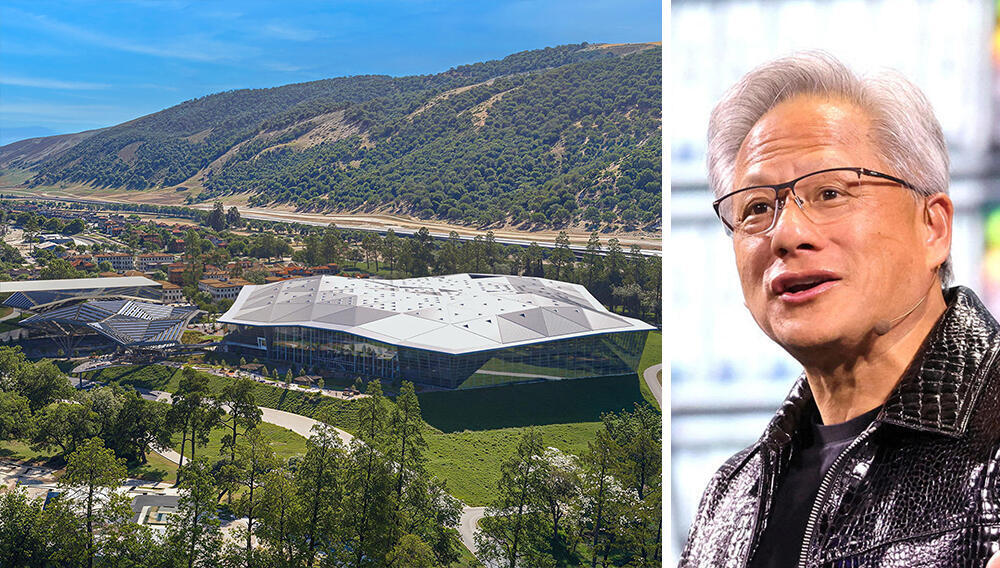
Jensen Huang alongside an illustration of Nvidia's new Israel campus.
(Photos: Reuters/Steve Marcus, Nvidia)
The fit was ideal, and Israel rapidly became Nvidia's largest and most significant R&D hub outside the United States. At Nvidia's GTC conference in San Jose in 2025, Huang presented a roadmap featuring five of the company's core products for the coming years. Development of three of them was being led from Israel.
Today, Nvidia's Israeli R&D center is involved in almost every major area of the company's development. "The lion's share of the networking division is based in Israel," Gilad Shainer, Nvidia's senior vice president of supercomputing and networking, recently told Calcalist. "However, because Nvidia operates as a unified organization, there are teams in Israel working on CPUs and GPUs as well, alongside collaborations with local start-ups."
There are also groups in Israel focused on autonomous vehicles and applied AI research. Communications technology is not a peripheral element of Nvidia's business, but an essential and inseparable part of the computing revolution.
Another area of work at the Israeli center involves addressing the problem of "rogue models," an issue that has attracted growing attention in the AI industry in recent months. "A processor being developed in Israel enables an external control mechanism for the actions of AI agents. It monitors all their activities in a way they cannot bypass, allowing them to be halted if necessary," Shainer said.
Huang was quick to recognize the importance of Israel to Nvidia. The company is now pursuing one of the largest foreign investment projects in the country's history: a new campus in Kiryat Tivon, covering 90 dunams (approximately 22 acres), with 160,000 square meters of built-up space. The facility is expected to be roughly the size of two of Nvidia's "spaceship" campuses in Silicon Valley combined, making it the largest technology campus in Israel. The company is expected to move in by 2031, and the project is estimated to cost billions of shekels.
Nvidia's commitment to Israel is due in large part to Huang himself, who has consistently demonstrated strong support for the country, even at a time when its international standing has deteriorated. "When Jensen speaks about Israel, he makes no secret of his support for the entire Nvidia team based there," Shainer said. "He was deeply involved in the case of Avinatan [Or], an Nvidia engineer who was abducted to Gaza on October 7 and released two years later, and remained in contact with his family. He has a wonderful team in Israel, and he views the entire company as one big family."
The question is whether Israel's standing within Nvidia could suffer under a different CEO who is less committed to the country. Much would depend on who that person is. If, for example, Johny Srouji, the senior Israeli executive at Apple, were to take over from Huang, it seems unlikely that Nvidia's relationship with Israel would be weakened. More broadly, however, the Israeli operation has become so deeply embedded in Nvidia's business that its position is now difficult to change through the influence of any single CEO.
The R&D center plays a pivotal role in the development of Nvidia's networking chips and other products. Any attempt to undermine its role would risk significant disruption within the company, precisely when a new CEO would need to project stability and confidence in Nvidia's future direction. There is also a strong sense of affinity for Israel across the company, making it difficult to imagine broad internal support for a move that would damage its existing operations in the country. From a purely business perspective, there is little incentive for Nvidia to weaken, relocate or scale back an operation that has become one of the engines of its growth.
The planned campus in Kiryat Tivon is a more complicated matter. Nvidia has already acquired the land and is nearing the completion of the planning and approval processes. Construction is scheduled to begin next year. The project is moving forward, but it has not yet passed the point at which cancellation would be practically unthinkable.
Even so, scrapping the plan without a compelling business reason would send a negative signal to investors. But if Nvidia's revenue were to suffer a significant blow, perhaps because of a collapse in AI investment, and the company faced a genuine need to cut costs, the campus could become a prime target. The project involves an investment of billions of shekels, while the ongoing costs of staffing and operating the facility would add considerably to the bill once it opens. In such circumstances, any CEO, including Huang, could decide to cancel it. The difference is that a leader with less commitment to Israel might be more inclined to prioritize the project for cancellation over other investments.
For now, time is working in Israel's favor. The further the project advances, the harder it will be to abandon. If the AI bubble, assuming there is one, does not burst in the coming quarters, construction of the Kiryat Tivon campus will move closer to becoming a fait accompli, regardless of who is Nvidia's CEO. And if the bubble does burst, triggering a collapse across the AI market and hitting Nvidia particularly hard, then we will all have much bigger problems to worry about, whoever happens to be at the helm.



