










Shawarma and rubble: The paradox of Gaza’s post-war recovery
Food stalls and improvised construction jobs signal early economic activity, but systemic recovery remains elusive.
The ceasefire in the Gaza Strip after two years of war has created a reality in which the IDF is deployed across more than 50% of the territory, and in large parts access to infrastructure, property, and agricultural land is limited or prohibited. At the same time, most of the population has been pushed into a narrow coastal strip, where Hamas maintains mechanisms of influence, enforcement, and a shadow economy. Anyone touring the traditional commercial centers of the Gaza Strip today, which remain under Hamas influence, will find it difficult to determine whether they are witnessing the start of a miraculous recovery or merely the survival maneuvers of a population that has learned to adapt to extremely difficult conditions.
The Gazan economy is currently in an unusual intermediate stage. On one hand, there has been an almost complete structural collapse of employment and production over the past two years of war. On the other, there is a localized revival driven by humanitarian aid, small-scale street entrepreneurship, and sparse cash flows. Contrary to expectations that Gazans might have had for a rapid and comprehensive reconstruction program immediately after the war, the reality suggests a prolonged phase of early recovery. Economic activity now stems less from capital investments, since the international community remains hesitant to inject funds without visible governmental stabilization, and more from the ability of local retail markets to adapt to changing inventories.
1 View gallery
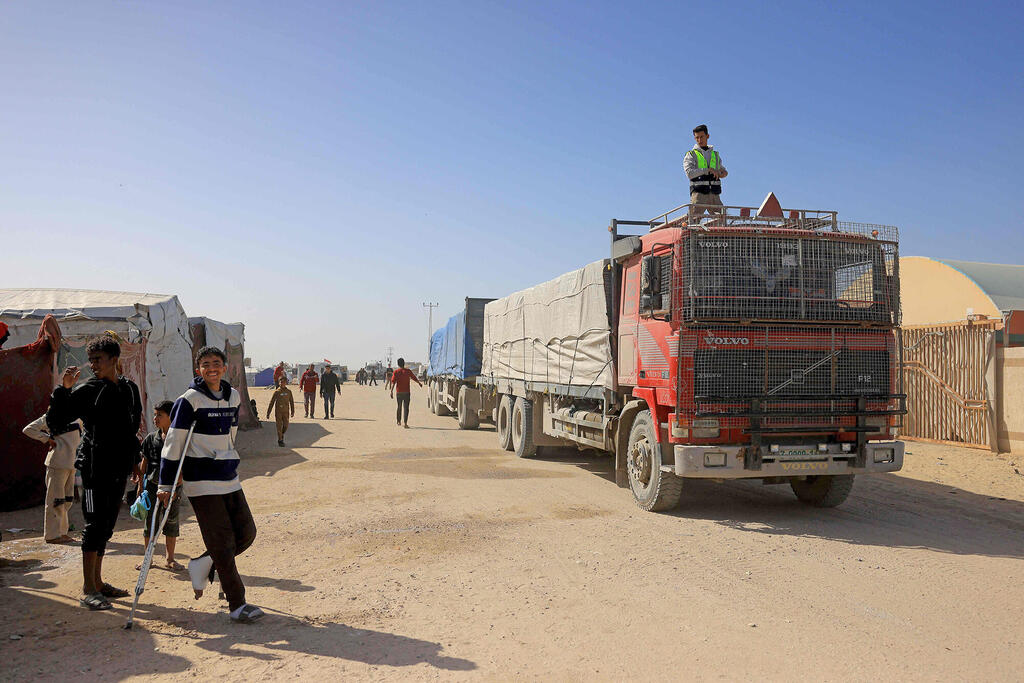
Trucks carrying humanitarian aid through the Rafah Crossing arrive in Khan Yunis, Gaza
(Bashar Taleb/AFP)
Nothing illustrates this paradox better than the food and bakery industry in the heart of Gaza City. The Arab media recently reported on Abu Zuhair Bakery in the Old City, a case that exemplifies the new operating model in the Strip. Previously equipped with a strategic location and advanced industrial equipment, the bakery was forced to reinvent itself after the ceasefire, operating in near-zero infrastructure conditions. Production shifted to manual methods using improvised combustible materials, such as wood and furniture scraps.
Economically, this represents a decades-long setback in labor productivity. While baking in a gas oven once took about half an hour, it now requires six hours due to manual heating and maintenance. Operating costs are significantly higher, yet in the vacuum of local production, these businesses are the only sources of economic activity. The improvised methods are not only a survival necessity but have become the backbone of the new “street kitchens,” which produce low output at high real costs despite rigid demand for basic food.
The return of restaurants and street stalls is part of a broader trend in commercial centers such as the Al-Zawiya Market. According to the UN Office for the Coordination of Humanitarian Affairs (OCHA), most markets in Gaza are currently open, and some have seen prices drop by around 11.5% in the past month. This decline is mainly due to increased humanitarian goods, but it is misleading: the purchasing power of most locals remains low. Restaurants in 2026 operate in an "instant economy" format, cooking based on the supplies delivered that morning, flour, oil, and legumes, rather than a fixed menu. Services are partial, limited to a few hours a day, and fully dependent on logistical continuity through the crossings.
“The smell of shawarma has returned to the streets, but some meat comes from canned goods or very limited local slaughter,” a trader told Al Jazeera about the street stalls resuming operations.
Liquidity and the Push Toward Digital Payments
The banking system presents one of the most complex challenges for Gaza’s economy. Despite directives from the Palestinian Monetary Authority and the Palestinian Central Bank to reopen branches, the Strip suffers from a severe shortage of physical shekel notes. This has created a black market where street money changers charge 15-30% for converting digital balances into cash.
While protests against this “tax” have emerged in front of banks, it is also accelerating forced digitization. Electronic wallets, such as Jawwal Pay, and phone-based payments have become common in vegetable stands out of necessity. In a December survey, 95% of business owners reported accepting cash payments, while 80% also accepted electronic wallets. Barriers to broader adoption remain, primarily because most wholesalers still demand cash.
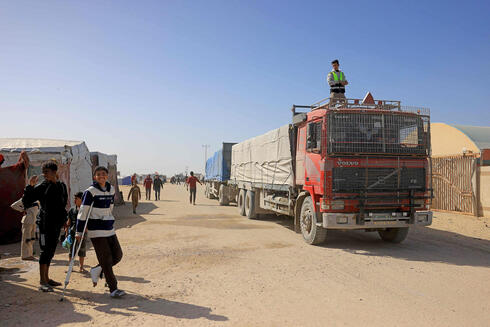
The fragile economy depends on the flow of trucks through crossings. The opening of the Rafah crossing to limited traffic does little to change this. Western foreign ministers, in December 2025, called for the entry of 4,200 trucks per week, with 250 allocated to the UN. In practice, only about 459 trucks entered per day (≈3,200 per week), below the target. The main bottleneck is logistical: warehouses and access roads were damaged during the war, causing trade and prices to fluctuate in waves.
Large-scale reconstruction has yet to begin. Current efforts focus on “gray reconstruction,” basic operations enabling movement and commerce, such as waste removal and road repairs. An extensive rubble recycling industry has developed, crushing concrete for road repair and restoring water and sewage lines.
Thousands of Gazans are employed in manually mining iron and concrete from rubble. Drivers of this labor market include private demolition contractors, the UN, and individuals extracting materials from their homes for sale. Daily wages are low, around 30 shekels, but this activity provides one of the few sources of employment.
Despite losing control over half of the Gaza Strip, Hamas remains a significant economic player. Operating a shadow economy, the terror organization collects “security fees” from aid trucks, takes control of some goods for resale, and manages a network of money changers. This creates market distortions: in central and southern Gaza, consumer prices rise sharply due to fees charged along supply routes.



