










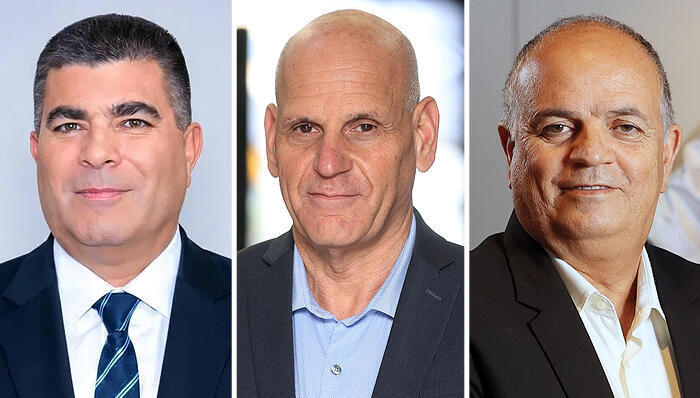
Israel's defense giants are financing the state's war effort as unpaid bills pile up
The government owes Rafael and IAI approximately NIS 14.5 billion, with the combined debt expected to reach NIS 16.5 billion by year-end. The companies are bearing substantial financing costs as the Finance and Defense ministries clash over how to settle the bills.
The state's mounting debt to Israel's defense industries has become a source of growing friction between the Government Companies Authority and the Ministries of Finance and Defense. The dispute follows a report by Calcalist last week that the government intends to increase its debt to state-owned defense companies Rafael and Israel Aerospace Industries (IAI) as a way of navigating its current financial constraints without breaching the budget framework.
At the same time, the Accountant General's Division at the Ministry of Finance has reached an arrangement with private defense contractor Elbit Systems over debts owed to the company by the Ministry of Defense. Under the agreement, the state has committed to covering the financing costs associated with those debts.
The Government Companies Authority is frustrated by the Finance Ministry's efforts to advance an arrangement with Elbit while showing less urgency in establishing a similar mechanism for Rafael and IAI, to which the state owes the bulk of its outstanding debt, estimated at approximately NIS 14.5 billion.
1 View gallery
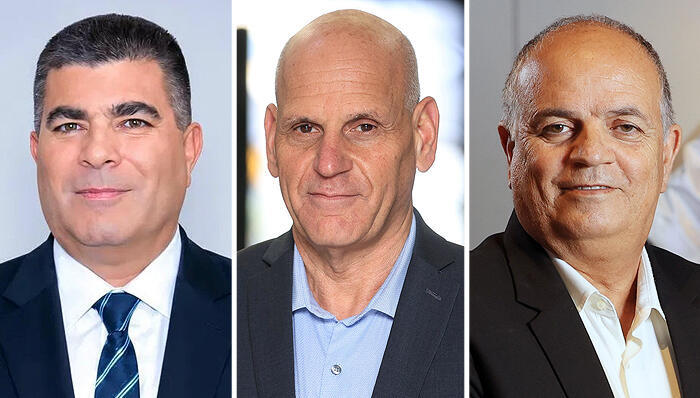
Rafael CEO Yoav Turgeman (from right), Elbit CEO Butzi Machlis and IAI CEO Guy Barlev.
(Photos: Elad Gershgoren, IAI)
Neither the Ministry of Finance nor the Ministry of Defense has disclosed the details of its arrangement with Elbit. Elbit has also declined to provide specifics, referring to the matter only briefly in its third-quarter financial report, released last week. At the time, CEO Bezalel (Butzi) Machlis told Calcalist that "it is a fair arrangement."
But Roi Kahlon, general manager of the Government Companies Authority, has raised concerns about what he sees as unequal treatment of private and state-owned defense contractors. "The disparity in how non-government companies are treated compared to state-owned companies raises a genuine concern regarding the potential abuse of the State's position, both as the controlling shareholder and as a significant client of these companies," he wrote.
Kahlon raised the issue in an urgent letter sent over the weekend to Michal Abadi-Boiangiu, the Accountant General at the Ministry of Finance, concerning the state's outstanding debts to IAI and Rafael. He argued that while the Accountant General is prepared to cover the financing costs associated with the debt owed to Elbit, she does not intend to offer the same arrangement to the two state-owned companies. Instead, the Finance Ministry plans to offset those costs against dividends that Rafael and IAI are already obligated to pay the state as their owner.
Approximately NIS 3 billion in accumulated profits from 2024 and 2025 has yet to be distributed to the state as dividends. The amount represents 50% of each company's annual net profit, which is due to be transferred to the state once the respective boards of directors declare a dividend. However, given the government's growing debts to the companies, and following guidance from the Government Companies Authority, Rafael and IAI have so far refrained from making the distributions.
Kahlon views the proposed offsetting arrangement as an attempt to circumvent the legal mechanism governing dividend distributions. He argues that "it is unreasonable for a private company to receive full compensation for financing costs, while state-owned enterprises are expected to bear these costs themselves, simply because the state sits on both sides of the transaction, acting as both their owner and their client."
Kahlon also argues that predetermining the amount of a dividend, or offsetting it against commercial debts owed by the Ministry of Defense in its capacity as a customer, would undermine the authority of the state-owned companies' boards of directors and their obligation to operate according to commercial considerations.
The state's debt to Elbit is estimated at approximately NIS 3.5 billion. Its outstanding obligations to Rafael are at least NIS 8 billion, while the debt to IAI stands at approximately NIS 6.5 billion. These unprecedented sums have accumulated as a result of urgent orders for munitions and weapons systems placed by the Ministry of Defense since the outbreak of the war on October 7, 2023.
The Government Companies Authority estimates that by the end of the year, the state's combined debt to Rafael and IAI will rise from approximately NIS 14.5 billion to NIS 16.5 billion. Around 75% of the total debt owed to the three companies is more than 90 days overdue, according to the Authority.
The delays force the defense companies to shoulder substantial financing costs and seek additional sources of credit, a burden that can also affect their ability to pay suppliers. The combined annual financing cost associated with the state's debt to the three companies is estimated at approximately NIS 1 billion.
Despite a sharp increase in defense spending, with the budget now nearly twice its pre-war level, the Ministry of Defense has struggled to settle its obligations to the defense industries. The impact has already been reflected in IAI's cash flow. In the second quarter of this year, the company recorded negative cash flow of approximately $800 million, compared with positive cash flow of $170 million in the second quarter of 2024. IAI is scheduled to publish its third-quarter results on Monday, offering another indication of the continuing impact of delayed government payments.
The Ministries of Finance and Defense maintain that the arrangements proposed for IAI are specific to that company and differ from the agreement reached with Elbit. They also argue that the financial position of both Rafael and IAI is stronger than ever, largely because of the surge in orders from the defense establishment since the war began and the state's efforts to promote their products in international markets.
Approximately 55% of Israeli defense exports in 2025 stemmed from government-to-government (G2G) deals facilitated by the Ministry of Defense, part of an effort to strengthen Israel's diplomatic and security ties with other countries. These agreements include the sale of IAI's Arrow 3 missile defense system to Germany in a deal worth approximately $7 billion, as well as air defense systems sold to Greece in agreements totaling more than $3 billion.
The Finance and Defense ministries also argue that Israeli defense companies benefit from their close relationship with the IDF. The operational use of their weapons systems on the battlefield provides them with valuable exposure that can subsequently support their marketing efforts overseas.
"Given all the benefits these industries derive from their direct ties to the IDF and the defense establishment, it is reasonable to expect them to show flexibility toward the state, considering the extraordinary situation in which the state now finds itself. They are making a fortune thanks to the state," a senior official at one of the government ministries told Calcalist.
The remarks have angered executives at the state-owned defense companies, although both firms have so far refrained from commenting publicly. A senior executive at one of the companies told Calcalist that "this reflects a patronizing attitude, under the guise of which the state is effectively seeking to extract 'forced credit' from the industries."
A senior government official offered a different interpretation: "We managed to reach an arrangement with Elbit, a company that knows how to do business, and the fact is that its own executives deemed it a good deal."
Sources at the Ministry of Finance told Calcalist that "the Government Companies Authority is overstepping its mandate by involving itself in matters outside its jurisdiction, for instance, by instructing Rafael and IAI to suspend dividend payments as a form of collateral for the repayment of debts owed to them. The state-owned industries were offered a fair, voluntary arrangement designed to benefit them. If they choose not to sign it, that is their prerogative."
The dispute over payments to the defense companies comes against the backdrop of a broader crisis in the defense budget, which has become a major source of tension between the Finance Ministry and the defense establishment. Since the outbreak of the war, defense spending has repeatedly exceeded the budgetary limits set by the Finance Ministry, with tens of billions of shekels in additional annual costs.
The defense budget for 2026 currently stands at NIS 158 billion. By the end of the year, the Ministry of Defense and the IDF expect the Finance Ministry to provide an additional NIS 22 billion to NIS 25 billion. The money is intended to cover the costs of operations on multiple fronts, urgent weapons procurement and the large-scale mobilization of reserve forces.
The Finance Ministry has repeatedly accused the IDF and the Ministry of Defense of failing to manage their budgets efficiently, wasting public funds and allowing spending to spiral under the justification of wartime emergency. The defense establishment, in turn, argues that the Budget Department deliberately allocates insufficient funds from the outset, leaving it with no choice but to exceed its budget.
The initial defense budget framework for 2026 was NIS 112 billion, but spending is now projected to reach as much as NIS 183 billion by the end of the year, which would be an unprecedented level.
Defense expenditures continue to rise as the IDF maintains operations in security zones in Lebanon, Syria and Gaza, while Israel remains on high alert for a possible resumption of conflict with Iran, either alongside the U.S. military or independently.



