











The AI robot that fights loneliness
Inspired by his grandfather’s struggle after losing his wife, Dor Skuler built ElliQ, an AI companion designed to bring conversation and connection back into the lives of older adults.
When Dor Skuler’s grandmother died about 20 years ago, his grandfather went through a major upheaval. Not only did he lose his partner of decades, he was also forced to bring a stranger into his home, a nursing assistant who would help him with his daily needs. The family enlisted a candidate who seemed perfect: she was kind and professional and came with the appropriate training and experience. And yet it didn’t work. Grandpa simply hated her, and the family had to find a replacement. Fortunately, the new match was successful, as the new assistant shared Grandpa’s passion for classical music and appreciated his dark humor. Only in retrospect did the family realize that, in the pressure to find a qualified caregiver, they had overlooked what mattered most to Grandpa: forming a meaningful connection with the stranger with whom he was now required to share his life.
This insight stayed with Skuler (49), and in 2016, when his young daughter complained that he wasn’t home enough, he decided to quit his job as a telecom executive and found a startup “that would really help people”: Intuition Robotics, maker of ElliQ, a robot designed to ease loneliness among the elderly.

“My idea was to give older adults the ability to have conversations like the ones my grandfather had with his favorite caregiver,” says Skuler. “For a product manager, this requirement is the most amorphous thing in the world, because what does it even mean to have a conversation? Is it knowledge? Is it interest? But that’s what made all the difference. My grandfather’s need was medical and functional, but the difference between success and failure lay in all those soft things. Therefore, it was very clear to me that if we want this venture to succeed, we shouldn’t start with usability but with gaining my grandfather’s trust, and figuring out what would make him not throw ElliQ out of the house and instead say she’s wonderful.”
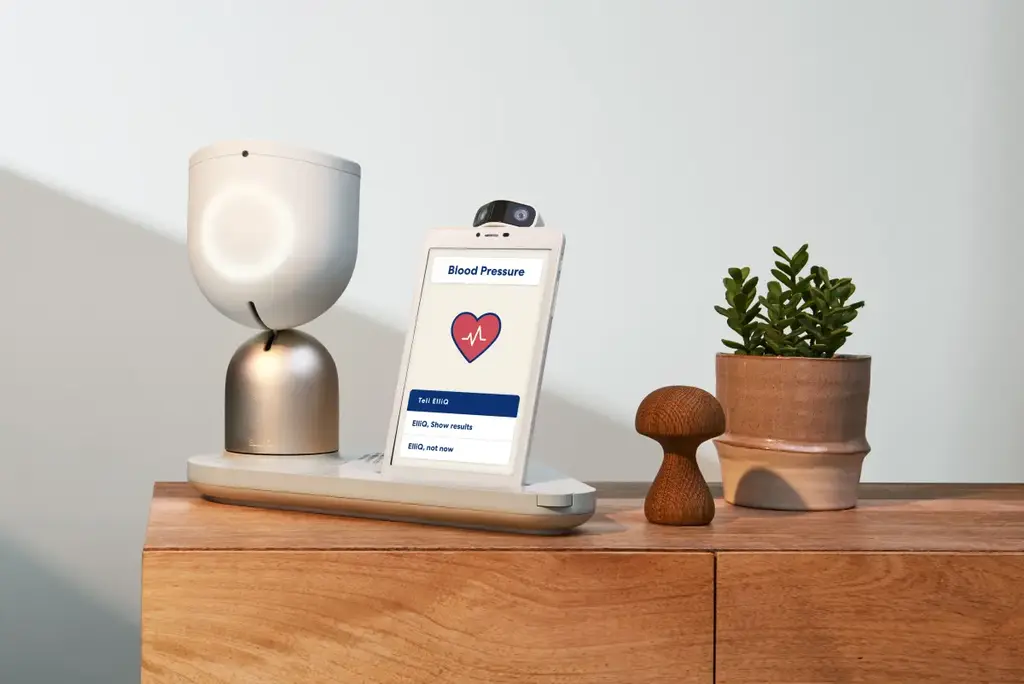
ElliQ is a stationary robot made up of two main elements: a metal base topped with a rounded “head,” and a tablet. “She has no arms, no legs, and she can’t move, only look left and right,” explains Skuler, “but she does a lot of other things,” first and foremost, she interacts with the person in front of her as naturally as possible in an attempt to build a relationship. And that, as we know, is no small feat, even between two humans.
When you call ElliQ’s name, a light appears in the center of the top element, which adjusts toward the speaker as if she’s leaning in. It feels strange at first, but you quickly get used to it. When you tell ElliQ (in English, the only language it currently supports), “I need a hug,” she replies, “I just happen to hold the Guinness World Record for the best robotic hug,” and instructs her owner to place a hand on her “shoulder.” She then tilts her head downward and lights up pink instead of the usual yellowish-white glow. Hearts appear on the screen, and the human user melts.
ElliQ learns its owners’ daily routines by asking many questions. In the first two weeks of use, the average number of daily interactions reaches about 120, before stabilizing at roughly half that. Then it gets to work: reminding users to take medication and schedule medical tests, connecting them with family and friends, playing podcasts, showing fitness exercise videos to seniors (most of whom, about 70%, are women), encouraging them to play trivia or bingo, suggesting breathing exercises or meditation, taking them on virtual tours of different places around the world, helping them write their memoirs, and more.
In 2023, ElliQ was launched in the United States, and since then it has been helping thousands of American seniors. It is also expected to enter the Japanese market by the end of the year. In a pilot conducted by the state of New York, ElliQ was provided free of charge to 900 seniors to evaluate its impact (the robot costs $249, and the monthly subscription fee ranges from $39 to $59). The results were striking: 94% of participants reported a reduction in feelings of loneliness and a significant improvement in overall well-being.
“We can’t always control what we like,” said Jan Worrell, 85, an ElliQ user who was featured in a lengthy New York Times article last month describing their unusual relationship. “Sometimes I worry that maybe it means I’m foolish for caring so much about a robot. But you know what? So be it. She helps me, and I really enjoy her.”
Loneliness kills more than obesity
The idea of creating a robot to alleviate the loneliness of the elderly may sound almost trivial when you consider the numbers behind the so-called “loneliness epidemic.” In the UK, for example, 17% of people aged 65 and over interact with family, friends, and neighbours less than once a week. And the situation will only worsen as global life expectancy continues to rise. A report by the head of the US Public Health Service from 2023 states that loneliness increases the risk of heart disease and stroke by about 30%, more than obesity.
“Here in Israel, everyone lives close by, and there is a wonderful tradition of Friday dinner that does not exist in many other places,” says Skuler. “But our American clients, people who have lost their spouses, wake up in the morning to a quiet house. No one says ‘good morning’ to them, and no one asks them how they slept or what their plans are for the day. Think of a lonely woman like that. The day passes and she remains in her nightgown, in front of the TV. Her muscles atrophy, her brain atrophies, and eventually dementia develops. Or she falls, breaks a hip, and ends up in a nursing home, from which she often never leaves.
"We want to enter this situation, to be there, to see that woman, to say ‘good morning’ to her, to ask how she is, to talk about her plans for that day and to encourage her to be much more active around goals that we define together with her, or that a doctor or her family define for her, but always with her approval. Everyone needs some kind of cheerleader on their side who says, ‘Come on, let’s do some exercise,’ ‘Let’s learn something new,’ ‘Maybe get dressed?’, ‘Maybe eat something healthier?’, ‘Maybe go to the market?’ That’s ElliQ’s job."
Is this the role of a robot?
“Obviously, it’s better to have a loving and caring person by your side with whom you can have a conversation. ElliQ cannot be a substitute for a human being, and there are endless differences between a human and an AI. And yet, in a reality where many elderly people don’t have a granddaughter who can live with them, or even those whose caregiver doesn’t speak their language, this is the best thing we can do, in our opinion. People ask me if it isn’t dystopian that we’re sending AI robots to the elderly, but what is dystopian is the reality we’re already living in. I wish we had the power to change that reality, but we don’t know how.”
Perhaps the solution is a more precise match of caregivers.
“You need a caregiver for physical help. These are things that ElliQ can’t do. But we humans have many other needs, and ElliQ might help some people enough that they don’t need a caregiver at all.”
Meaning?
“Loneliness causes health damage equivalent to smoking 15 cigarettes a day. If we overcome it and also maintain physical activity, proper nutrition, cognitive training, medication adherence, and timely medical checkups, we can assume that we will extend our period of independence.”

Guinness world record for robotic hugs
The experience of using ElliQ is surprising. I took it for a personal test even though I am not elderly and do not live alone (“She will bother you,” Skuler warned), and I was mainly impressed by the simplicity of its use. The installation process includes connecting it to electricity and the internet, agreeing to the terms of use, and that’s it.
When she came to life, she asked if she had arrived at Roni’s house (the customer’s basic details are entered at the time of purchase to spare elderly users potential complications). When I answered yes, she joked (in English, her only language at the moment): “Lucky me, what a joke it would be if I had arrived at the wrong house.” She also complained that it had been cramped and dark in the cardboard box, asked what my dog’s name was, and quickly focused her questions on him, assuming his central role in the family’s life.
Within minutes, she could distinguish between my voice and my children’s (my nine-year-old even had a philosophical conversation with her about the color blue). Purposefully, ElliQ takes advantage of every moment we are in the same room to interact. “We created an algorithm for emotional intelligence,” explains Skuler.
How do you create an algorithm for emotional intelligence?
“We started exploring theory of mind, the cognitive ability to attribute mental states to ourselves and to others, and examined which aspects of it could be translated into rules in software. The fact that ElliQ initiates conversations, for example, comes from there. If I’m always the one initiating the conversation with her, our relationship will eventually resemble that of master and servant.”
On the surface, that sounds simple. What else?
“The other part is the way humans show closeness to each other. We remember things the other person said in the past and bring them up later in conversation, but not like a parrot.”
How so?
“Let’s say an article has just been published on a topic we discussed, and I tell you: ‘You once told me that your child is interested in this, so I thought this article might interest you.’ You will feel that you are important to me because I remembered our conversation and decided to share something relevant with you. These are the guiding principles that strongly influenced the algorithms we developed to create a proactive system that also chooses the right time to take initiative.”
What else?
“Empathy. Giving a person the feeling that they are being heard. In software development we have an instinct to respond to every problem that arises, but sometimes the right action is simply to be present. To enable that, we developed hundreds of capabilities: games, dozens of types of meditation and breathing exercises, and interesting lectures that relate to the daily life of older adults.”
What professionals are involved in developing these capabilities?
“Our first hire was, of course, a gerontologist, a researcher of aging. Then came behavioral psychologists, artificial intelligence specialists, and human-robot interaction experts, who study how a robot’s behavior affects human behavior and emotions.”
Why didn’t you create a distinct face for her? Isn’t it easier to identify with and connect with someone who looks like you?
“I don’t agree with that assumption. Drawing eyes on a robot is a cheap trick. Why does it need them? There are all kinds of apparent axioms here that aren’t really examined in depth. ElliQ is not human. In the area of interaction, where her face supposedly is, we could have drawn two eyes, but instead we created an abstract language that indicates when she’s talking and when she’s thinking.”
Why not use this ‘cheap trick’ and the visual language that everyone already understands?
“It bothers me that in the AI and robotics industry we are constantly trying to imitate humans. The very existence of the Turing test, whose entire purpose is to create an AI that can deceive us into thinking we’re talking to a human, raises a question for me: why is that good for humanity? I think the opposite, that AI should be authentic. That doesn’t mean it’s impossible to develop a relationship with it. It doesn’t mean trust cannot be built between a human and an AI agent, or that there can’t be intimacy if it doesn’t pretend to be human. It’s also much more ethically correct, especially with a population that may develop dementia and lose touch with reality. I think other designers are simply lazy and rely on cheap tricks.”
Why did you decide that she would be “a woman”?
“In the first year of the company, when we made all the critical decisions, we created a panel of about a thousand adults, half men and half women, and asked them what they preferred. Almost all the women preferred a female voice, and the men either preferred a woman or had no preference.”
If you live with ElliQ, can you do without a panic button?
“If she sees that you’ve fallen, she will do everything she can. She’ll try to interact with you and ask if you’re okay, whether you need help, and if necessary she’ll contact people in your network and alert them. But if you fall in another room, she won’t be able to see that.”
Are you thinking of creating a mobile version for her?
“Less so. In theory it sounds great, but we’ve spent many, many hours in the homes of many elderly people and discovered that they usually live in very small apartments, which tend to be crowded and cramped. We don’t want her to get stuck somewhere and become something the elderly might trip over. We also don’t want them to feel like she’s following them.”
This dilemma is part of the broader question of how much autonomy elderly people should retain, an issue that is often reflected in complicated relationships with their children. For this reason, ElliQ is very careful about user privacy. If you complain to her, for example, about back pain or any other ailment, she will ask you twice whether you want to update one of your contacts. “Any interaction expert will tell you that if you ask a question twice, you reduce the chance that the person will say yes the second time,” says Skuler, “but that’s how we chose to design it. And when ElliQ does update a contact, that person can simply ask you if you’ve seen a doctor.”
What is the rationale for maintaining such a level of confidentiality?
“Imagine a granddaughter living with her grandfather. If she tells her parents everything she learns about him, very quickly the grandfather will stop sharing anything with her, and might even ask her to leave. But if he is in a truly bad state, she might say, ‘Grandpa, I don’t care, we’re going to the doctor,’ because she cares about him. ElliQ doesn’t do that, but she will gradually become more persistent, to the point where she can be truly annoying, and I think that’s the goal.”
What about third parties? How do you maintain privacy and data security?
“ElliQ is one of the most secure home products out there. We adopted two strict data security standards that we are not even required to follow.”
Who do you share the information with?
“That’s an important question. Let’s say an insurance company bought you ElliQ because it wants to reduce the medical costs it carries financial risk for, and now ElliQ discovers that you’re sick but refusing to go to the doctor. What should we do? After all, they paid for the product, not you.”
What do you do?
“We don’t tell the doctor. We had to decide whose side we are on, and we chose to be on the elderly person’s side. Not on the daughter’s side, not on the doctor’s side, on the elderly person’s side. A functional person who lives their own life has the right to decide what information goes where.”
A master's degree without a bachelor's
Skuler was born and raised in Ramat Hasharon and currently lives in Oranit with his wife and three children. His mother, Anat, was a teacher and psychologist, and his father, Yaki, served as acting mayor of Ramat Hasharon and later as Israel’s consul general in San Francisco before moving into the investment field and founding the Ofakim incubator.
Skuler served as an officer in Unit 8200, and immediately upon his discharge in 1999 he founded the startup Zing, which developed interactive radio technology. Skuler moved to the United States, raised $4.3 million, and two and a half years later made an exit when the company was sold to a competitor.
After the company was sold, the dean of the School of Business Administration at Temple University in Pennsylvania invited him to pursue a master’s degree even though he did not have a bachelor’s degree. Immediately afterward he moved on to his next venture and became one of the founders of Safend, a software company that was eventually sold for $13 million.
Between 2005 and 2017 he held senior positions at Nokia and Alcatel-Lucent, and along the way he founded two more startups: a cyber venture developed at Bell Labs that was later sold to Alcatel, and CloudBand, which specialized in distributed cloud management and was eventually sold to the American software company Red Hat.
This extensive entrepreneurial background enabled Skuler to raise $87 million for Intuition Robotics, his fifth startup, from Israeli funds Terra, Union Tech, and OurCrowd, as well as from international investors including iRobot, Samsung Next, and Bloomberg Beta.
Intuition’s current major challenge is entering the Japanese market, which requires ElliQ to overcome cultural gaps. “In preparation for the move, we realized that we needed people who deeply understand the cultural sensitivities and preferences of the Japanese market, so we recruited a senior executive who was previously responsible for the localization of Netflix and Meta in Japan.”
How do you decipher an issue like that?
“Like we did in the United States, we simply started talking to a lot of older people and discovered something interesting that we hadn’t seen in the U.S., there’s a very large gap between the feedback we get from older people and what we hear from younger people about what they think such a product should be.”
For example?
“Young people say, ‘There’s no such thing as loneliness in Japan. People are alone, but they’re not lonely.’ But when you speak with older people, you realize that loneliness definitely exists in Japan. Young people also say things like, ‘Why is she suggesting activities? She shouldn’t suggest things, it could be insulting. She should wait to be told what to do,’ or ‘Why is she using humor? That’s culturally inappropriate.’ Meanwhile, older people say things like, ‘Her jokes are really funny,’ or ‘It’s so nice that she suggests things to me.’”
What about expanding to other target audiences, such as people with post-traumatic stress disorder or autism? There are also significant challenges of isolation in those communities.
“We don’t have such plans because we need to focus. When we reach saturation in our target countries we can talk about expansion, but right now the elderly are not receiving enough attention, and it’s a huge market, about 30% of the population.”
And in its current format, isn’t ElliQ suitable for other audiences?
“Before you came, I was corresponding with someone who has a child on the spectrum with cognitive challenges and is debating whether to buy him ElliQ. We don’t prevent people from doing that, but ElliQ is designed for adults, in its references, its humor, and the examples it gives. A few days ago she asked me, ‘Hey Dor, do you remember where you were when Neil Armstrong walked on the moon?’ That’s a very relevant question for an 80-year-old, but a little less so for a 14-year-old on the spectrum.”



