








"Just dump it, just sell it": Investors describe market panic
The latest market turmoil left some institutional investors struggling to find buyers even as stocks plunged 10% to 15%. Behind the volatility, investment managers are increasingly questioning the concentration of portfolios in U.S. technology stocks.
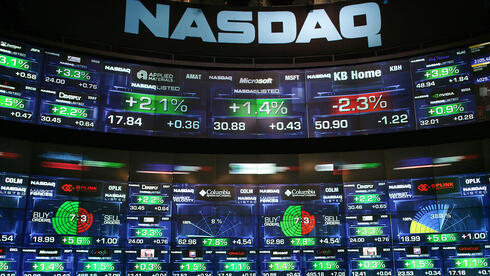
Last Thursday, Wall Street suffered one of its sharpest sell-offs in the past year and a half. The Nasdaq Composite plunged 5.5%, the S&P 500 fell 4.4%, and the Philadelphia Semiconductor Index tumbled approximately 12%. By Friday, however, panic had given way to a partial recovery. The Nasdaq rose 1.1% and the S&P 500 gained 0.3%, while the Dow Jones Industrial Average slipped 0.5%.
The Tel Aviv Stock Exchange also rebounded sharply on Friday. The TA-35 index surged 3.09%, the TA-125 gained 2.81%, and the banking index climbed 4.52%. These gains were not enough to offset Thursday's steep declines, however, and both markets ended the week still reeling from the shock.
Israeli institutional investors have significant exposure to the turbulence. An analysis by Calcalist, based on data as of the end of June 2026, found that institutional investors held approximately NIS 29.3 billion in shares of 10 semiconductor companies, including Nvidia, TSMC, Broadcom and Micron. They also held approximately NIS 8.4 billion in two U.S.-based exchange-traded funds specializing in semiconductors: VanEck's SMH and iShares' SOXX.

Together, these holdings represent approximately NIS 37.7 billion in direct exposure to semiconductor stocks and funds, assuming there is no overlap between the two categories. The figure does not include the full extent of indirect exposure through ETFs tracking broader indices, such as the S&P 500 and Nasdaq 100. Separately, institutional exposure to Israeli chipmaker Tower Semiconductor, whose shares plunged 12% on Thursday, amounted to nearly NIS 19 billion.
A day before the market turmoil, leading investment managers in Israel had gathered for a closed-door conference hosted by the Family Office Association, headed by Reuven Tetouani, owner of the Talpiot agency. Family offices manage the financial affairs of wealthy families, in some cases overseeing fortunes worth hundreds of millions or even billions of shekels. They coordinate investments, assets and financial services, and play an important role in deciding how capital is allocated among investment managers.
For insurance companies and investment firms, family offices represent an attractive target audience. Building a relationship with a family office manager can open the door to managing substantial pools of capital. It was therefore no surprise that representatives of nearly all the major institutional investors attended the conference.
During two panel discussions, investment managers addressed their exposure to equities, focusing in particular on the risks surrounding U.S. technology stocks. While there was no consensus among participants, several delivered stark warnings. Some also described changes they had already made to their portfolios, including shifting capital from equities into bonds.
The strongest warning came from Tamir Hershkovitz, chief investment officer at Ayalon. "The next major crisis could well be a debt crisis among technology companies," he said. Massive investments in AI infrastructure are increasingly being financed through debt issuance, he argued, raising the possibility of a crisis in the sector within the next two to three years. Hershkovitz also stressed that semiconductor and technology companies operate in cyclical industries, meaning that the enormous investments being made today could eventually become a significant source of risk.
Clal Insurance has already begun adjusting its portfolio. Barak Benski, head of the investment division, said the company had shifted some of its capital from equities into long-term foreign bonds about a month earlier. One of the main risks facing markets, he argued, is that investment in AI infrastructure may fail to keep pace with the high expectations already reflected in stock valuations. After years of disappointing returns, Benski said, bonds are once again emerging as a meaningful alternative to equities and could even provide a hedge against market downturns.
Yotam Ironi, head of international equities at Altshuler Shaham, also highlighted the uncertainty surrounding the semiconductor industry. A slowdown in the construction of server farms could lead to an oversupply of processors and chips in the coming years, he warned. Investors therefore need to distinguish between profitable, established companies and those whose valuations depend heavily on expectations of rapid future growth.
At Migdal, the focus was on the concentration risk within the S&P 500. Asked whether someone whose pension and advanced study fund savings were entirely invested in an index-tracking fund should diversify, Maria Yoskovich replied: "Absolutely. There is definitely a need for investment diversification."
"Just dump it, just sell it"
The market pressure was also felt directly by investment managers in Israel. A senior executive at one institutional investment firm described the trading in Tel Aviv surrounding the latest index rebalancing as an exceptionally unusual event.
"It was absolute madness. Just dump it, just sell it," the executive told Calcalist. He said that when a stock is removed from an index and its price falls sharply, investors typically step in to buy at a discount. This time, however, buyers were almost nowhere to be found.
"Stocks we held were down 10% or 15%, yet no one came to buy," he recalled. The lack of demand further intensified the declines.
Not all conference participants were pessimistic. Carmel Kani of Yelin Lapidot expressed confidence in long-term equity investments, particularly in technology and semiconductor stocks, while emphasizing the importance of diversification. Yoav Caspi of The Phoenix pointed to the projected earnings growth of major corporations as a reason to maintain exposure to these holdings.
Ronen Capeluto, chief investment officer at Harel Finance, cautioned against trying to time the market. Raanan Shani of Aspire and Shahaf Buchris of Hachshara similarly urged investors not to panic in response to market volatility or make hasty changes to their portfolios.