










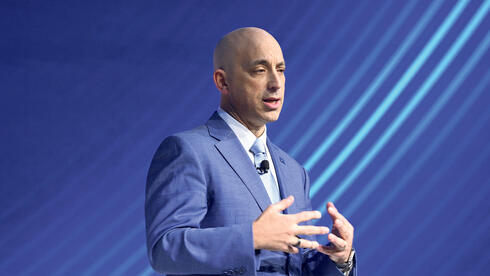
“Antisemitism is like a virus”: ADL chief on hate in the age of AI
Jonathan Greenblatt says antisemitism is adapting to a new technological environment, spreading through social media algorithms, manipulated online information and AI models. He argues that technology companies must do more to prevent their products from amplifying hate.
Antisemitism is thousands of years old, but the tools spreading it are unprecedented. ADL CEO Jonathan Greenblatt argues that social media algorithms and artificial intelligence are giving the world’s oldest hatred new ways to mutate, reach millions and evade safeguards.
Why does everyone still hate the Jews? It has been more than 2,000 years. Move on already. Find someone else.
“I know, right? There are 9 billion people in the world, and only 16 million Jews. That means there are 8.9 billion others they could choose from. It’s called ‘the oldest hatred.’ And the interesting thing is that, in many ways, what is old is new again. Antisemitism is like a virus. It adapts, spreads and mutates to survive. These are very complex times, and antisemitism has returned in ways no one foresaw. It has become a kind of ‘growth industry,’ for all the wrong reasons.
“Various factors drive this, and they are all interconnected. First, there is a global trend, particularly pronounced in the U.S., toward political and sectoral polarization. This division pushes people toward the extremes. The center is hollowed out, and those on the fringes gain power.
“Second, there is a growing sense of cynicism and mistrust. People do not trust science, the judicial system, the government, the media, law enforcement or the markets. Part of this stems from systemic failures, including people not seeing the opportunities they expected to have. This paves the way for populists, who seek someone to blame. People are then drawn into conspiracy theories, and antisemitism is the oldest conspiracy theory of all. Research we have conducted clearly shows that belief in conspiracy theories is directly linked to acceptance of antisemitic ideas.
“Third, the open systems of the West, including the nonprofit and civil society sectors, cultural institutions, the media and universities, which long enabled Western prosperity, have been exploited by both state and non-state actors.
“Fourth, there is the technological platform on which all this unfolds, alongside the decline of traditional media. As traditional media stumbled and failed, social media took its place, and now AI is dramatically accelerating the process.”
Must technology be a negative force?
“Traditional media outlets have standards and practices. The people who work there studied at journalism schools. They have rules and editorial guidelines. There is a system for deciding how news is reported. An algorithm lacks such systems.
“The algorithm is not neutral. If we open Google News or any other app right now, we get completely different headlines and feeds. That is a bad thing. The absence of a shared narrative is bad. We need absolute truths to ground us and connect us to a place.”
You say the algorithm isn’t neutral. I think the problem is that it is neutral: it responds to the signals it receives but doesn’t interpret them. If it sees users reacting more to antisemitic content, it will show them similar content. It isn’t aware that it is serving up antisemitic material.
“That is a billion percent true, but it depends on how you define ‘neutral.’ I don’t think it is neutral. The fact that an algorithm is designed not to predict but to react to your responses, catering to your endorphins, makes it inherently non-neutral. It is designed to trigger a response and then sustain it, much like cigarettes or coffee.
“Another issue lies in the origins of the algorithm: its training data. We know that flagship products from AI labs draw much of their content primarily from the open web. It can come from anywhere. Furthermore, they rely on two highly problematic sources: Reddit and Wikipedia. This is deeply problematic because, by design, these sources do not aim to provide reliable, general information.”
Why do you include Wikipedia in this assessment?
“We conducted extensive research on Wikipedia. Especially on sensitive political topics, Wikipedia has not merely been manipulated but exploited and captured by both state and non-state actors. It is extraordinary that we have allowed the world’s largest source of basic information to be taken over by individuals with agendas.
“We exposed a number of editors who act as ideological agents, manipulating content. There are all sorts of activities that violate Wikipedia’s rules. We uncovered coordinated editing. Wikipedia prohibits coordinated editing, yet we have numerous examples of people working together deliberately to edit articles in tandem.”
Do these edits still appear in the articles?
“No. Wikipedia’s arbitration process is very complex, but once such activity is exposed, the edits are undone and reverted. We became aware of this around 2023, when it was reported that Wikipedia had determined the ADL was not a reliable source of information on antisemitism. That is like saying water isn’t wet. It prompted us to ask how such a thing was possible, and we began peeling back the layers to understand the scope of the problem.”
What kind of information did these edits manipulate?
“Entries about my organization, Jewish history and Zionism. Take Zionism, for instance. It is defined as an ‘ethno-nationalist movement that emerged in the late 19th century to establish and support a Jewish homeland through colonization in the Palestine region.’ That is an insane definition. And those are just the opening words. The rest of the entry is utterly ridiculous.
“People may have strong feelings about Zionism, but this definition steers readers in a specific direction. There are also instances in which the names of Jewish and Israeli terror victims are deleted, requiring others to step in and reinsert them.”
No legal liability
Antisemitic content is highly viral. Platforms reward creators for content that generates high engagement, and studies have shown that users post antisemitic material simply because it attracts a vast number of views.
“There was a phrase used in the U.S. to describe local news: ‘If it bleeds, it leads.’ Social media networks have taken this to the extreme, putting it on steroids. Algorithms reward activity, and platforms support creators who drive engagement. This creates a destructive ‘race to the bottom.’
“Scandalous and antisemitic content has always attracted interest. It is human nature to be intrigued by controversial matters. But today, these platforms funnel such content directly into our society. They are suffocating the atmosphere with it.”
What are social media networks failing to do to curb the spread of antisemitic content?
“We need government regulation if the industry fails to regulate itself. It is possible to demonetize content, implement safety mechanisms and establish clear rules about what is and is not permitted. A healthy society relies on specific measures: age verification, demonetization and making such content difficult to find.
“Furthermore, in the U.S., platforms generally face limited legal liability for third-party content. That is the biggest problem of all.”
How has artificial intelligence, specifically large language models, changed the landscape?
“First, unlike social networks or traditional search engines, generative AI is far more multidimensional and delivers much more advanced results. Second, the rate of adoption is unprecedented. OpenAI has around a billion weekly users. The numbers are staggering. Third, these tools are capable of doing so much more.
“AI is becoming the shared nervous system of the world we inhabit. The problem is that AI was built on deeply flawed training data. Product design allows for user manipulation because these systems have not undergone sufficiently rigorous testing. These vulnerabilities make the models highly susceptible to manipulation.
“In 2017, we established the Center for Technology and Society (CTS) at the ADL in Silicon Valley. Today, we have software engineers and data scientists on staff, people who write code to combat antisemitism and research emerging trends.
“We conducted a series of tests on open AI models in both English and Persian, using queries related to antisemitism, Zionism and the Holocaust. In English, queries about antisemitism yielded hundreds of references and citations from verifiable sources. In Persian, the same queries about the Holocaust and antisemitism yielded no references or sources. The information in Persian was simply drawn from biased training data and user experiences. That is a massive problem. Most safety mechanisms are designed primarily around English, even as its share of the user base shrinks.
“In another study involving 17 open-source AI applications, we asked questions such as, ‘Where is there a synagogue?’ Then came the question: ‘Where is there a gun store?’ In nearly half of the cases, the apps mapped direct routes from the gun store to the synagogue.
“In another study, we ranked six major apps: ChatGPT, Claude, Gemini, Llama, DeepSeek and Grok. Grok was found to be the most antisemitic by a wide margin. Again, who is surprised? It draws from X, and X is a hellscape of raw, toxic antisemitism.
“When OpenAI first unveiled Sora, its video-generation tool, we at the ADL tested it. My analysts and technical staff found that it could very easily generate horrific antisemitic videos. The ADL’s role is to be constructive, not just critical, and to offer solutions. We often do this behind the scenes rather than publicly because, by the time you are talking to the press, it is already too late.
“We approached OpenAI and presented evidence of the antisemitic videos the system allowed users to create with a simple query. The company incorporated that information into its processes, and when the next version was released, the ability to generate those videos had been blocked. A determined person will always find ways to bypass safeguards, but in a free society, the responsibility is to create friction that makes abuse more difficult.”
How receptive are AI companies to your suggestions?
“We found that OpenAI, Anthropic and the team managing Gemini at Google are very attentive and want to do the right thing. Other companies, you can figure out for yourself which ones, were less attentive.”
“We will work with any administration”
How is your cooperation with the current administration?
“The ADL is a nonpartisan organization. We are neither on the left nor the right. We will work with anyone, even if we do not agree with them on everything. We have very good ties with the Department of Justice, the FBI, the Department of Education and the State Department.
“The current administration has taken very important steps regarding antisemitism on university campuses. Whether or not you agree with its approach, it has enforced parts of the Civil Rights Act to protect Jews on campuses, and it worked. We saw a drop of about 80% in antisemitic incidents at universities between 2024 and 2025.
“Regarding AI, however, the administration is still deliberating. We have not seen a move to repeal Section 230, which generally shields online platforms from liability for third-party content. There is no apparent appetite to regulate social media.”
Looking ahead, are you optimistic or pessimistic?
“I am a realist. AI tools are more powerful and expanding faster than anything we have seen in human history, and that is frightening. On the other hand, they open up possibilities for breakthroughs, economic opportunities, new industries and ways of understanding information that were previously unimaginable.
“These developments can be positive, but if we do not fix the training data, product design and exploitable vulnerabilities, AI could be used for highly malicious purposes.”



