












Top 50 Most Promising Startups
Israel’s AIR looks to bring aviation into the consumer era
With software updates and home-based infrastructure, the company, ranked third in Calcalist and CTech’s top 50 most promising startups of 2026, mirrors Tesla’s playbook in the skies.
In the modern world of technology, the term “disruption” is thrown around far too often, usually in the context of delivery apps or fintech tools. It is rare to come across a company that truly disrupts the established rules of the game, and AIR, which emerged in Kfar Yona in the Sharon region, is aiming to do just that.
AIR isn’t just building aircraft; it is creating a new category in the transportation industry, personal aircraft that almost anyone can fly themselves. With a billion-dollar order backlog and fresh approval from the US Federal Aviation Administration (FAA), it is positioning itself at the forefront of the electric revolution in the skies and is already being called “the Tesla of the skies.”
While most eVTOL (electric vertical take-off and landing) aircraft companies focus on “flying taxi” projects, AIR has chosen a markedly different and bolder path: personal aviation that is cheaper and more accessible to the masses. The aircraft the company is building, AIR ONE, is capable of reaching speeds of 250 km/h with a flight range of about 160 km on a single charge. Unlike traditional light aircraft, which require significant skill to operate, it is equipped with software that prevents the pilot from performing dangerous maneuvers, simplifying the process of obtaining a flight license and significantly lowering the barrier to entry.
The FAA recently granted the company’s prototype a Light Sport Aircraft certification, paving the way for production models to be licensed. AIR is expected to deliver its first aircraft to customers later this year; it already has a waiting list of 3,300 people willing to pay about $500,000 per unit. The company plans to produce dozens of aircraft by 2027 and thousands in the years that follow. To finance the transition to mass production, AIR raised $30 million in its latest funding round and will also rely on existing revenues of about $35 million annually from supplying unmanned AIR Cargo models to the logistics and defense sectors.
The comparison to Elon Musk’s Tesla is not merely a marketing gimmick but is rooted in the company’s engineering and business philosophy. AIR CEO Rani Plaut argues that Tesla succeeded not because it built better batteries, but because it redefined the car as a computer on wheels that improves over time. AIR, he says, is applying the same logic to aviation.
AIR ONE is essentially a flying robot that interprets the pilot’s intent using advanced artificial intelligence. If the pilot moves the stick to the right, the system calculates the required angles, speed and power, coordinating all eight motors to prevent critical human errors.
A second aspect of the “Tesla effect” lies in infrastructure and maintenance. AIR does not just sell aircraft; it aims to build an ecosystem that allows them to operate from a home environment. Its wings fold at the push of a button, enabling it to fit into a standard parking space or be towed behind a regular car. Its charging system is compatible with electric vehicle infrastructure, allowing for straightforward charging at home.
The most significant innovation, however, lies in the software embedded in the aircraft. As Tesla upgrades vehicle performance through over-the-air updates, AIR ONE is designed to evolve over time. Software updates downloaded from the cloud are expected to improve energy efficiency, enhance navigation capabilities and update safety systems without requiring a visit to a maintenance facility.
From an engineering perspective, AIR ONE emphasizes efficiency. It can take off and land vertically like a drone, eliminating the need for a runway, and transition smoothly into horizontal fixed-wing flight. Its range already covers many everyday use cases, from commuting to short leisure trips. The company is also developing improved battery technology aimed at extending range while maintaining a lightweight structure.
Following the FAA approval, the company’s Kfar Yona facility, which currently produces dozens of units annually through meticulous manual processes, is expected to expand into a mass production center. AIR is also collaborating with engineering group ST Engineering to establish a global logistics and support network, ensuring that customers in cities such as Miami or Berlin receive service comparable to that offered in Israel.
Another notable aspect of AIR’s strategy is its focus on branding. Beyond developing technology, the company is positioning itself as a cultural product. The aircraft’s futuristic design, along with planned appearances in Hollywood productions and major technology events such as CES in Las Vegas, is intended to create aspirational demand. While the current price point remains high, the company draws parallels to Tesla’s early years: as production scales and technology matures, prices are expected to fall. Future models, including a planned four-passenger aircraft, are intended to reach a broader market.
Company ID
Sector: Aviation
Established: 2018
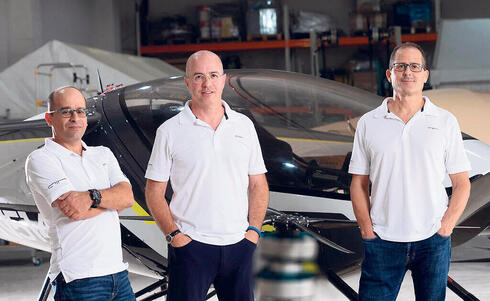
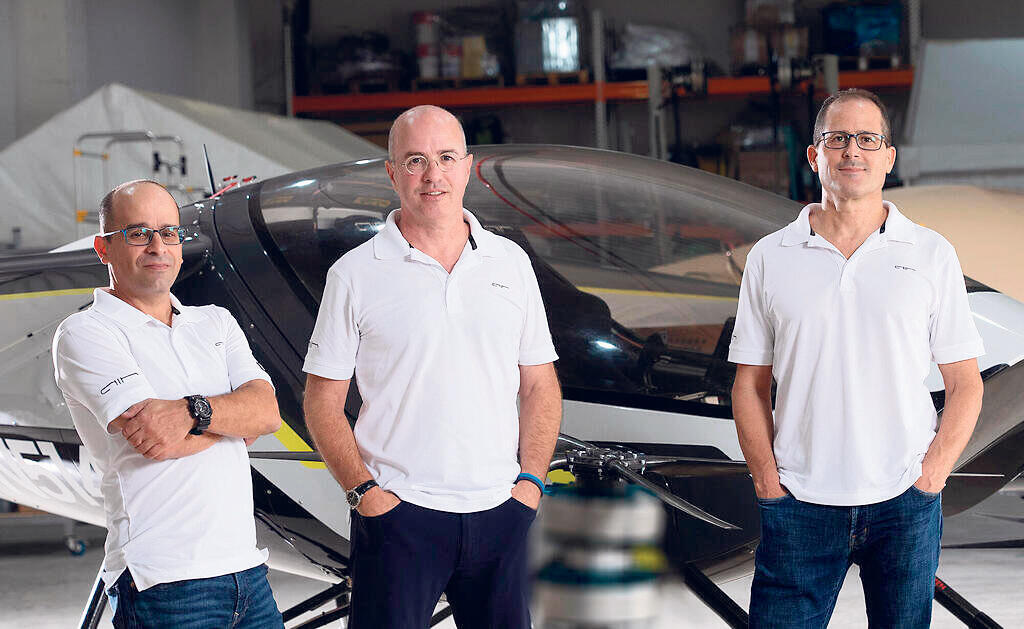
Founders: Rani Plaut, Chen Rosen, Netanel Goldberg
Employees: 70, including 7 in the United States
Funding: $50 million from Entree Capital, Shmuel Harlap, and others
First published: 08:47, 21.04.26



