










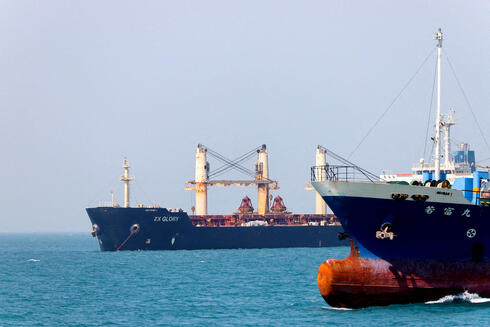
Strait of Hormuz crisis enters its most dangerous phase
Falling inventories and disrupted tanker flows are tightening global oil supply far beyond headline prices.
The global oil market is now entering a more sensitive phase of the Strait of Hormuz crisis. In the early weeks, headlines focused on barrel prices and attacks on tankers and facilities in the strait. In recent weeks, attention has shifted to whether the United States and Iran are moving closer to a settlement. Now a deeper problem is emerging: a rapid depletion of oil inventories available for consumption and refining, and a widening gap between oil that exists “on paper” and oil that is actually available where it can be used quickly.
To understand the risk, it is important to distinguish between total oil inventories and those available for immediate use. “Observed global oil inventories” is a broad term that includes onshore stocks, oil held in tanks, storage terminals, pipelines, and refineries, as well as oil held “afloat,” meaning cargoes in tankers en route to their destination, awaiting discharge, or taking longer-than-usual routes. Statistically, both types count as inventory. Operationally, they are not equivalent: a barrel stored near a refinery is immediately usable, while a barrel stuck on a tanker delayed by insurance constraints, security risks, or rerouting does not provide the same certainty to the market.
According to the latest report from the International Energy Agency (IEA), observed global inventories fell by 129 million barrels in March and by 117 million barrels in April. Onshore inventories declined by 170 million barrels in April, while oil on water increased by 53 million barrels. This indicates that some oil has not “disappeared,” but has shifted from readily accessible onshore storage into a maritime system that is slower, more expensive, and less predictable.
This complex situation has made June a testing month for the market, not because the world is expected to run out of oil, but because commercial inventories cannot fall to zero. Refineries, ports, pipelines, and distribution systems require minimum operating stocks. As inventories approach low levels, the market becomes more sensitive to any further disruption. Tankers unable to transit the strait, insurance constraints, refinery outages, or additional attacks could all trigger sharp price reactions. Experts estimate that if the Strait of Hormuz remains effectively constrained and OECD inventories continue to decline at the pace recorded in April, they could reach critically low levels by the end of June. In such a scenario, oil prices could rise to at least $140 per barrel, compared with around $112 today.
The Iraqi example illustrates why the Strait does not need to be fully closed to cause serious disruption. Iraq’s incoming oil minister, Bassem Mohammed, said over the weekend that in April the country exported only 10 million barrels through the strait, compared with about 93 million in the previous month. According to him, exports now depend on the arrival of tankers, many of which are not entering due to insurance difficulties, even though Iraq is considered one of the most Iran-friendly countries in the region. This suggests that even without an official closure, the strait can function as effectively “blocked” from a commercial perspective, as shipowners and insurers refuse to assume the risk.
The problem is not limited to crude oil. According to IEA estimates, refinery output will fall by 4.5 million barrels per day in the second quarter, partly due to infrastructure damage, export restrictions, and reduced feedstock availability. This matters because the global economy does not consume crude oil directly, but rather refined products such as diesel, jet fuel, gasoline, fuel oil, and other distillates. If crude does not reach refineries on time, shortages tend to emerge first in transportation, aviation, agriculture, maritime shipping, and ultimately food prices. The timing is particularly sensitive, as the crisis coincides with summer months in the Northern Hemisphere, when fuel demand typically rises.
At the same time, the diplomatic dimension is becoming clearer. After the suspension of the U.S. operation to escort vessels through Hormuz, Iran said it would ensure safe passage “in accordance with new procedures,” without elaborating. The wording has drawn attention from Gulf states, which are not necessarily eager for a force-based reopening of the route but are interested in a framework that restores confidence in insurance, pricing, and logistics.
For Riyadh, Abu Dhabi, Doha, and Kuwait, the issue is not only security but also export revenues, reliability for Asian customers, insurance costs, and their reputations as stable suppliers in a strained global energy market. For Qatar and Kuwait, which have limited alternative export routes, the stakes are especially high.
Ultimately, the Iranians do not need to fully close the Strait of Hormuz to disrupt the market. It is enough that it ceases to function as a reliably insurable and priceable route. As onshore inventories erode, the global system becomes less able to absorb further delays, insurance exclusions, or logistical disruptions. Without even minimal certainty over passage, the crisis risks shifting from price volatility to systemic pressure across transport, aviation, and food supply chains. In that sense, Hormuz is no longer just a geopolitical flashpoint between Washington and Tehran, but a test of the operational trust underpinning the global energy economy.



