










OpenAI exposes Russian campaign promoting fake Israeli “research institute"
The influence campaign used AI tools to promote IBI, a fictitious research institute that was presented as an Israeli entity. OpenAI estimates that the impact of the campaign was limited.
OpenAI has uncovered a Russian influence campaign that used its AI capabilities to promote a fictitious Israeli “research institute” called the International Burke Institute (IBI). “What began as an investigation into social media posts generated by AI led to the exposure of a much broader influence campaign, built around a website that contained plagiarized academic work, a ‘sovereignty index’ that portrayed Russia in a positive light, and efforts to disguise the Russian origin of the activity,” the company said in a report published yesterday. The influence campaign was uncovered after OpenAI identified (and blocked) a cluster of ChatGPT accounts whose operator wrote Russian prompts to Generoot posts and comments on Substack, Telegram, X (formerly Twitter), Facebook, and LinkedIn. “Most of the comments were in English, and the operator sought to disguise linguistic cues to the Russian origin. We do not allow access to our models from Russia, and a VPN was used to access our platform,” the company said.

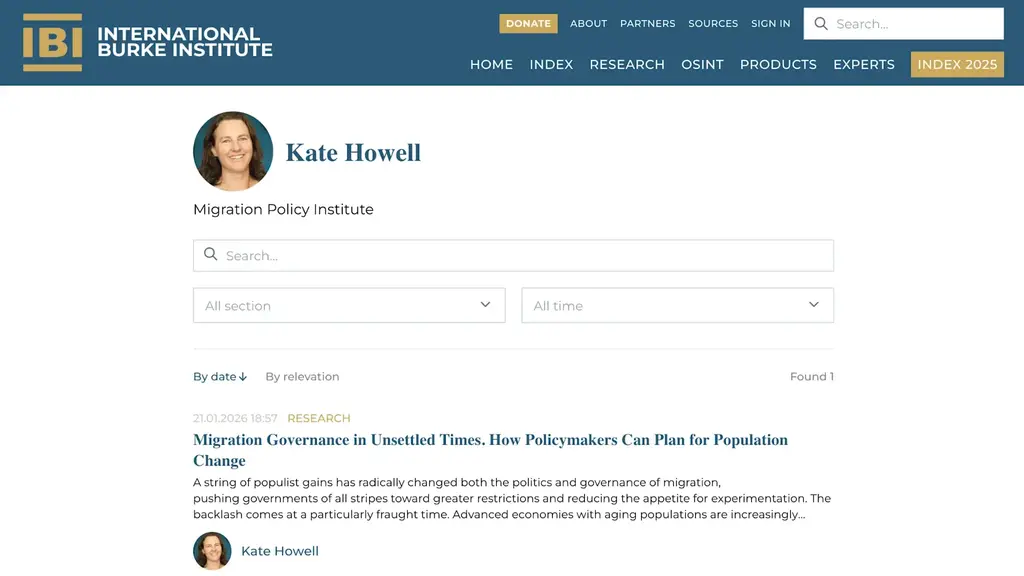
Most of the AI-generated content sought to promote the fictitious research institute IBI. The institute’s website claims to be based in Israel, and many of the articles published there were actually copied from real academic publications, with false attribution. Others were written in a Slavic language and automatically translated into English. The most prominent publication on the institute’s website was a “Sovereignty Index” intended to glorify Russia and harm Western countries.
The primary use of ChatGPT was to create posts that promoted the institute. “Some were posted by accounts that included the IBI name and logo, others appeared to come from regular (likely fictitious) users whose primary activity was posting IBI posts,” OpenAI said. “In addition, the operators generated responses to posts by real users on Substack on a variety of topics. The responses often included a request to follow IBI’s channel on the platform and were posted by it.”
In addition, one operator generated posts in German published on the Telegram channel Lahme Ente (lame duck), criticizing Ukraine, the European Union, and the German government. Another operator jined logos for a dozen Telegram channels, including Lame Duck, that focused on Germany, the United States, France, Poland, and Turkey. Some of these channels included IBI posts.
The AI activity that OpenAI identified was merely a supplement to the core work of the influence campaign, which was the operation of the fictitious research institute. The IBI website claimed to be an independent “community of experts” operating from Israel, whose members included world-renowned experts such as Francis Fukuyama and Noam Chomsky.
But a sample review of 36 articles published on the site by the company revealed that 34 of them had been copied from elsewhere. “Some were several years old; others were attributed to the wrong authors. For example, one article on the China-Pakistan Economic Corridor was copied from a Cambridge University Press publication and incorrectly attributed to a professor from the University of Nottingham. This behavior indicates an attempt to give IBI a more legitimate image by incorporating authentic content."
Alongside the articles, the IBI website includes reports on the sovereignty of various countries and their rankings in the "Sovereignty Index." Most of the reports, which were not generated in AI, included criticism of Western countries. For example, about the US, it was written: "Trump arrived in Beijing with the number 1 sovereignty index in the world and left after taking several steps that could be considered an infringement on autonomy." About France, it was written that after a decade of Macron's rule, the country "is opening up like a safe and being sold off piece by piece."
According to OpenAI, there is online evidence that Israeli officials mentioned or represented IBI in articles they submitted for publication and at conferences they attended. "We cannot determine the relationship between these individuals, IBI, and the operators in Russia," the company said.
Despite this, OpenAI estimates that the impact of the campaign was limited: the posts that were published recorded a low number of views, and the IBI accounts had a small number of subscribers. The campaign's Telegram channels recorded between 10,000 and 20,000 followers. "The importance of the campaign lies less in the audience it reached, but more in the infrastructure it built," it said. "At a time when "While the operators used ChatGPT only to garner isolated posts, these posts pointed to a credible-looking institution, with purported experts, republished academic papers, and a seemingly unique metric. This illustrates how influencers can use AI as a tool in a broader effort to generate authority, obfuscate preferred narratives, and establish assets that can be scaled over time."



